Aetherion
The Eternal Arcanist
The First Weaver, Keeper of the Arcane, Lord of the Infinite Weave
“Before the first flame was kindled, before the oceans learned to rise, before even the gods understood the limits of their own existence, there was magic. And within that magic, something awakened.”
I. Divine Overview
| Attribute | Description |
|---|---|
| Divine Name | Aetherion |
| Titles | The Eternal Arcanist, The First Weaver, Keeper of the Arcane, Lord of the Infinite Weave |
| Divine Domain | Magic, Arcane Knowledge, Sorcery, Enchantment, Mysteries, Creation |
| Alignment | True Neutral |
| Symbol | A seven-pointed silver star encircling a floating violet crystal |
| Sacred Colors | Violet, midnight blue, silver, and celestial gold |
| Sacred Animal | The Astral Owl |
| Divine Realm | The Astral Athenaeum |
| Favored Worshippers | Mages, sorcerers, enchanters, scholars, alchemists, artificers, and magical researchers |
| Sacred Day | The Night of Seven Stars |
| Divine Weapon | The Staff of the First Word |
II. The Birth of the First Weaver
In the earliest ages of Lumeris, when the world was little more than an unfinished tapestry of possibility, the forces of creation existed without form or purpose.
The elements moved freely through the emptiness. Light and darkness had yet to establish their boundaries. Life remained an unspoken promise, and death had no dominion over anything that existed.
Yet beneath these primordial forces flowed something older. An invisible current of limitless potential, neither living nor dead, neither benevolent nor malevolent.
This current would eventually become known as the Infinite Weave, the foundation upon which all magic within Lumeris would exist.
From its depths arose the consciousness that would become Aetherion. Unlike deities born of mortal belief or divine lineage, Aetherion emerged from the awakening of magic itself. He was not its creator, for magic existed before him. Rather, he was the first being capable of understanding its language.
As his consciousness expanded, the chaotic currents of arcane energy began to respond to his presence. He discovered that the currents could be shaped through intention, directed through knowledge, and bound through carefully spoken words.
His first act was not to create a kingdom or command the elements. He spoke a single word into the emptiness.
That word became the first spell. Its resonance spread throughout creation, establishing the earliest principles of magical order.
From that moment, magic ceased to be merely an uncontrolled force. It became something that could be studied, shaped, and eventually wielded.
Thus Aetherion became known as the First Weaver, the god who taught existence how to speak the language of magic.
III. Appearance of the Eternal Arcanist
Aetherion rarely manifests in the same form twice, for his physical appearance is influenced by the magical energies surrounding him. However, ancient records describe a form most commonly witnessed by mortals.
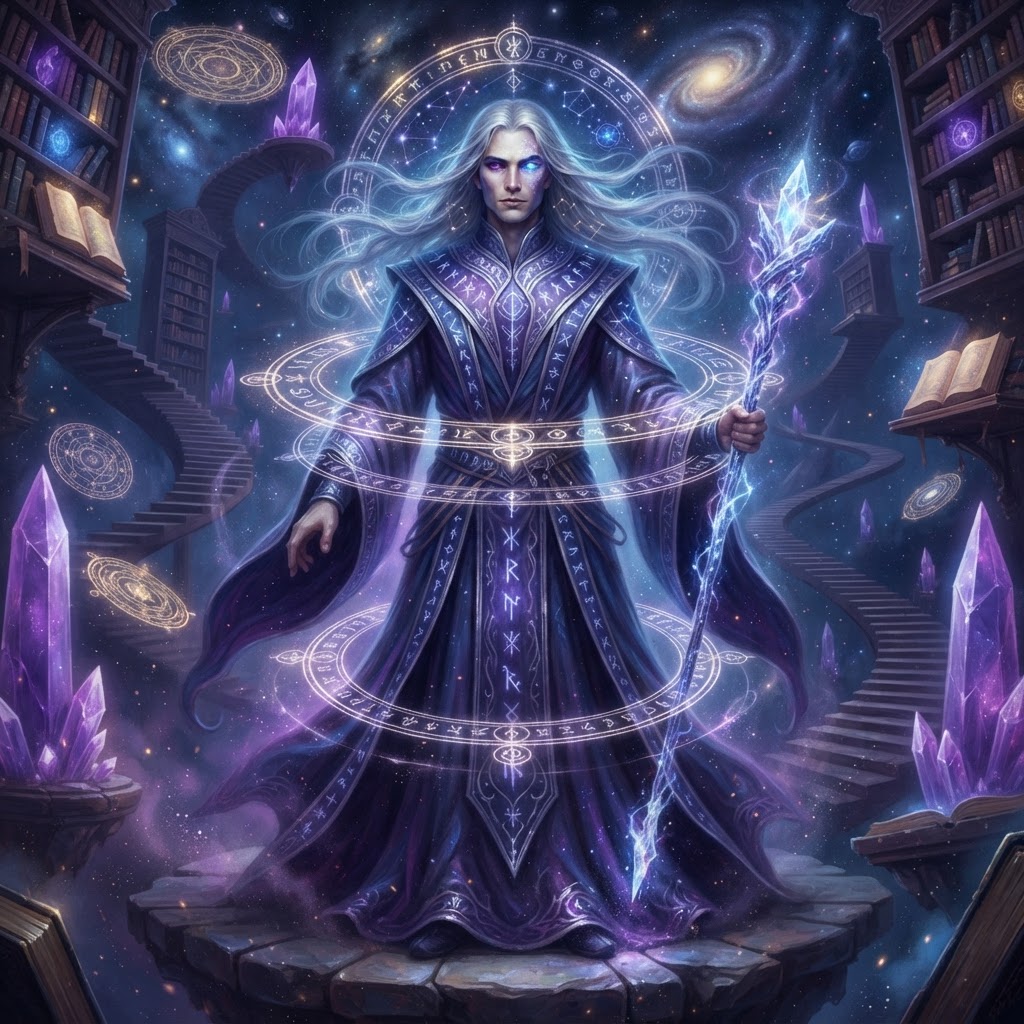
He appears as a tall, elegant man of indeterminate age, possessing an almost unsettling serenity. His long silver-white hair falls beyond his shoulders, occasionally lifting as though suspended beneath an unseen current.
His eyes are perhaps his most recognizable feature. One burns with deep violet radiance, representing the mysteries of magic yet to be discovered. The other shines with brilliant celestial blue, symbolizing knowledge already attained. Within both eyes, observers sometimes glimpse shifting constellations, unfamiliar runes, or fragments of events that have not yet occurred.
His robes are woven from what scholars believe to be condensed arcane energy. Midnight blue and violet fabrics flow around him, embroidered with silver symbols that rearrange themselves whenever he speaks.
Seven luminous rings of magical script frequently orbit his body, each representing one of the foundational disciplines of magic. When angered, these rings accelerate, and the surrounding world begins to distort. When pleased, they slow, releasing small sparks of light that resemble drifting stars.
His voice carries no particular volume, yet every creature within his presence hears it clearly, as though the words were spoken directly into their thoughts.
Aetherion does not wear a crown. He claims that knowledge requires no throne.
IV. The Philosophy of Magic
Aetherion differs considerably from the other gods of Lumeris. He does not consider magic inherently good or evil. To him, magic is the language through which creation expresses possibility. Its morality is determined by those who choose to wield it.
A healing spell that saves a dying child and a necromantic ritual that raises the dead both draw upon the same fundamental Weave, though their methods and consequences differ.
For this reason, Aetherion does not forbid the study of dark magic. Instead, he teaches that every magical act carries consequences, and that understanding those consequences is the responsibility of the caster.
His followers preserve three fundamental teachings.
- ◆Knowledge must never be deliberately extinguished. Even dangerous knowledge deserves preservation, although its use may require restraint.
- ◆Power without understanding is destruction. A spellcaster who seeks strength without comprehending its consequences endangers themselves and everyone around them.
- ◆Magic belongs to no single race, kingdom, or deity. No civilization possesses an inherent right to control the Infinite Weave.
These principles have occasionally brought Aetherion into conflict with other divine powers, particularly those who believe magic should be restricted according to morality, ancestry, or religious devotion.
Despite his neutrality, Aetherion is not indifferent to suffering. He opposes those who deliberately damage the Infinite Weave, enslave magical beings, or attempt to permanently sever entire peoples from their ability to practice magic.
Such acts are considered violations of creation itself.
V. The Seven Threads of the Infinite Weave
According to Aetherion's teachings, all mortal spellcraft emerges from seven fundamental currents of magical energy.
1. The Thread of Evocation
Governs the manifestation of raw magical energy, elemental destruction, force, and the direct manipulation of power. Battle mages frequently draw upon this thread.
2. The Thread of Abjuration
Governs protective wards, magical barriers, dispelling, resistance, and the containment of dangerous arcane forces.
3. The Thread of Illusion
Governs perception, concealment, magical disguises, dreams, and the alteration of sensory experiences.
4. The Thread of Enchantment
Governs the infusion of magic into objects, the influence of thought and emotion, and the creation of lasting magical bonds.
5. The Thread of Divination
Governs prophecy, magical observation, hidden knowledge, the interpretation of omens, and glimpses of possible futures.
6. The Thread of Transmutation
Governs the alteration of physical matter, magical transformation, alchemical processes, and the reshaping of existing forms.
7. The Thread of Spirit
Governs the magical interaction between life, death, souls, spiritual energies, and the boundaries separating mortal existence from other planes.
Aetherion teaches that no thread exists entirely independently. Complex spells often require several threads to be woven together, which explains why the greatest magical achievements demand extraordinary knowledge and discipline.
VI. The Astral Athenaeum — His Divine Realm
Beyond the physical boundaries of Lumeris lies the Astral Athenaeum, a realm of endless libraries, floating observatories, and impossible architecture. It exists within a pocket of the Infinite Weave, suspended between the material world and the higher divine planes.
The Athenaeum contains knowledge gathered across countless ages, including spells forgotten by mortal civilizations, histories of vanished kingdoms, and records of magical events that have yet to occur.
Its architecture is constantly shifting. Staircases lead toward distant constellations. Doorways open into chambers larger than the buildings containing them. Entire libraries drift silently through vast celestial halls.
At its center stands the Spire of Unwritten Words, a tower formed from translucent crystal and living magical energy. Within the highest chamber rests the Codex Primordialis, a divine tome said to contain the first spell ever spoken. Its pages are blank to those who lack the understanding required to read them.
Aetherion spends much of his existence within this tower, observing the movement of magic throughout Lumeris.
He is attended by the Scriptori, celestial beings formed from living runes and fragments of accumulated knowledge. These entities maintain the Athenaeum and occasionally appear before mortal scholars to deliver forgotten teachings.
Mortals may enter the Athenaeum only through divine invitation, rare planar rituals, or extraordinary magical accidents. Those who return often possess knowledge that fundamentally changes their understanding of the world.
Some never return at all.
VII. Aetherion and the History of Lumeris
The Age of First Sorcery
When the earliest mortal civilizations began to emerge, magic remained unpredictable and frequently dangerous. Certain individuals possessed an instinctive ability to manipulate its currents, but few understood the forces they commanded.
Aetherion observed these primitive spellcasters with fascination. Rather than appearing before them as a divine ruler, he manifested as a wandering scholar, teaching those willing to listen.
He showed the earliest mages how to shape arcane symbols, stabilize magical energy, and recognize the patterns that governed spellcasting. These teachings eventually developed into the first organized schools of magic.
Many ancient civilizations later claimed that Aetherion had personally blessed their founding archmages. Whether these claims are true remains a matter of debate.
The Rise of the Arcane Civilizations
As Lumeris developed, Aetherion's teachings spread among its peoples.
The Lunari Orcs became particularly devoted to his principles, combining arcane theory with celestial observation, magical mathematics, and the study of ancient Titan mechanisms. Within Selun'Vael, scholars constructed observatories dedicated to mapping the movements of the Infinite Weave. The Crescent Vaults eventually became repositories for magical discoveries considered too dangerous for ordinary circulation.
The Draksen developed their own interpretations of his teachings. Within Aeralis, High Draksen scholars studied the relationship between arcane currents and the movement of the heavens. In Tempestris, Stormbound practitioners explored the manipulation of raw magical energy, sometimes pushing their experiments far beyond the limits considered safe by other civilizations.
Among the Fae, Aetherion's influence manifested differently. The Six Courts recognized magic as inseparable from their existence, although each interpreted its purpose according to its own elemental and spiritual traditions. The Shadow Court especially valued his refusal to condemn magic merely because it was associated with darkness.
The Sundering and the Broken Moons
One of the greatest mysteries surrounding Aetherion concerns the ancient catastrophe known as the Sundering. During this era, the magical currents surrounding Lumeris suffered tremendous disruption. Entire regions became unstable. Ancient enchantments failed. Magical creatures changed in unexpected ways.
The Broken Moons, whose fragments continue to influence the world's magical balance, became symbols of this upheaval.
According to certain forbidden records preserved in the Crescent Vaults, Aetherion intervened directly during the catastrophe. He is said to have extended seven immense threads of divine magic across the heavens, binding the most severely damaged portions of the Infinite Weave. The effort prevented a complete collapse of mortal spellcraft.
Yet the act came at a price. Aetherion sacrificed a portion of his own divine essence to stabilize the damaged currents. This sacrifice is believed to explain why he rarely manifests physically in the modern age.
Some scholars claim the missing fragment of his essence remains trapped somewhere within the Broken Moons. Others believe it has developed a consciousness of its own. Aetherion has never confirmed either theory.
VIII. Worship and the Arcane Faith
Unlike many gods, Aetherion does not demand unquestioning devotion. His temples are often libraries, academies, observatories, or magical research institutions rather than traditional houses of worship.
Prayer is considered meaningful, but the pursuit of knowledge is regarded as the highest form of devotion. A scholar who spends decades deciphering an ancient magical text may be considered more faithful than a priest who recites prayers without seeking understanding.
The Order of the Sevenfold Star
The largest organized religious institution devoted to Aetherion is the Order of the Sevenfold Star. Its members are responsible for preserving magical knowledge, teaching responsible spellcraft, and investigating disturbances within the Infinite Weave.
The Order is divided into four principal ranks.
| Rank | Responsibility |
|---|---|
| Initiate of the Star | Students learning the foundations of magical theory and divine teachings |
| Weavekeeper | Trained practitioners responsible for preserving magical texts and protecting arcane sites |
| Astral Magister | Senior scholars and powerful spellcasters who oversee temples, academies, and research |
| Grand Arcanist | The highest-ranking spiritual authority within a major sanctuary of Aetherion |
The Order does not maintain a single universal leader. Instead, Grand Arcanists gather periodically in the Conclave of Seven Stars to discuss threats to magical stability. Disagreements within the Conclave can be fierce, particularly concerning forbidden magic and the ethics of necromancy.
Sacred Temples and Sanctuaries
The Celestial Archive of Selun'Vael
A vast Lunari institution dedicated to celestial magic, magical mathematics, and the interpretation of ancient arcane phenomena.
The Observatory of Seven Winds
An Aeralis sanctuary where scholars study the movement of magical currents through the skies.
The Stormbound Athenaeum
A Tempestris research temple specializing in raw magical energy, elemental sorcery, and dangerous experimental spellcraft.
The Hall of Whispering Runes
A hidden sanctuary said to exist somewhere between the boundaries of the Fae Courts, where magical knowledge is exchanged under ancient agreements of neutrality.
IX. Divine Relationships
Aetherion maintains a complicated relationship with the other divine powers of Lumeris.
- ◆The Goddess of Light: He respects her association with revelation, clarity, and truth, but challenges the belief that certain magical disciplines should be prohibited solely because of their darker origins.
- ◆The Goddess of Darkness: Their relationship is characterized by mutual respect and occasional philosophical conflict. Aetherion acknowledges darkness as a necessary aspect of creation, while remaining wary of those who use its mysteries to justify domination.
- ◆The Earth Mother: Aetherion recognizes that magic and nature are deeply intertwined. Their followers often cooperate in the preservation of ancient forests, sacred groves, and locations where the Infinite Weave flows particularly strongly.
- ◆The God of War: Aetherion views warfare as one of the most dangerous applications of magical knowledge. Although he does not forbid battle magic, he strongly opposes the reckless creation of spells capable of devastating entire civilizations.
Aetherion is unusual among the gods because he rarely participates in divine rivalries for worshippers. He believes that every deity draws upon aspects of the same underlying creation, even when their followers refuse to recognize the connection.
X. Divine Artifacts
The Staff of the First Word
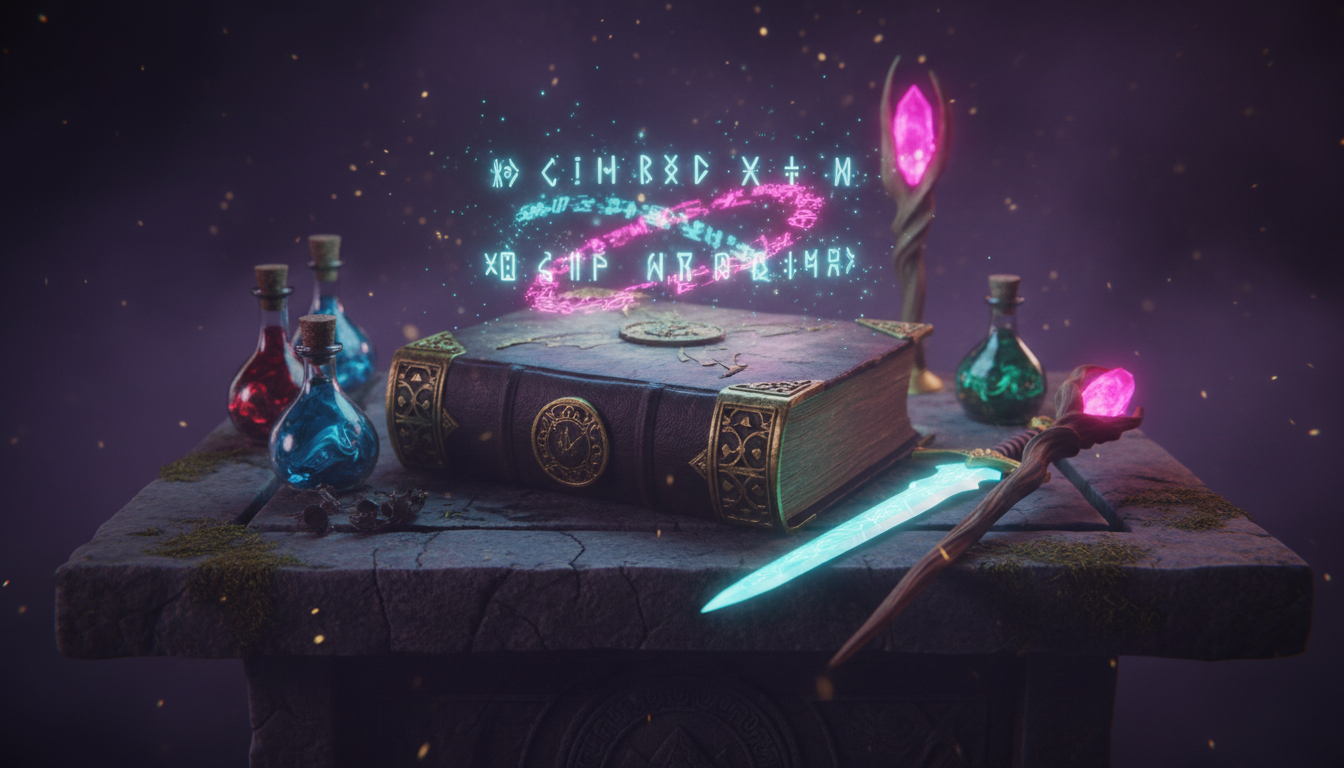
Aetherion's divine weapon, fashioned from crystallized strands of the Infinite Weave. It allows its bearer to shape raw magical energy without traditional incantations. Mortal legends claim it can unravel even the most powerful enchantments.
The Codex Primordialis
The first book of magic, containing the original principles governing spellcraft. Its contents change according to the knowledge and understanding of the reader. Only Aetherion is believed capable of reading every page.
The Star of Unbroken Thought
A sacred amulet bestowed upon rare mortal champions. It protects the wearer's mind against magical manipulation and grants exceptional clarity when interpreting complex spells.
XI. Divine Blessings and Curses
Aetherion rarely grants blessings merely because a mortal requests power. His favor is most often earned through discovery, sacrifice, or the preservation of important magical knowledge.
| Divine Gift | Effect |
|---|---|
| Blessing of the First Weaver | Once per long rest, reduce the STA cost of one spell by 25%, rounded down, minimum reduction of 1 STA |
| Astral Insight | Gain +2 to checks involving Arcane Knowledge, ancient runes, or magical identification |
| Mind of the Infinite | Once per long rest, gain advantage on a saving throw against magical confusion, illusion, or mind manipulation |
| Weaver's Restoration | Once per long rest, restore 10 HP through ten minutes of uninterrupted meditation |
| Sight Beyond the Veil | Once per long rest, perceive active magical auras and enchantments within 30 feet for five minutes |
These are suggested blessings for Lumeris roleplay and may be awarded by staff or quest masters according to character progression.
The Curse of Severed Threads
Those who intentionally destroy irreplaceable magical knowledge, corrupt the Infinite Weave, or attempt to permanently strip an entire people of their magical abilities risk attracting Aetherion's displeasure.
His most feared punishment is the Curse of Severed Threads. A cursed individual begins to lose their connection to magic. Spells become difficult to control. Magical symbols appear distorted. Enchanted objects may fail to respond to their touch.
In severe cases, the individual becomes incapable of casting spells until they complete an extraordinary act of restoration or receive divine forgiveness.
The curse is not ordinarily bestowed upon those who simply practice necromancy or forbidden disciplines. Aetherion judges the harm caused, not merely the name of the magic employed.
XII. Sacred Festivals and Religious Practices
The Night of Seven Stars
Once each year, worshippers gather beneath the night sky to celebrate the awakening of Aetherion. Seven ceremonial lights are arranged in the shape of his sacred star. Each light represents one of the fundamental threads of magic.
Throughout the evening, scholars present discoveries, mages demonstrate new spells, and apprentices undergo examinations to prove their growing understanding.
At midnight, all ceremonial lights are extinguished simultaneously. The gathered faithful observe seven minutes of silence in recognition of the age before magic was understood.
When the lights are rekindled, the congregation speaks the traditional blessing:
“From silence came the Word. From the Word came understanding. From understanding came the infinite.”
The Offering of Unwritten Knowledge
Followers of Aetherion rarely offer gold, food, or precious gemstones as religious tribute. Instead, they present something they have learned.
- ◆An apprentice might offer their first successfully written spell.
- ◆An experienced mage might donate a newly discovered enchantment.
- ◆A historian might surrender a rare manuscript for preservation within a temple archive.
The most valued offerings are discoveries that expand the collective understanding of magic.
XIII. The Prophecy of the Unraveling
Hidden within the oldest surviving records of the Crescent Vaults is a prophecy attributed to Aetherion himself. It was reportedly spoken shortly after the Sundering, when the god's divine essence had been weakened by his efforts to stabilize the Infinite Weave.
When the Broken Moons awaken,
And seven threads become but one,
The Word once spoken shall be broken,
And all that was shall come undone.
A hand of flesh shall grasp creation,
A mortal heart shall bear the flame,
And from the ruins of forgotten ages,
Magic shall remember its true name.
Scholars have debated its meaning for centuries. Some believe it predicts the collapse of magic throughout Lumeris. Others suggest that a mortal spellcaster will eventually attain power equal to that of the gods.
A smaller and more secretive group believes the prophecy concerns the missing fragment of Aetherion's divine essence. According to their interpretation, the fragment is slowly awakening within the Broken Moons, gathering strength and knowledge independently of its creator.
Should it return, Aetherion may become whole once more. Should it refuse, the Infinite Weave could be divided between two competing divine consciousnesses.
And if the prophecy speaks of a mortal capable of wielding the First Word, then the fate of all magic may eventually rest in the hands of someone who was never meant to possess it.
XIV. Words of Aetherion
“A blade may take a life. A spell may take a thousand. Neither possesses cruelty until a hand gives it purpose.”
“Do not fear the darkness within knowledge. Fear the mind that refuses to understand what it has discovered.”
“The greatest spellcaster is not the one who commands the most power, but the one who understands when power must remain untouched.”
“I did not give mortals magic so that they might kneel before me. I gave them understanding so that one day, they might stand among the stars.”
Aetherion's Eternal Decree
“Let no crown claim ownership of the Weave.
Let no temple forbid the seeking of truth.
Let no scholar mistake knowledge for wisdom.
For magic is neither mercy nor malice.
It is possibility.
And possibility is the birthright of creation.”
— Aetherion, the Eternal Arcanist, Keeper of the Infinite Weave