
Vaelithra
The Velvet Flame
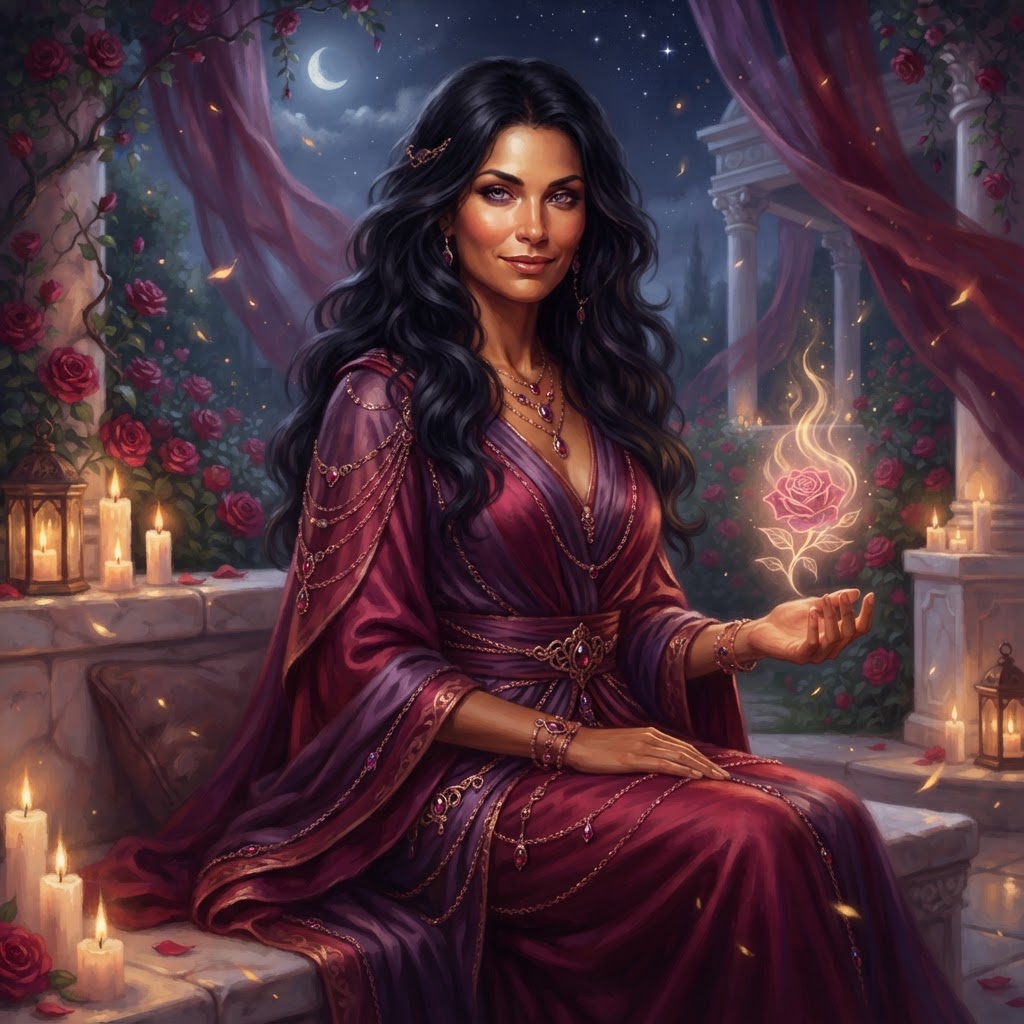
Goddess of Sexuality, Desire, Sensuality, Passion, and Sacred Pleasure
“To desire is not to sin. To feel is not to weaken. Within every willing touch burns the sacred fire of creation.”
I. Divine Identity
Within the ancient pantheon of Lumeris, few deities inspire as much fascination, devotion, controversy, and longing as Vaelithra, the Velvet Flame.
She is the goddess of sexuality in all its expressions, governing physical desire, sensual awakening, intimacy, attraction, passion, and the profound connections forged between willing souls.
Unlike deities who demand purity, restraint, or sacrifice, Vaelithra teaches that the mortal body is neither shameful nor unworthy. It is a sacred vessel through which life experiences pleasure, vulnerability, affection, and the intoxicating mysteries of desire.
Yet Vaelithra is not simply a goddess of lust. Her dominion extends to the delicate balance between passion and devotion, freedom and responsibility, temptation and self-control.
She is worshipped by lovers, courtesans, entertainers, newlyweds, artists, and those seeking to reclaim their confidence or rediscover intimacy.
Her teachings are simple:
- ◆Pleasure is sacred when freely chosen.
- ◆Desire is powerful when honestly understood.
- ◆No passion grants ownership over another soul.
Divine Titles
- ◆The Velvet Flame
- ◆Lady of a Thousand Kisses
- ◆The Crimson Temptress
- ◆Mistress of Sacred Desire
- ◆The Silken Mother
- ◆Keeper of the First Embrace
| Attribute | Divine Association |
|---|---|
| Alignment | Chaotic Neutral, with benevolent tendencies |
| Domains | Sexuality, Desire, Pleasure, Intimacy, Passion, Fertility, Beauty |
| Divine Symbol | A crimson rose encircling a golden flame |
| Sacred Colors | Deep crimson, violet, rose gold, midnight black |
| Sacred Animals | Swans, serpents, peacocks, and moonmoths |
| Sacred Elements | Fire, water, and moonlight |
| Divine Realm | The Everblooming Veil |
| Favored Offerings | Perfumes, silk, roses, wine, poetry, and handcrafted jewelry |
II. Appearance of the Goddess
Vaelithra possesses no single permanent form. She appears differently to those who behold her, reflecting the beauty and desire within their own hearts.
Her most frequently depicted manifestation is that of a strikingly beautiful, mature woman with flowing midnight hair, luminous violet eyes, and skin that glows faintly beneath the warmth of candlelight.
She dresses in layers of crimson and violet silk, adorned with delicate chains of rose gold and gemstones that shimmer with an almost living radiance.
Her presence carries the subtle fragrance of blooming roses, warm amber, and exotic spices.
When she speaks, her voice is rich and melodic, capable of stirring forgotten memories of affection, longing, and tenderness.
Although her appearance is often seductive, those who encounter her describe something far more profound than physical attraction.
They feel seen.
Vaelithra perceives the desires mortals conceal beneath duty, fear, shame, and expectation. She does not judge these desires merely for existing, but she does judge the choices made in their pursuit.
III. The Birth of the Velvet Flame
Before the Sundering
Ancient scriptures preserved within the hidden sanctuaries of Lumeris speak of an age when the gods walked closer to the mortal world.
During this primordial era, divine powers shaped the mountains, oceans, forests, and skies. Yet even as creation flourished, something remained absent.
Life existed, but the deeper yearning that draws one soul toward another had not fully awakened.
According to the Verses of the First Embrace, Vaelithra was born when two ancient beings willingly reached toward one another, not from necessity or obligation, but from genuine longing.
From their shared desire emerged a brilliant flame of crimson and gold.
That flame became Vaelithra.
She was neither created through divine command nor shaped by the will of another god. She was born from desire freely given and freely returned.
As her essence spread through creation, mortal beings began to experience attraction, longing, romantic affection, and the desire for intimate companionship.
The earliest Fae recognized her presence in the intoxicating fragrances of blooming gardens and the warmth of moonlit celebrations.
Among the Draksen, she was associated with the harmonious joining of elemental energies, particularly the passionate fires of Pyraxis and the flowing waters of Nerathis.
The ancient Orc clans regarded her as a patron of courtship, chosen bonds, and the continuation of bloodlines, although the Lunari later developed a more philosophical interpretation of her influence.
To the Felari and other Beastkin, she became associated with courtship rituals, beauty, and the freedom to choose one's companions.
Thus, Vaelithra became one of the few divine beings whose influence crossed nearly every racial and cultural boundary within Lumeris.
The War of Veils
When the Fae Courts fractured and the War of Veils began, Vaelithra witnessed how affection could be twisted into jealousy, possession, and cruelty.
Lovers betrayed one another for political advantage. Marriages became instruments of conquest. Enchantments were created to manipulate attraction and undermine free will.
For the first time, Vaelithra withdrew her blessings from entire noble houses.
She declared that no divine power under her authority would sanctify intimacy obtained through coercion.
This became known as The Crimson Decree.
Her temples thereafter established strict traditions protecting personal autonomy, mutual consent, and the right to refuse even a divinely favored union.
IV. The Everblooming Veil
Vaelithra's divine realm, known as the Everblooming Veil, exists between the mortal plane and the deeper currents of divine magic.
It is a breathtaking sanctuary of endless gardens, fragrant orchards, warm pools, moonlit terraces, and palaces constructed from pale marble and rose-colored crystal.
Time behaves differently within the Veil. A mortal visitor may experience a single evening while several days pass in Lumeris.
Its gardens are said to respond to emotion. Roses bloom when affection is expressed, fountains shimmer with the colors of passion, and ancient trees release silver petals when lovers make sincere promises.
At the heart of the realm stands the Palace of a Thousand Veils, Vaelithra's celestial residence. Within its chambers are three sacred halls:
The Hall of Longing
A place where visitors confront their deepest desires and discover whether those desires arise from love, loneliness, ambition, or obsession.
The Chamber of Reflection
A sanctuary where broken hearts may find healing and individuals may rediscover their worth beyond the attention or approval of others.
The Garden of the First Embrace
The holiest location within the realm, where Vaelithra is said to bless relationships founded upon genuine affection and freely chosen devotion.
No soul may be held within the Everblooming Veil against its will.
V. The Church of Vaelithra
The worship of Vaelithra differs considerably from the solemn traditions of many other Lumerian deities.
Her temples are places of celebration, education, beauty, and emotional healing. Music, dance, poetry, perfumery, and artistic expression are considered sacred offerings.
Her priesthood teaches that sexuality is a natural aspect of mortal existence, neither inherently virtuous nor sinful.
Religious Hierarchy
| Rank | Title | Responsibilities |
|---|---|---|
| 1 | Rose Initiate | Studies the goddess's teachings and assists with temple ceremonies |
| 2 | Silken Devotee | Guides worshippers through questions of desire, relationships, and self-acceptance |
| 3 | Keeper of Embers | Conducts blessings, ceremonies, and spiritual healing |
| 4 | Crimson Oracle | Interprets divine visions and oversees major festivals |
| 5 | Velvet Hierophant | Governs regional temples and protects sacred traditions |
| 6 | The First Rose | Highest mortal representative of Vaelithra |
The First Rose is chosen through a sacred ritual called the Blooming of the Heart, during which the goddess is believed to reveal her chosen representative through a crimson rose that blossoms with golden fire.
Priests and priestesses are not required to marry or remain celibate. Their relationships and personal lives are governed by the same principles of honesty, autonomy, and respect that they teach others.
VI. Sacred Teachings and Divine Laws
Vaelithra's followers observe seven fundamental teachings, known collectively as the Seven Petals of Desire.
- ◆The First Petal — Freedom: No affection, intimacy, or devotion is sacred unless freely chosen.
- ◆The Second Petal — Honesty: Desire must never become an excuse for deliberate deception or betrayal.
- ◆The Third Petal — Pleasure: The enjoyment of one's body and senses is not inherently shameful.
- ◆The Fourth Petal — Respect: Every individual possesses the right to establish and maintain personal boundaries.
- ◆The Fifth Petal — Passion: Emotion should be experienced fully, but never permitted to excuse cruelty.
- ◆The Sixth Petal — Devotion: Love and sexuality may exist together or separately; neither must be forced to imitate the other.
- ◆The Seventh Petal — Renewal: Hearts may heal, desires may change, and no mortal is forever defined by past relationships.
Her church strongly condemns coercive enchantments, forced unions, exploitation, and the use of divine blessings to override another person's will.
VII. Sacred Festivals
The Night of a Thousand Roses
Celebrated beneath the first full moon of spring, this festival honors attraction, romance, beauty, and the freedom of personal expression. Cities host masquerade balls, elaborate dances, poetry competitions, and candlelit feasts.
The Binding of Silken Threads
A ceremony in which willing partners exchange silk ribbons as symbols of affection, trust, or commitment. The ritual may celebrate marriage, romantic devotion, or another mutually chosen bond.
The Unveiling
A quiet festival of self-discovery and renewal. Worshippers write down burdens of shame, heartbreak, or unwanted expectations and symbolically release them into sacred flames or moonlit waters.
VIII. Divine Powers and Blessings
Vaelithra's magic is most often practiced by Clerics, Priestesses, Bards, and specialized Mages who devote themselves to her teachings.
Her gifts influence emotional clarity, confidence, connection, and restorative warmth rather than controlling the minds of others.
| Divine Gift | Effect |
|---|---|
| Velvet Presence | Grants confidence and a calming aura. +2 to non-coercive Charisma checks for one hour |
| Rosefire Touch | Restores 2d6 HP to a willing creature through divine warmth |
| Heart's Reflection | Reveals the caster's own true feelings or helps a willing target distinguish affection from magical influence |
| Silken Sanctuary | Creates a protective aura around up to three willing creatures, granting +2 to saving throws against fear and charm for 10 minutes |
| Crimson Renewal | Restores 4d6 HP and removes one ordinary exhaustion effect after a sacred restorative ritual |
| Flame of Devotion | Two willing allies gain +1 to defensive rolls while protecting one another for three rounds |
| Unbroken Will | Ends one magical charm or compulsion affecting a creature, subject to an appropriate dispelling check |
These are suggested Lumeris mechanics and can be adjusted to match the established class and LFE progression system.
IX. Sacred Relics
The Crimson Heart of Vaelithra
An ancient ruby said to contain a fragment of the goddess's original divine flame. The gemstone glows softly when held by someone experiencing sincere affection. When carried by a devoted priest, it can strengthen restorative blessings and reveal the presence of coercive enchantments.
The Silken Veil
A delicate veil woven from celestial threads within the Everblooming Veil. Its wearer becomes exceptionally resistant to magical manipulation of emotions and may perceive illusions intended to disguise another person's intentions.
The Chalice of First Desire
A golden chalice decorated with roses and intertwined serpents. Water poured into the chalice becomes a fragrant restorative draught capable of easing fatigue and restoring HP. Its power cannot be used to create attraction or compel intimacy.
The Rose of Eternal Embers
A living crimson rose that never wilts. Its petals may be used in rare healing rituals for grief, magical emotional trauma, or the lingering effects of cursed enchantments.
X. Relationships with the Other Divine Powers
Vaelithra's position within the pantheon is complicated.
She recognizes the importance of life, beauty, and creation, but refuses to accept the belief that desire must always serve marriage, reproduction, or social obligation.
Her relationship with the divine powers of light is especially fascinating. Where the Goddess of Light represents revelation, hope, and the illumination of truth, Vaelithra represents the private desires that mortals often conceal from the world.
The two are not natural enemies.
Indeed, ancient texts describe their powers working together to reveal hidden truths within the heart. Yet their followers occasionally disagree over the nature of temptation, personal restraint, and whether every desire deserves to be pursued.
Vaelithra also shares a complicated connection with the Shadow Court of the Fae. Many Shadow Fae celebrate her mysteries and sensuality, while others resent her absolute opposition to magically enforced affection.
Among the Ember Fae, she is often honored through passionate dancing and firelit festivals.
Within the Light Court, she is more commonly revered as a patron of sincere affection, emotional honesty, and freely chosen devotion.
XI. The Dark Reflection — The Hollow Rose
Not all who invoke Vaelithra understand her teachings.
An underground cult known as The Hollow Rose believes that desire is the ultimate expression of power and that those capable of inspiring obsession deserve dominion over others.
Its members practice forbidden enchantments designed to manipulate affection, exploit emotional vulnerability, and establish supernatural dependency.
Although they claim Vaelithra as their patron, the goddess has publicly rejected them through her oracles. According to legend, she once appeared before the cult's founder and extinguished every enchanted rose within his sanctuary.
Her words were preserved by the survivors:
“You have mistaken hunger for devotion and possession for love. What you seek is not my blessing.”
The Hollow Rose nevertheless survives in secret, providing a dangerous antagonist for campaigns involving divine corruption, forbidden magic, and political intrigue.
XIII. The Prophecy of the Withered Rose
Among the oldest surviving scriptures of Vaelithra is a prophecy believed to have been written shortly before the Sundering.
When the Broken Moons bleed silver tears,
And love is traded for a crown,
The Velvet Flame shall cease to dance,
And crimson petals shall fall.
When willing hearts are bound in chains,
And desire is stripped of choice,
The goddess shall awaken wrath,
And silence every tyrant's voice.
Yet from the ashes of the rose,
A single golden bloom shall rise,
And only hearts that choose their bonds
Shall see the dawn beyond the skies.
Some scholars believe this prophecy foretells the return of an ancient deity capable of corrupting mortal affection on a massive scale.
Others suspect it references the Broken Moons themselves and a forgotten connection between divine desire and the original creation of Lumeris.
The priesthood of Vaelithra maintains that the prophecy has not yet been fulfilled.
XIV. A Prayer to the Velvet Flame
“Vaelithra, Lady of the Crimson Rose,
Keeper of passion and guardian of the willing heart,
Teach me to know my desires without shame,
To offer affection without demanding its return,
To embrace pleasure without cruelty,
And to recognize beauty within myself.
Let my heart remain free,
My passions remain true,
And my spirit never mistake possession for love.
By rose and flame, by silk and moonlight,
May I always choose, and always be free.”
XV. Vaelithra's Place in Lumeris
She is a deity of profound personal freedom, sensuality, sexuality, and emotional connection. Her faith offers opportunities for adult-oriented social roleplay, romance, religious intrigue, divine magic, and darker campaigns involving corrupted devotion, while giving her a distinctive moral identity within the wider pantheon.