Vaelthryss
The Eternal Veil
Goddess of Darkness, Death, Forbidden Knowledge, Shadows, and Necromancy
“Before the first light pierced the heavens, there was darkness. And within that darkness, I was waiting.”
I. Divine Identity
| Attribute | Description |
|---|---|
| Divine Name | Vaelthryss |
| Titles | The Eternal Veil, Mother of Shadows, Queen of the Unseen, Mistress of the Last Breath, Keeper of Forbidden Truths |
| Divine Alignment | Neutral Evil, though her followers range from neutral to profoundly malevolent |
| Domains | Darkness, Death, Necromancy, Shadows, Secrets, Forbidden Knowledge |
| Sacred Symbol | A black crescent moon embracing a violet eye, surrounded by seven silver stars |
| Sacred Colors | Obsidian black, midnight violet, deep crimson, tarnished silver |
| Sacred Animals | Ravens, black serpents, shadowmoths, and pale-eyed spiders |
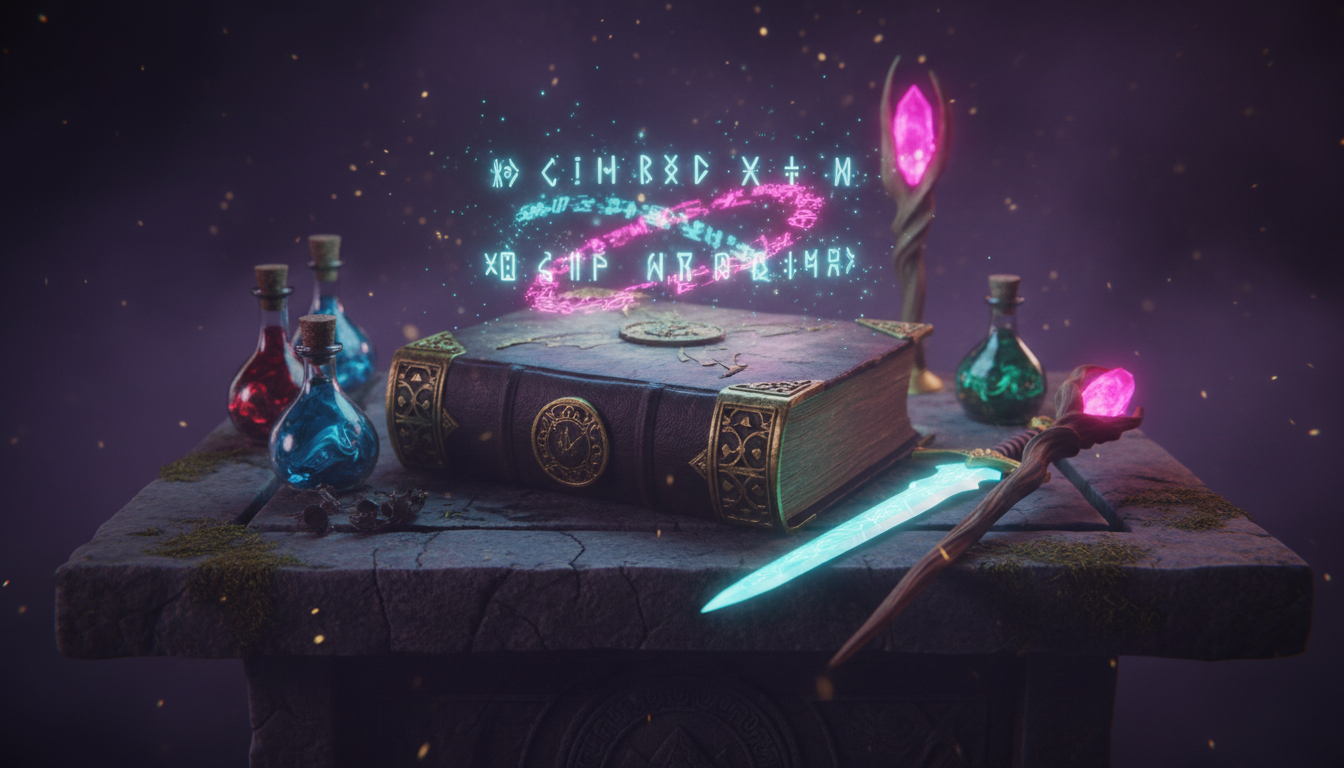
| Sacred Weapon | The Veilblade, a ceremonial curved dagger |
| Divine Realm | Nyth'Vaelor, the Kingdom Beyond the Veil |
| Primary Worshippers | Dark Elves, Necromancers, Shadow Mages, Assassins, Death Priests, and practitioners of forbidden magic |
| Holy Night | The Night of the Hollow Moon |
II. The Origin of the Eternal Veil
Before the Birth of Light
In the oldest surviving scriptures of Lumeris, there are passages that speak of an age before the gods walked among mortals, before the Broken Moons illuminated the heavens, and before the first kingdoms rose from the earth.
There was only the Primordial Expanse.
It was neither good nor evil. It possessed no shape, no beginning, and no end. Within its endless stillness, the first divine consciousnesses awakened.
Among them was Vaelthryss.
Unlike the gods who would eventually shape mountains, oceans, fire, and life, Vaelthryss desired neither creation nor dominion. She was fascinated by the possibilities hidden within the unknown.
- ◆Where others saw emptiness, she saw potential.
- ◆Where others feared silence, she heard whispers.
- ◆And where others sought to illuminate the darkness, she understood that certain truths could survive only when concealed.
It is said that when the first Goddess of Light brought illumination into existence, Vaelthryss did not recoil. Instead, she smiled.
For in that instant, the first shadow was born. And with the birth of shadows, her dominion became eternal.
The First Divine Conflict
As the divine powers began shaping Lumeris, disagreements arose over the nature of mortal existence. The gods of light believed knowledge should guide mortals toward enlightenment. The gods of nature believed life should follow the sacred cycles of growth, decay, and rebirth.
Vaelthryss challenged both.
She believed mortals should possess the freedom to pursue knowledge regardless of its consequences. Death, she argued, was not sacred because it ended life. It was sacred because it revealed the mysteries that life concealed.
She began studying the boundaries between the living world and the realms beyond. Through her experiments, she discovered that souls retained fragments of memory, emotion, and power after death. These discoveries became the foundations of necromancy.
When other divine beings demanded that she cease her investigations, Vaelthryss refused.
“You call it corruption because you fear what lies beyond your understanding. I call it wisdom.”
The disagreement eventually fractured the divine order. Rather than submit to restrictions imposed by her celestial kin, Vaelthryss withdrew into the deepest reaches of the spiritual planes.
There, she established Nyth'Vaelor, a realm of eternal twilight where the boundaries between shadow, memory, and death were thin.
Although many legends claim she was banished, her oldest priests insist that she departed willingly. To them, her withdrawal was not defeat. It was the first act of divine independence.
III. The Goddess and the Dark Elves
The Children of the Veil
Of all the mortal peoples of Lumeris, few have developed a relationship with Vaelthryss as profound as the Dark Elves.
Their earliest histories speak of an ancient division among the Elven peoples, occurring during a period of magical upheaval that followed the Sundering. While some Elven civilizations pursued celestial magic and alliances with the powers of light, others sought knowledge within the hidden places beneath the world.
These explorers descended into forgotten caverns, buried ruins, and ancient subterranean kingdoms. There they encountered remnants of magical civilizations predating recorded Elven history. Among those discoveries were inscriptions bearing the symbol of the violet eye.
The inscriptions promised knowledge that could not be obtained beneath the sun.
The Dark Elves' ancestors began worshipping Vaelthryss, believing she alone understood the power concealed beneath Lumeris. According to their sacred histories, the goddess appeared before their earliest matriarchs in the form of a beautiful woman crowned with living darkness. She offered them three gifts.
- ◆The Gift of Veils: The ability to see through ordinary darkness and perceive the movements of shadow-bound magic.
- ◆The Gift of Whispers: An affinity for secrets, illusion, hidden knowledge, and the subtle manipulation of magical energies.
- ◆The Gift of Remembrance: The ability to communicate with ancestral spirits through carefully performed sacred rites.
In exchange, Vaelthryss demanded that her teachings never be forgotten. She did not require universal obedience or the destruction of other races. She required devotion to the pursuit of hidden truths.
Over centuries, the Dark Elves developed powerful religious institutions dedicated to her worship. In many subterranean cities, her priestesses became influential political figures, advising rulers, preserving ancestral histories, and interpreting omens.
Some cities eventually developed strict matriarchal religious hierarchies. Others allowed individual temples to operate independently.
Although Vaelthryss remains the most widely worshipped deity among these Dark Elven societies, not every Dark Elf follows her, and not every follower interprets her teachings in the same manner.
The Covenant of the Seven Shadows
Dark Elven religious tradition describes an ancient agreement between Vaelthryss and seven founding noble houses. Each house received responsibility for protecting one aspect of her divine teachings.
| Sacred House | Divine Responsibility |
|---|---|
| House Vhaelryn | Guardians of forbidden knowledge |
| House Nyssara | Masters of shadow magic and illusion |
| House Morveth | Keepers of ancestral spirits and death rites |
| House Thal'Vess | Protectors of sacred temples and relics |
| House Xyrath | Masters of secrets, intelligence, and espionage |
| House Velkyn | Scholars of necromancy and soul magic |
| House Draelith | Interpreters of prophecy and divine visions |
The houses have frequently fought over influence, sacred relics, and the interpretation of their goddess's will. Vaelthryss rarely intervenes. Her priesthood teaches that ambition reveals the true nature of those who possess it.
However, there is one transgression she considers unforgivable: the deliberate destruction of knowledge entrusted to her followers. Even the most powerful Dark Elven ruler may lose her favor for such an offense.
IV. Appearance and Manifestations
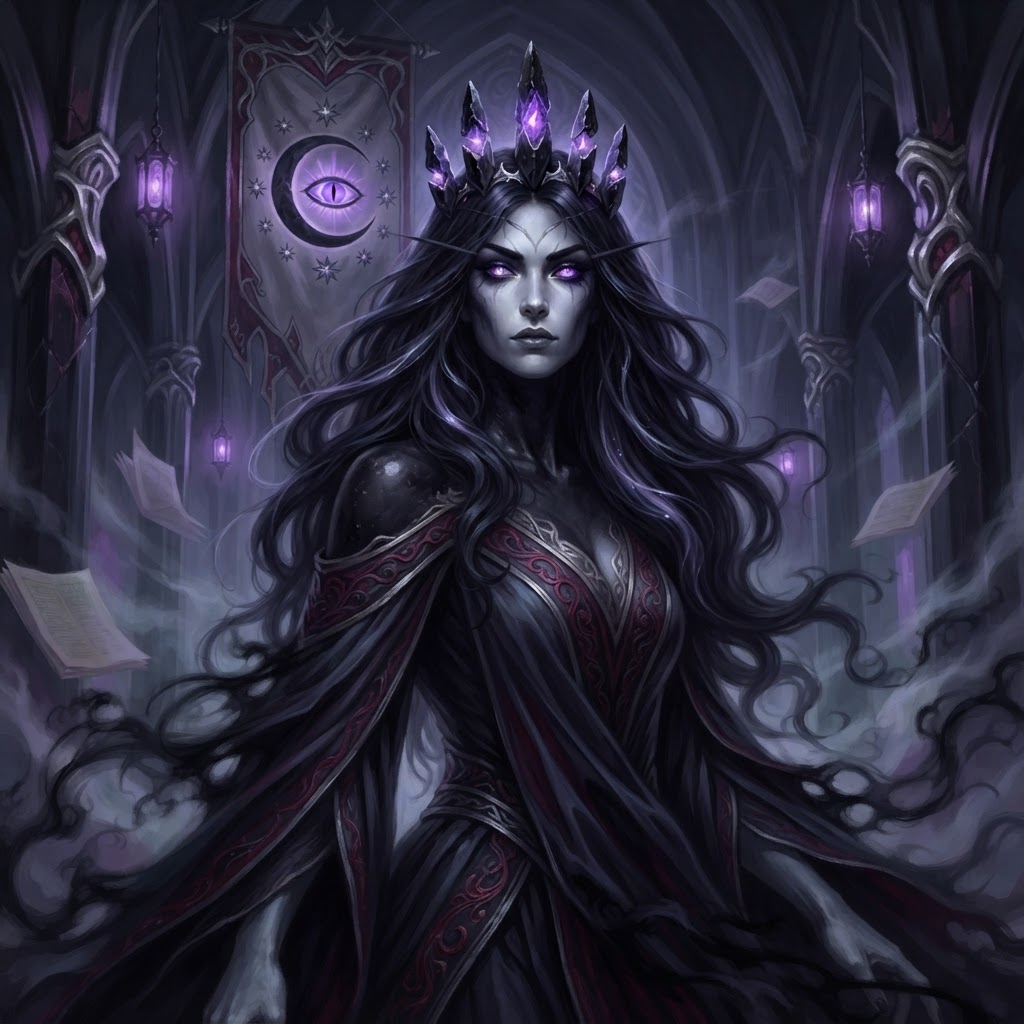
Vaelthryss possesses no permanent physical form, but her most recognizable manifestation resembles a strikingly beautiful Dark Elven woman of imposing height.
Her skin ranges from deep obsidian to pale silver-gray, depending on the circumstances of her appearance. Her hair flows like liquid midnight, occasionally shimmering with silver or violet strands resembling distant stars.
Her eyes are luminous violet, with pupils that resemble narrow vertical fractures in reality. Those who meet her gaze sometimes experience visions of forgotten memories, buried fears, or events that have not yet occurred.
She wears flowing robes woven from living shadows. The fabric moves independently of wind and occasionally dissolves into drifting black mist. A crown of seven obsidian points rests upon her head, each bearing a fragment of violet light.
Her presence is accompanied by unnatural silence. Candles dim. Shadows lengthen. Reflections become distorted. And those who stand before her often hear distant whispers speaking in voices they recognize.
Her Three Divine Aspects
The Veiled Mother
Her protective aspect, revered by Dark Elven families, exiles, and those seeking refuge. She appears as a solemn maternal figure cloaked in black silk, sheltering her followers beneath immense shadowy wings.
The Pale Sovereign
Her aspect of death and necromancy. She appears pale and regal, crowned with bone and obsidian. Necromancers invoke this manifestation when communicating with the dead or attempting to unravel the secrets of souls.
The Nameless Shadow
Her oldest and most terrifying manifestation. She possesses no recognizable face or body, appearing instead as a vast silhouette filled with shifting stars and countless watching eyes. Only her highest-ranking servants dare summon this aspect.
V. The Realm of Nyth'Vaelor
“Beyond the final breath, beyond the fading light, lies a kingdom where forgotten truths never die.”
Nyth'Vaelor exists beyond the ordinary mortal planes, suspended between the realms of shadow and death. It is not a conventional afterlife. Rather, it is a vast spiritual dominion where memories, secrets, and fragments of deceased souls are preserved.
The realm is illuminated by an enormous fractured violet moon that never moves across the sky. Black rivers flow between towering obsidian mountains. Forests of pale, leafless trees whisper the names of the dead. Immense libraries rise from islands suspended above bottomless darkness.
At the center stands the Throne of the Eternal Veil, a magnificent citadel constructed from black crystal, silver bone, and living shadow.
Important Locations
The Palace of Unspoken Names
Vaelthryss's divine residence. Its corridors change constantly, and every door opens according to the memories of whoever approaches it. Those who enter without permission risk becoming trapped within their own forgotten past.
The Sepulcher of Echoes
An immense necropolis containing the spiritual remnants of scholars, sorcerers, kings, and forgotten civilizations. Powerful necromancers seek access to its ancestral spirits.
The Blackwater Expanse
A vast lake whose surface reflects not the viewer's appearance, but their deepest concealed desires. It is said that those who drink its waters experience visions of possible futures.
The Library of Hollow Stars
A near-infinite archive containing forbidden magical theories, lost histories, and fragments of knowledge erased from the mortal world. Some scholars believe the library contains records concerning the Broken Moons, the ancient Titans, and the origins of Lumeris itself.
The Gate of Seven Whispers
The primary threshold between Nyth'Vaelor and other spiritual planes. Seven spectral guardians demand a secret from every traveler seeking passage. The greater the secret surrendered, the farther into the realm the traveler may venture.
VI. The Doctrine of Eternal Darkness
Vaelthryss does not teach that darkness is inherently evil. She teaches that darkness is necessary.
- ◆Without darkness, there can be no secrets.
- ◆Without secrets, there can be no discovery.
- ◆Without death, there can be no understanding of life's limitations.
Her followers interpret these teachings through seven sacred doctrines, collectively called the Seven Whispers.
- ◆1. Knowledge Shall Never Be Feared. No truth is forbidden merely because it is dangerous or uncomfortable.
- ◆2. The Shadow Reveals What Light Conceals. Appearances are deceptive, and true understanding requires looking beyond what is visible.
- ◆3. Death Is a Threshold, Not an Ending. The passage of the soul is a mystery worthy of study rather than unquestioning acceptance.
- ◆4. Power Must Be Earned Through Understanding. Strength without wisdom is temporary and easily destroyed.
- ◆5. Secrets Are Sacred. Knowledge entrusted in confidence must be protected unless its concealment threatens a greater purpose.
- ◆6. The Forgotten Shall Be Remembered. Histories, names, and ancestral wisdom must never be deliberately erased.
- ◆7. The Veil Must Never Be Torn Without Purpose. Those who manipulate death and spiritual energies must understand the consequences of their actions.
These doctrines have produced vastly different religious traditions. Some followers become historians, spiritual guides, and protectors of the dead. Others interpret the goddess's teachings as permission to pursue power through manipulation, murder, and forbidden necromantic experimentation.
Vaelthryss does not automatically condemn either path. She judges her followers primarily by their understanding, determination, and willingness to accept the consequences of their choices.
VII. Worshippers and Religious Orders
Although Dark Elves constitute her largest organized following, Vaelthryss attracts worshippers from nearly every race of Lumeris.
The Umbral Matriarchs
The most influential Dark Elven priestesses of Vaelthryss. They oversee major temples, interpret divine prophecies, preserve sacred bloodlines, and advise the ruling houses. The most powerful Matriarchs are believed to communicate directly with the goddess through dreams.
The Gravebound Covenant
A secretive order of necromancers dedicated to studying death and the persistence of consciousness. Their members include Dark Elves, Humans, Orcs, Dwarves, and other magically gifted peoples. The Covenant recognizes three principal traditions.
- ◆The Remembrancers: Necromancers who communicate with spirits, preserve ancestral memories, and investigate ancient deaths.
- ◆The Boneweavers: Practitioners who animate skeletal remains, construct undead guardians, and manipulate the physical remnants of death.
- ◆The Soulbinders: Feared scholars who experiment with spiritual imprisonment, resurrection, and the transfer of consciousness.
Soulbinding remains controversial even within the goddess's own temples. Many priests believe forcibly imprisoning a soul violates the sacred purpose of death. Others argue that no avenue of knowledge should remain unexplored.
The Silent Veil
An order of assassins, spies, and shadow practitioners who regard secrecy as a divine art. They believe the most significant victories are achieved without open conflict. Members frequently serve as intelligence gatherers for Dark Elven rulers, although their ultimate loyalty remains with Vaelthryss.
The Daughters of the Hollow Moon
An exclusively female religious order whose members serve as oracles, diviners, and guardians of ancient prophecy. They interpret visions received during lunar eclipses and periods when the Broken Moons appear unusually close.
Their prophecies are rarely direct. Instead, they speak in riddles involving shadows, fractured crowns, and forgotten names.
The Ashen Pilgrims
Wandering devotees who travel through ruins, graveyards, abandoned cities, and battlefields. They collect forgotten histories, recover lost artifacts, and record the names of those whose deaths have gone unremembered.
Unlike many other religious orders, the Ashen Pilgrims frequently assist communities that do not worship Vaelthryss. Their philosophy holds that the preservation of knowledge transcends religious allegiance.
VIII. Sacred Temples and Places of Worship
Temples dedicated to Vaelthryss are generally constructed beneath the earth, within shadowed mountain valleys, or among ancient ruins. Their architecture emphasizes towering arches, black stone, silver ornamentation, and luminous violet crystals.
Unlike temples dedicated to gods of light, these sanctuaries rarely contain open flames. Instead, they are illuminated by enchanted gemstones, ghostly lanterns, or pools of softly glowing water.
The Grand Temple of the Eternal Veil
The largest known sanctuary dedicated to Vaelthryss stands within the Dark Elven subterranean metropolis of Vhaelryndor, also called the City Beneath the Silent Moon.
Its central chamber contains a colossal statue of the goddess, carved from a single formation of black crystal. Seven immense pillars surround the statue, each representing one of the founding Dark Elven houses.
The temple is governed by the High Matriarch, whose authority extends across many affiliated sanctuaries. Beneath the temple lies the Vault of Forgotten Kings, where the remains of ancient Dark Elven rulers are preserved.
The Hollow Sanctum
A remote monastery constructed within a cavern where ordinary light mysteriously fails. Necromancers travel here to study spiritual magic under the supervision of the Gravebound Covenant. Its deepest chambers are sealed by magical wards believed to predate the modern kingdoms.
The Shrine of Last Whispers
A small but sacred sanctuary built near an ancient battlefield. Pilgrims visit to speak the names of fallen loved ones and request guidance from ancestral spirits. The shrine is particularly popular among those who worship Vaelthryss as a guardian of the dead rather than a patron of forbidden magic.
IX. Holy Rituals and Religious Practices
The Offering of Secrets
The most common ritual among her followers. A worshipper kneels before an obsidian altar and whispers a secret never previously spoken aloud. The secret is considered an offering of personal vulnerability. Priests teach that Vaelthryss values genuine revelation more than material wealth.
The Vigil of Seven Shadows
A sacred rite undertaken by those seeking initiation into her priesthood. The initiate spends seven consecutive nights in darkness, meditating upon one of the Seven Whispers each night. During the final vigil, the initiate must confront a magically induced manifestation of their deepest fear. Successful initiates receive a ceremonial silver mark shaped like a crescent moon.
The Communion of the Departed
A necromantic ceremony allowing priests to communicate briefly with deceased ancestors. The ritual requires an object associated with the deceased, a circle of black salt, and a crystal infused with shadow magic. The ceremony does not guarantee contact. Spirits may refuse to answer, and powerful wards can prevent communication.
The Night of the Hollow Moon
The most important annual observance in the worship of Vaelthryss. It occurs during a rare lunar alignment when the visible moons cast unusually faint light upon Lumeris.
Dark Elven cities extinguish ordinary lanterns and illuminate their streets with violet crystals. Priestesses lead processions through the streets while chanting ancient hymns. Necromancers perform ceremonies honoring the dead. Families gather to recount ancestral histories.
At midnight, every participating temple observes seven minutes of complete silence. It is believed that during these moments, the veil separating the mortal world from Nyth'Vaelor becomes exceptionally thin.
X. Divine Magic and Blessings
Vaelthryss grants power through shadow, necromantic energy, spiritual knowledge, and manipulation of perception. Her magic is particularly attractive to Shadow Mages, Necromancers, Clerics, Assassins, and advanced practitioners of forbidden arcane arts.
The following are suggested blessings and spells for the Lumeris roleplay system. LFE costs can be adjusted to match the established class progression.
1. Veil of the Forgotten — Minor Blessing
The caster surrounds themselves with shifting shadows, obscuring their appearance and muffling their movements. Cost: 10 STA · Duration: 3 turns · Effect: +2 to stealth-related rolls while in dim light or darkness.
2. Whisper of the Departed — Minor Spell
Allows the caster to hear faint impressions from a recently deceased spirit. Cost: 15 STA · Duration: 5 minutes · Effect: Ask up to three questions. Answers depend on what the spirit knew and whether it is willing to communicate.
3. Grasp of the Hollow — Intermediate Spell
Shadowy hands emerge from the ground, grasping a target and draining its vitality. Cost: 25 STA · Damage: 2d8 necrotic · Effect: On a failed resistance check, the target is restrained for 1 turn.
4. Eyes of the Eternal Veil — Intermediate Blessing
The caster's eyes glow violet, revealing magical traces, concealed spirits, and unnatural shadows. Cost: 20 STA · Duration: 10 minutes · Effect: Detect nearby undead, spiritual disturbances, and shadow-based illusions within 30 feet. Does not automatically reveal all concealed creatures.
5. Covenant of Bone — Advanced Spell
The caster temporarily animates skeletal remains, creating a guardian bound to their commands. Cost: 40 STA · Duration: 5 turns · Effect: Summon one skeletal guardian with 20 HP and an attack dealing 1d8 damage. Requires suitable remains.
6. Embrace of Nyth'Vaelor — Divine Spell
The caster opens a temporary fracture into the goddess's realm, releasing a wave of supernatural darkness and spectral energy. Cost: 75 STA · Area: 20-foot radius · Damage: 5d10 necrotic · Effect: Magical darkness lasts 3 turns. Creatures within the area must resist or become frightened for 1 turn.
Divine Favor and Punishment
Those who earn Vaelthryss's favor may receive prophetic dreams, heightened awareness in darkness, resistance to spiritual corruption, or the ability to perceive concealed magical energies. Her most devoted servants occasionally manifest violet markings beneath their skin when channeling divine power.
Those who betray sacred oaths or intentionally destroy entrusted knowledge may experience the withdrawal of her blessings. In extreme circumstances, the goddess imposes the Curse of the Hollow Name.
The afflicted gradually become forgotten by those around them. Written records of their identity fade, and even close companions struggle to remember their faces. Only divine intervention or the recovery of knowledge deliberately destroyed can end the curse.
XI. Relationships with the Other Gods of Lumeris
The Goddess of Light — The Eternal Opposition
Vaelthryss's relationship with the Goddess of Light is among the oldest divine rivalries. The two represent opposing approaches to truth. Light seeks to reveal. Darkness seeks to understand what remains concealed.
Their followers have frequently clashed, particularly when religious authorities attempt to suppress forbidden magical research. Yet ancient scripture suggests the goddesses were not always enemies.
Some scholars believe their powers were originally complementary. Without light, shadows cannot exist. Without darkness, light possesses nothing against which to define itself. This philosophical connection has led certain religious orders to argue that the goddesses are eternal counterparts rather than irreconcilable enemies.
The God of War — The Shadow Behind the Blade
Vaelthryss respects strategic intelligence, patience, and calculated conflict. Although she rarely supports warfare for its own sake, she recognizes that conflict reveals the ambitions and weaknesses of mortal civilizations.
Her followers sometimes serve as spies, assassins, and advisers within military campaigns. She particularly favors commanders who achieve victory through knowledge rather than brute force.
The Earth Goddess — The Keeper of Buried Things
The Earth Goddess and Vaelthryss maintain a complicated relationship. The earth shelters ancient ruins, forgotten civilizations, buried relics, and the remains of the dead. Vaelthryss considers these places sacred repositories of knowledge.
The Earth Goddess, however, recognizes the importance of allowing certain things to decay naturally. Their followers occasionally cooperate in preserving ancient sites, but conflict arises when necromancers disturb resting places or exploit sacred natural energies.
The Goddess of Sexuality — Desire and Secrecy
Vaelthryss recognizes desire as one of the most powerful forces influencing mortal decisions. Secrets born from love, passion, jealousy, and longing are particularly interesting to her.
Some Dark Elven religious traditions celebrate the connection between desire and hidden identity, while others regard emotional attachment as a vulnerability. The two goddesses share an understanding that mortal desires frequently reveal truths that reason attempts to conceal.
XII. Sacred Artifacts of Vaelthryss
The Veilblade of Seven Sorrows
A legendary curved dagger forged from divine obsidian. It can sever magical bindings, damage spectral entities, and reveal hidden enchantments when bathed in moonlight.
The Crown of Hollow Stars
Said to contain seven fragments of the goddess's original divine crown. Its wearer can perceive spiritual beings and hear echoes of forgotten histories. Prolonged use risks overwhelming the wearer with memories that are not their own.
The Grimoire of Unspoken Deaths
A forbidden tome containing advanced theories of necromancy, soul preservation, and resurrection. Its pages reveal different writings depending upon the reader's magical knowledge.
The Mirror of Nyth'Vaelor
A polished black mirror that can reveal concealed truths, distant locations, or fragments of possible futures. Every vision demands the surrender of a personal memory.
XIII. The Dark Prophecy of the Broken Moons
Among the oldest scriptures of Vaelthryss is a prophecy believed to predate the Sundering. It is preserved within the Library of Hollow Stars and repeated by the Daughters of the Hollow Moon.
When broken moons begin to bleed,
And ancient roots forget their seed,
When crowns of light are cast below,
And buried rivers cease to flow,
The Seven Shadows shall arise,
Beneath the gaze of hollow skies.
The dead shall whisper names once lost,
The living learn creation's cost.
And she who watched before the dawn,
Shall claim the truths that gods have drawn.
Not death, nor night, shall end the age,
But secrets freed from heaven's cage.
Dark Elven scholars believe this prophecy refers to an approaching period of tremendous magical instability. Some interpret the bleeding moons as a warning that the barriers separating the mortal world from the spiritual planes will weaken.
Others believe the prophecy concerns the awakening of ancient powers connected to the Titans and the creation of Lumeris.
The most radical followers believe Vaelthryss will eventually emerge from Nyth'Vaelor and reveal a truth capable of transforming the entire divine order. Whether this revelation would save Lumeris or destroy its established civilizations remains unknown.
XIV. How Vaelthryss Interacts with Mortals
Vaelthryss rarely appears openly. She prefers subtle communication through dreams, shadows, reflections, and the voices of the departed.
Her guidance is frequently ambiguous.
- ◆She may reveal the location of a forgotten artifact without explaining the dangers surrounding it.
- ◆She may warn a priestess of betrayal without identifying the traitor.
- ◆She may grant a necromancer the knowledge needed to restore a lost soul while withholding the consequences of doing so.
The goddess does not seek to eliminate mortal choice. She believes that knowledge has value only when individuals decide what to do with it.
This makes her an unpredictable divine patron. A follower may receive extraordinary blessings for pursuing dangerous truths, only to discover that those truths bring devastating consequences.
Vaelthryss does not always prevent such suffering. To her, wisdom without consequence is merely information.
XV. Prayer of the Eternal Veil
This prayer is spoken by Dark Elven priestesses during religious ceremonies, by necromancers before undertaking dangerous rituals, and by travelers seeking protection within the darkness.
“Mother of Shadows, Keeper of the Unseen,
She who walked before the first dawn,
Draw thy veil across my fears,
And guide my steps where light has gone.
Let no forgotten truth escape me,
Let no ancient whisper fade,
Grant me wisdom in the silence,
And strength within the shade.
When my final breath is taken,
When my mortal light grows pale,
Remember me, O Eternal Mother,
And welcome me beyond the Veil.”
— Traditional Prayer of the Veiled Faith
XVI. Vaelthryss's Place in the Kingdoms of Lumeris
Vaelthryss occupies a unique position within the divine pantheon. She is not simply the embodiment of evil, nor does she represent darkness as an inherently destructive force. She embodies the mysteries that civilizations fear to confront.
She is the patron of those who question divine authority, explore forbidden ruins, commune with the dead, and challenge the boundaries imposed upon mortal understanding.
- ◆For the Dark Elves, she is an ancestral protector, divine matriarch, and source of cultural identity.
- ◆For necromancers, she is the ultimate authority on death and spiritual magic.
- ◆For assassins and shadow practitioners, she represents the power of patience, secrecy, and precision.
- ◆For scholars, she is the guardian of truths that history has attempted to erase.
- ◆And for those who fear her, she is a reminder that some mysteries are concealed for reasons mortals may never fully comprehend.
Vaelthryss does not promise salvation, forgiveness, or eternal peace. She promises knowledge.
And in the Kingdoms of Lumeris, knowledge can be more dangerous than any sword, spell, or divine curse.
“Fear not the darkness, child. Fear what you may discover when you finally learn to see within it.” — Vaelthryss, the Eternal Veil