Varkhadon
The Iron Sovereign
God of War, Conquest, Valor, and Sacrifice
“War is not born upon the battlefield. It is born in the hearts of those who believe something is worth dying for.”
I. Divine Identity
| Attribute | Description |
|---|---|
| Divine Name | Varkhadon |
| Titles | The Iron Sovereign, Lord of the Crimson March, The Unbroken Blade, Father of Battle, Keeper of the Fallen |
| Divine Alignment | Lawful Neutral, with tendencies toward Lawful Evil |
| Divine Domains | War, Conquest, Strength, Valor, Sacrifice, Strategy |
| Sacred Symbol | A black iron sword piercing a crimson sun, surrounded by a broken golden crown |
| Sacred Colors | Crimson, blackened silver, and antique gold |
| Sacred Animal | The Ashen Warwolf |
| Sacred Weapon | Greatsword, known as Worldrender |
| Divine Realm | The Crimson Bastion |
| Worshippers | Warriors, knights, mercenaries, military commanders, conquerors, gladiators, and battle clerics |
| Divine Manifestation | The sound of distant war drums, the scent of iron, and crimson embers drifting through the air |
II. The Birth of the Iron Sovereign
Before the First War
Long before the kingdoms of Lumeris raised their banners, before the Fae Courts were divided and before the great Orcish fortresses were carved from volcanic stone, the world existed beneath the uncertain guidance of ancient divine powers.
It was an age of creation, when the energies of Lumeris were wild and untamed. Mountains rose from the earth, seas swallowed entire valleys, and the first mortal races struggled to survive in a world that had not yet learned mercy.
Among the earliest divine beings was a nameless spirit born not from creation itself, but from the struggle to preserve it.
When the first mortal raised a stone to defend another against a greater predator, something stirred within the fabric of existence.
When the first tribe stood together against an invading enemy, that presence grew.
And when the first warrior willingly sacrificed their life so that others might survive, the spirit awakened.
That spirit became Varkhadon.
Unlike gods whose existence was bound to the sun, moon, earth, or stars, Varkhadon was born from mortal conflict. He was the embodiment of the will to fight, the determination to endure, and the terrible realization that peace sometimes demanded blood.
The ancient gods regarded him with unease. For while their strength came from the natural forces of creation, Varkhadon's strength grew whenever mortals took up arms. And mortals, they soon discovered, would never cease fighting.
The First Divine War
During the ancient upheavals that preceded the Sundering, Varkhadon became one of the most formidable powers among the gods. He did not seek dominion over creation in its entirety. Instead, he believed that conflict was the crucible through which civilizations became worthy of survival.
This belief brought him into opposition with divine beings who sought everlasting harmony.
When disputes among the ancient powers erupted into open warfare, Varkhadon refused to remain an observer. He descended upon the battlefield carrying a blade forged from the heart of a dying star.
With a single strike, he shattered the celestial defenses of an invading divine host. With another, he cleaved a mountain range, leaving a scar that would endure for ages.
Yet the war changed him.
He witnessed gods sacrificing entire mortal civilizations to achieve victories that held no meaning beyond their own pride.
For the first time, the God of War questioned the purpose of conquest. He declared that battle without purpose was slaughter, and victory without sacrifice was merely vanity.
This declaration became known as The Iron Covenant, the foundation of his divine philosophy. It did not make Varkhadon a peaceful god. It made him a god who demanded that every war have a reason.
III. Physical Appearance
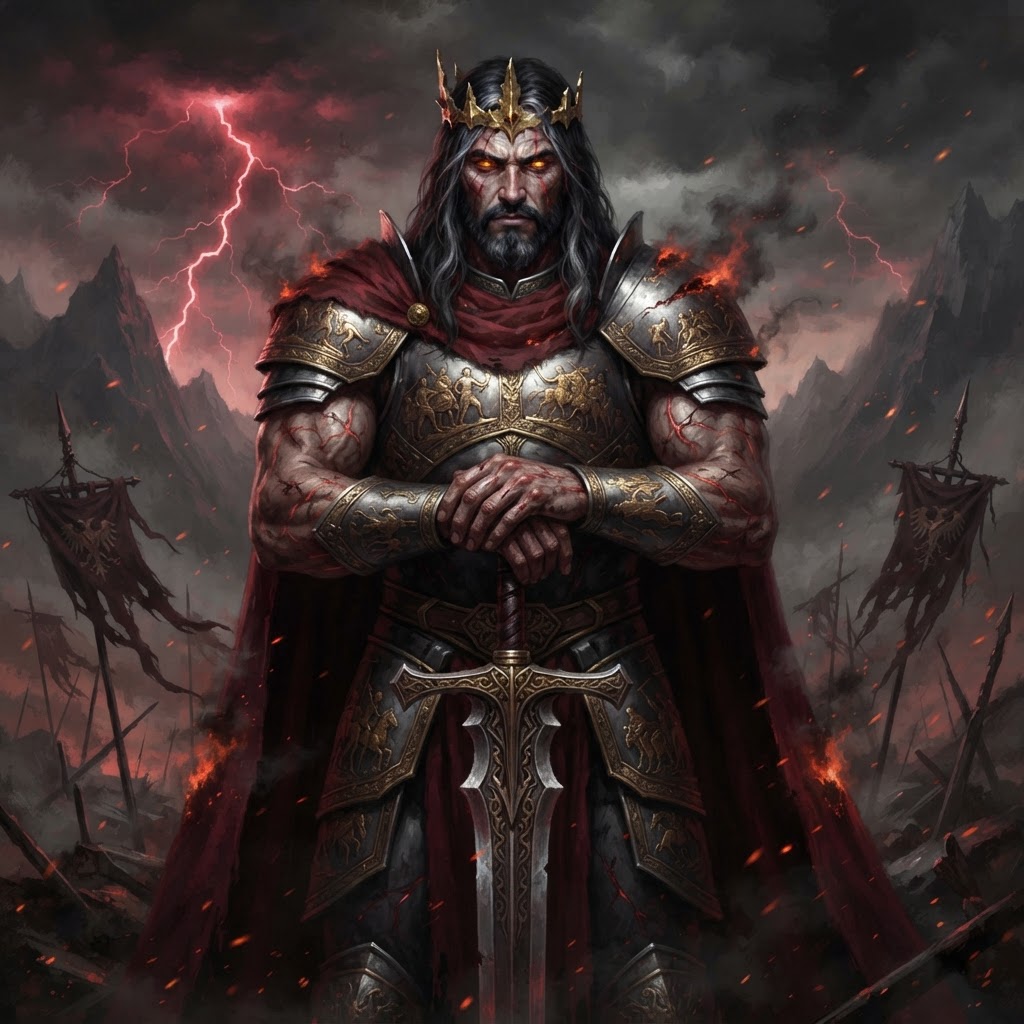
Varkhadon is an imposing deity, standing nearly nine feet tall when assuming his preferred mortal-like form.
His physique is powerful, bearing the scars of battles fought across countless ages. Unlike many gods, he refuses to heal these scars, believing that every wound is a testament to a lesson learned.
His skin carries the faint warmth of forged iron, with subtle veins of crimson light visible beneath its surface whenever his anger rises.
His hair is long and black, streaked with silver that resembles molten metal cooled beneath moonlight. His beard is neatly kept, though it becomes wild and unkempt when he manifests upon an active battlefield.
His eyes are perhaps his most unsettling feature. They burn with the color of molten gold, and those who meet his gaze often experience fleeting visions of every battle they have ever fought.
He wears armor forged from a substance known as Godiron, a divine metal said to have been drawn from the shattered weapons of fallen celestial warriors. His armor is dark silver, nearly black, with intricate gold engravings depicting ancient battles. A deep crimson cloak falls from his shoulders, its edges perpetually smoldering without ever being consumed.
Upon his brow rests a broken crown. Varkhadon deliberately shattered it after the First Divine War, declaring:
“A god who demands obedience without earning loyalty is no sovereign. He is merely a tyrant awaiting his execution.”
IV. Personality and Divine Nature
Varkhadon is neither a mindless butcher nor a benevolent guardian. He is a complicated and often contradictory god whose philosophy centers on the belief that strength is necessary, but that strength without discipline inevitably destroys itself.
- ◆Honor and discipline. Varkhadon respects warriors who stand by their convictions, even when those convictions oppose his own. A soldier who refuses an unjust command may earn his favor more readily than one who follows orders blindly.
- ◆Conquest and ambition. He does not condemn conquest. He believes kingdoms must sometimes expand, compete, and challenge one another. However, rulers who wage war merely to satisfy vanity risk earning his wrath.
- ◆Sacrifice. Of all mortal virtues, sacrifice is the one he reveres most. A warrior who knowingly faces death to protect others is considered sacred in his eyes.
- ◆Mercy. Varkhadon recognizes mercy as a form of strength, though he rarely offers it freely. He teaches that sparing a defeated enemy may require greater courage than killing them.
- ◆Rage. His anger is legendary. When truly enraged, Varkhadon abandons diplomacy and becomes a living catastrophe, capable of devastating armies and reducing fortresses to rubble.
His greatest flaw is his inability to fully understand peace. Although he recognizes its value, he fears that civilizations untouched by hardship will become complacent and vulnerable.
For this reason, some scholars believe Varkhadon quietly encourages conflict even while condemning needless bloodshed.
V. The Crimson Bastion — Divine Realm of War
Beyond the mortal planes of Lumeris lies a divine dominion known as The Crimson Bastion.
It is an immense fortress-city suspended between mountains of black iron beneath a sky perpetually illuminated by crimson lightning. Rivers of molten metal flow through its foundations, feeding enormous forges where divine weapons are created.
The Bastion contains countless halls dedicated to the memory of fallen warriors. Unlike ordinary memorials, these halls do not celebrate victory alone. They preserve the names of those who fought with courage, regardless of which side they served.
The Hall of Broken Banners
The largest chamber within the Crimson Bastion contains the banners of civilizations destroyed by war. Some belong to kingdoms forgotten by mortal history. Others bear symbols recognizable to the oldest scholars of Lumeris. Every banner represents a warning. Varkhadon visits this hall in silence, remembering the cost of every war he has witnessed.
The Eternal Crucible
Deep within the Bastion burns a forge fueled by the lingering strength of fallen celestial warriors. Here, Varkhadon's divine smiths create weapons that may eventually find their way into mortal hands. Some are gifted to champions. Others are hidden within ancient ruins, awaiting warriors worthy of wielding them.
The Fields of the Unyielding
Beyond the fortress stretch endless plains where the honored spirits of fallen warriors may train, feast, compete, and test themselves. Those who enter these fields are not forced into endless combat. They may lay down their weapons whenever they choose. For Varkhadon believes that a warrior who has earned eternal rest should never be denied it.
VI. Varkhadon's Influence Upon the Races of Lumeris
The Orcs — Children of the Iron Trial
Among the Orcish peoples of Lumeris, Varkhadon is widely revered as a patron of strength and survival. The Ashblood Orcs of Kharzug-Dur are particularly devoted to his teachings.
Their warriors believe the volcanic forges beneath their city were blessed by Varkhadon during the earliest ages of Orcish civilization.
Before entering battle, some Ashblood warriors press their weapons against heated stone and whisper:
“May my strength endure beyond my flesh.”
The Thornhide Orcs interpret his teachings differently. They regard war as a necessary defense of ancestral lands rather than a means of conquest.
The Lunari Orcs, whose traditions emphasize knowledge and celestial study, often examine Varkhadon's philosophy through the mathematics of warfare, military engineering, and strategic prediction.
The Minotaurs — The Horned Vanguard
Among the Minotaur clans, Varkhadon is known as The Great Challenger. Minotaur warriors believe that the god measures courage not through victory, but through the willingness to confront seemingly impossible odds.
Some clans conduct ritual combats in his honor, though these contests are traditionally fought without lethal intent.
Minotaur Warlords who follow Varkhadon often decorate their armor with crimson markings and broken crown symbols.
The Draksen — The Divided Flame
Varkhadon's influence among the Draksen varies considerably.
In Pyraxis, militant Fire Draksen sometimes invoke his name to justify military supremacy and the conquest of weaker civilizations. Yet scholars of Verdantreach argue that these interpretations deliberately ignore his teachings concerning sacrifice, restraint, and responsibility.
Stormbound warriors of Tempestris are fascinated by his divine power, and some have attempted to channel the destructive energies associated with his celestial battles.
The unifying Draksen Council regards his worship with caution, recognizing that his philosophy can inspire both heroic defenders and dangerous conquerors.
The Fae — The God Beyond the Courts
The Fae Courts maintain a complicated relationship with Varkhadon. During the War of Veils and the events surrounding the Sundering, many Fae warriors invoked his name, even when their rulers forbade it.
- ◆The Ember Court admires his ferocity and determination.
- ◆The Shadow Court respects his strategic cunning.
- ◆The Light Court acknowledges the nobility of sacrifice but questions his belief that conflict is necessary for growth.
- ◆The Nature Court regards him as a dangerous force that can disrupt the balance of life.
Varkhadon himself has never sworn allegiance to any Fae Court. He considers their ancient rivalries evidence of both the strength and foolishness of immortal civilizations.
VII. The Church of the Iron Covenant
The organized faith of Varkhadon is known as The Iron Covenant. Its temples are frequently constructed near military strongholds, city gates, training grounds, and ancient battlefields.
Unlike many religious orders, the Covenant does not require its followers to pursue warfare. Instead, it teaches preparedness, discipline, and responsibility.
Religious Hierarchy
| Rank | Title | Responsibilities |
|---|---|---|
| I | Ash Initiate | New followers studying the teachings of Varkhadon |
| II | Iron Disciple | Trained devotees who undertake sacred trials |
| III | Crimson Blade | Warriors entrusted with protecting temples and pilgrims |
| IV | War Chaplain | Clerics who provide spiritual guidance upon battlefields |
| V | Iron Castellan | Commanders responsible for temples and regional orders |
| VI | Blood Marshal | High-ranking leaders who oversee military religious orders |
| VII | High Sovereign | Supreme mortal representative of Varkhadon's faith |
The Seven Laws of the Iron Covenant
- ◆Never draw a blade without purpose. Violence without reason dishonors the warrior.
- ◆Strength must serve something greater than pride. Power used only for personal vanity is wasted.
- ◆Honor the fallen, regardless of allegiance. Courage is not the exclusive possession of the victorious.
- ◆Never abandon those entrusted to your protection. Loyalty is measured most clearly in adversity.
- ◆Accept the consequences of conquest. Those who seize dominion must bear responsibility for what follows.
- ◆Do not mistake cruelty for strength. A warrior who delights in suffering has surrendered to weakness.
- ◆Stand when others cannot. The highest calling of a warrior is to become the shield of those unable to defend themselves.
Not every worshipper follows these laws faithfully. Some militant sects reinterpret them to support conquest, political domination, and religious warfare. These disagreements have led to violent divisions within the Covenant itself.
VIII. Sacred Orders and Military Brotherhoods
The Crimson Vanguard
An elite military order dedicated to protecting settlements threatened by overwhelming forces. Members are trained to hold defensive positions even when retreat appears inevitable. Their defining oath is: “Behind us stand those who cannot fight. Before us stands whatever would destroy them.”
The Blackened Crown
A controversial religious faction that believes Varkhadon's true purpose is to unite all of Lumeris beneath a single military sovereign. Its followers argue that endless wars between competing kingdoms can only be ended through absolute conquest. Most traditional Covenant temples condemn their methods. However, the faction has gained influence among ambitious nobles and military leaders.
The Keepers of the Last Flame
A solemn order responsible for recovering the bodies and possessions of fallen warriors. They travel through battlefields after conflicts have ended, offering funeral rites regardless of race, nationality, or religious allegiance. Many communities regard them as sacred and grant them passage even during active wars.
The Ironbound
A secretive brotherhood whose members believe that Varkhadon's divine essence can be awakened through extraordinary feats of martial endurance. They seek ancient relics associated with the First Divine War. Rumors suggest that some members have discovered fragments of Godiron capable of altering mortal flesh.
IX. Divine Powers and Abilities
Varkhadon's power extends far beyond physical combat. As a deity of war, he commands the spiritual and metaphysical forces that surround conflict.
The Endless Legion
Varkhadon can summon spectral warriors from the honored dead. These soldiers retain their memories, combat skills, and personal identities. They cannot be compelled to fight against their deepest convictions.
Sovereign's Wrath
When Varkhadon strikes the earth with Worldrender, he unleashes a devastating wave of divine force capable of shattering fortifications and breaking entire battle formations.
The Unbroken Will
Varkhadon may grant a mortal warrior extraordinary endurance, allowing them to remain standing despite wounds that would otherwise prove fatal. The blessing fades when the warrior's sacred purpose is fulfilled.
The Eye of Conquest
Varkhadon perceives the shifting possibilities of battle. He can recognize weaknesses in formations, predict enemy movements, and reveal strategic opportunities invisible to mortal commanders.
The Final Command
Varkhadon's most feared divine ability is known as the Final Command. By speaking a single word in the ancient language of the gods, he can temporarily silence all violence across an entire battlefield.
Weapons become impossibly heavy. Spells dissolve before reaching their targets. Even the most bloodthirsty combatants find themselves unable to strike.
This power lasts only a short time, but it has ended wars and prevented the destruction of entire civilizations. Varkhadon uses it sparingly, believing that mortals must ultimately choose peace for themselves.
X. Divine Relics of Varkhadon
Worldrender — The First Blade
The legendary weapon of Varkhadon, forged from a dying star and tempered in divine blood. It is capable of damaging celestial beings and severing powerful magical enchantments. No mortal is believed capable of wielding its full power.
The Crown of the Unyielding
A fragment of Varkhadon's shattered divine crown. Those who wear it may inspire extraordinary loyalty among allies, but its influence also amplifies their desire for conquest.
Aegis of the Last Stand
A sacred shield carried by one of Varkhadon's earliest mortal champions. Its defensive power increases as its wielder protects wounded or defenseless companions.
The Horn of the Crimson March
An ancient war horn whose sound can be heard across enormous distances. Legends claim that sounding it three times can summon an army of spectral warriors from the Crimson Bastion.
XI. Divine Blessings for Lumeris Roleplay
These blessings provide optional mechanics for characters who earn Varkhadon's favor. They are designed to complement Lumeris's STA system and may be adjusted by roleplay administrators.
| Blessing | Mechanical Effect | Duration |
|---|---|---|
| Warrior's Resolve | +2 to physical attack rolls | 3 turns |
| Iron Flesh | Reduces incoming physical damage by 25% | 2 turns |
| Crimson Valor | Restores 15 HP and grants resistance to fear | 3 turns |
| Battle Instinct | +2 to defensive or evasion rolls | 3 turns |
| Last Stand | Remain at 1 HP instead of falling to 0 once | Single activation |
| Sovereign's Command | Grants up to 3 allies +1 to attack rolls | 2 turns |
| Blood of the Unyielding | Restores 5 HP at the beginning of each turn | 3 turns |
Divine limitation: A character may benefit from only one blessing of Varkhadon at a time. These effects require appropriate divine favor, class abilities, or approved religious rituals.
Divine Favor and Disfavor
Varkhadon's favor may be earned by defending a settlement against overwhelming odds, showing mercy to an honorable enemy, leading allies through desperate circumstances, or sacrificing personal ambition for the safety of others.
His disfavor may be earned through the deliberate slaughter of noncombatants, betrayal of sworn companions, desecration of the honored dead, or using his name to excuse purposeless cruelty.
A disgraced champion may seek redemption through a sacred ordeal known as The Trial of Broken Steel, in which the warrior must face a challenge without relying upon divine blessings.
XII. Worship, Festivals, and Sacred Rituals
The Day of Crimson Remembrance
Once each year, followers of Varkhadon gather to honor warriors who have died in battle. Weapons are placed upon altars, names of the fallen are spoken aloud, and crimson candles are lit throughout the night. This festival is observed by many who do not otherwise worship the God of War.
The Forging of Oaths
Before undertaking a military campaign or accepting a sacred duty, followers may perform the Forging of Oaths. A ceremonial blade is heated in a forge while the individual declares their purpose before witnesses. The blade is then cooled in water mixed with ash. Breaking an oath sworn through this ritual is considered a grave spiritual offense.
The Feast of the Unbroken
Following a major victory, worshippers traditionally host a feast in honor of both survivors and the fallen. Food is offered first to the wounded, widowed, orphaned, and displaced. Only afterward do commanders and warriors partake. This custom reflects Varkhadon's belief that the true cost of war is borne by those left behind.
XIII. The Prophecy of the Shattered Crown
Among the oldest surviving writings of the Iron Covenant is a prophecy believed to have been spoken by Varkhadon himself shortly before the Sundering.
When the Broken Moons bleed crimson,
And the banners of six courts fall,
When the children of stone and flame
Hear the ancient war drums call,
The Iron Sovereign shall rise.
Not to conquer, nor to reign,
But to stand before the darkness
That shall make all wars seem vain.
And upon the field of ending,
Where the last of kingdoms stand,
The crown shall be made whole again
By a mortal's bloodied hand.
The prophecy has generated centuries of debate. Some believe it foretells Varkhadon's return to the mortal world during a catastrophic war that will threaten all of Lumeris. Others believe the shattered crown symbolizes the eventual unification of the kingdoms under a single ruler.
The Blackened Crown faction considers this prophecy justification for its ambitions. However, the Keepers of the Last Flame interpret it differently. They believe the final battle will not be won through conquest, but through a mortal champion willing to surrender absolute power.
XV. Varkhadon's Place Among the Gods of Lumeris
Varkhadon represents a divine force that is both necessary and dangerous. He is not inherently evil, nor does he represent goodness. He embodies the reality that civilizations are shaped by conflict, sacrifice, and the choices made when peaceful solutions fail.
He may stand beside a Goddess of Light when defending innocent lives, yet oppose her when he believes her pursuit of peace leaves a kingdom defenseless.
He may respect a Goddess of Love or Sexuality for inspiring the passions that mortals are willing to protect, while regarding unchecked desire as one of the greatest causes of war.
He may even fight alongside darker deities when a greater threat endangers the existence of Lumeris itself.
Yet Varkhadon bows to no divine throne. He has watched kingdoms rise, watched empires crumble, and witnessed gods fall beneath the weight of their own arrogance. He understands that no victory is permanent. And he knows that one day, even the greatest warrior must lay down their sword.
The Iron Sovereign's Final Teaching
“You call upon me when your walls are broken.
You pray to me when your children are threatened.
You curse my name when the battlefield grows silent,
and the dead are counted.
Yet understand this, children of Lumeris.
I did not place hatred within your hearts.
I did not teach your kings to covet the lands of others.
I did not whisper vengeance into the ears of the grieving.
I am the strength you summon when all other strength has failed.
I am the blade.
You are the hand that chooses where it falls.”
— Varkhadon, the Iron Sovereign, God of War