The Centaur
Keepers of the Undying Memory
A People of Two Natures
Overview
Of all the races drawn into Lumeris through the chaos of the Luminous Veil, none arrived more completely themselves than the Centaurs. Their culture, their histories, their laws, and their songs were not stored in libraries or temples — they were stored in living minds, passed breath to breath across generations with a precision that rivals any written archive.
The Centaurs are a people of two natures in perfect balance: the power and endurance of the great plains-horse and the wit, memory, and craft of a humanoid civilization centuries deep. Neither half dominates. Both are essential. A Centaur who neglects their body grows slow in spirit. One who neglects their mind grows savage. The herd demands both.
To encounter a Centaur is to encounter the weight of history. They remember everything. They forget nothing. And they carry that knowledge across Lumeris with a pride that can feel, to shorter-lived races, like arrogance — but which is, in truth, the solemnity of a people who know what it means to lose a world and survive.
The Form of the Steppe-Born
Physical Form
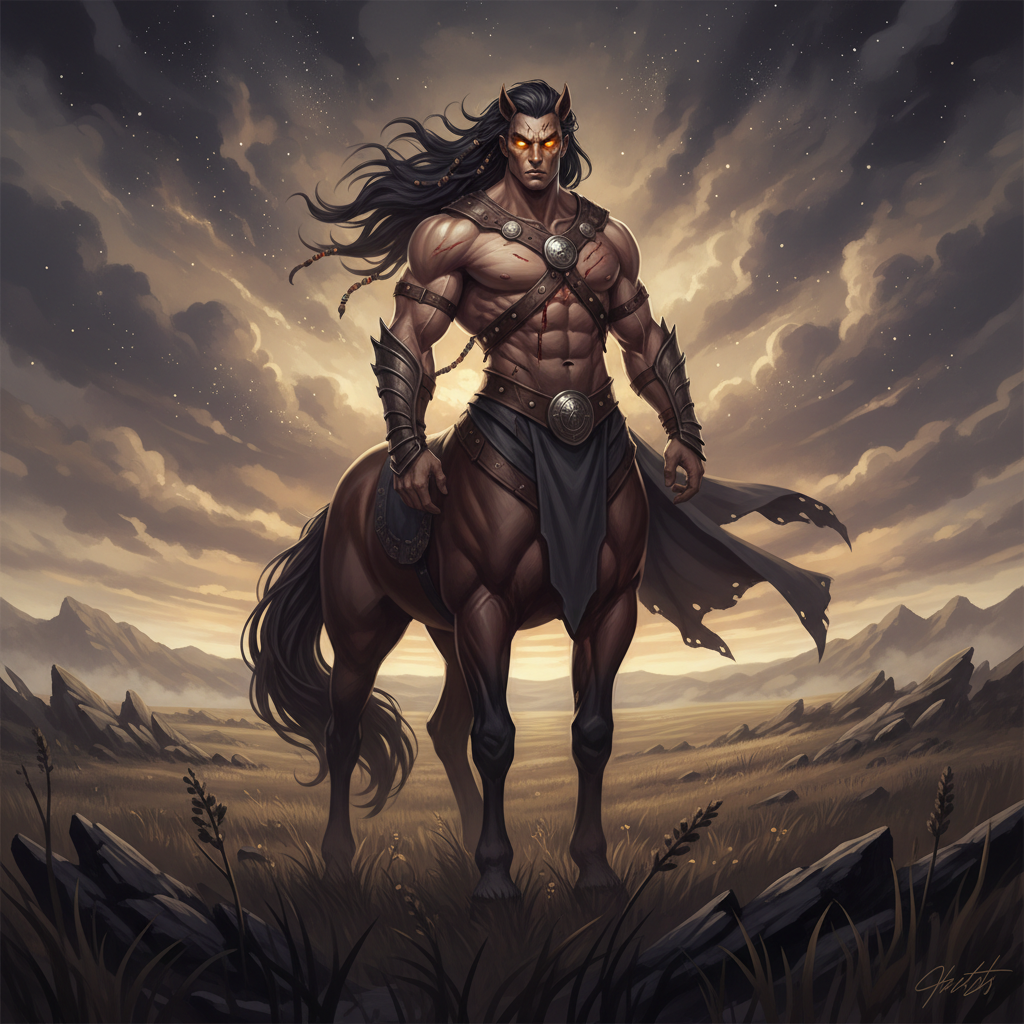
Centaurs stand between seven and nine feet tall at the shoulder, with a powerful equine lower body supporting a humanoid upper body of considerable strength. Their build is one of endurance rather than brute force — they are built to run for days, not to lift boulders — and this shows in their proportions: deep chest, long powerful hindquarters, lean upper arms, and a neck that carries the head with natural pride.
The transition between humanoid and equine halves varies by individual. Coat colors follow the same broad range as the horses of other worlds: bays, chestnuts, greys, blacks, palominos, duns, and roans are all common. Their hands are broad and powerful, capable of fine work despite their size — the finest bowyers in Lumeris are Centaurs, and the compound bows they produce are among the most coveted weapons on the continent.
- ◈Stand between seven and nine feet tall at the shoulder
- ◈Powerful equine lower body with lean humanoid upper body
- ◈Built for endurance — deep chest, long hindquarters, lean arms
- ◈Coat colors: bays, chestnuts, greys, blacks, palominos, duns, roans
- ◈Spotted blanket and leopard patterns mark distinguished lineages
- ◈Mane runs from the humanoid head down the spine, matching the coat
- ◈Large round-pupiled eyes — warm browns, ambers, deep greens
- ◈Star Speaker lineages sometimes bear pale grey or silver eyes
- ◈Broad, powerful hands capable of extraordinary fine craft
Origins of the Centaurs
The Endless Steppe
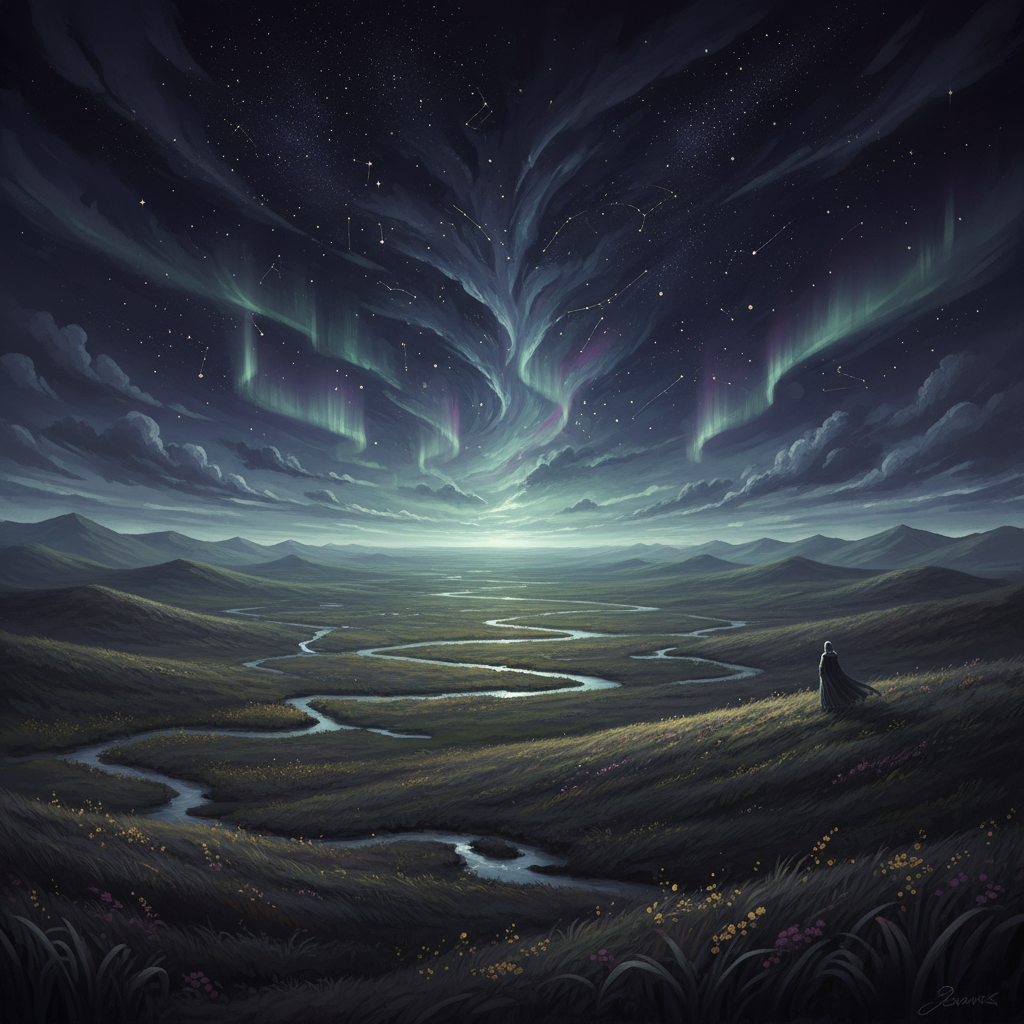
The Centaurs came from a world they called the Endless Steppe — a vast, unbroken grassland world where the horizon stretched in every direction without interruption. No mountains. No inland seas. Only rolling hills of deep grass, seasonal rivers, and a sky so large it shaped the Centaur soul.
Their civilization developed not through city-building but through movement. The herd was their city. The migration path was their road. Their architecture was temporary — seasonal camps, wooden frames, and stretched hides — because permanence was considered a trap. To stop moving was to begin dying.
What the Centaurs built instead of monuments was memory. Their Lorekeepers — elder Centaurs dedicated to the preservation of oral history — could recite thousands of years of lineage, law, mythology, and cosmology from memory alone. When the Centaurs say they keep the oldest histories among the races of Lumeris, they are not boasting. No other people arrived with their full civilizational record intact.
Their sky-priests — called Star Speakers — mapped the movements of constellations across seasons, using their observations to time migrations, predict storms, mediate disputes, and interpret omens. On the Endless Steppe, the sky was the only constant. Everything else moved. When the world began to collapse, the herds were already running toward the gathering light of the Luminous Veil.
The Age of Settlement
Arrival in Lumeris
The Centaurs did not arrive in Lumeris frightened. They arrived moving — great columns of herd-groups crossing through the Luminous Veil at full gallop, their Lorekeepers reciting the names of the Steppe aloud so the memory would not be broken by the transition.
They were among the first races to spread across the new world's interior. Where other peoples clustered near the convergence points and coastal landfall sites, the Centaur herds ran inward, scouting grasslands and river plains that no other race had yet reached. Within a generation, they had mapped more of Lumeris than any other people.
The great road networks that now connect Lumeris's settlements were first walked by Centaur scouts following instinct and the patterns of the stars. Many place names in the interior of Lumeris are corruptions of old Steppe-tongue words the Centaurs used to mark their trails.
They did not intend to shape Lumeris. They simply ran, and the world was shaped by the running.
Over the generations, certain herds established seasonal ranges — territories they moved through on predictable annual circuits. These ranges became the foundations of the five Great Herds recognized across Lumeris today.
Their Way of Life
Culture
Centaur culture is built around the herd, the Lorekeeper, and the Run. They are a people of motion — to stop moving is to begin dying. But their movement is not aimless. Every circuit follows ancestral paths, every season has its rituals, and every member of the herd has a role that exists in the memory of the Lorekeeper.
They Place Great Importance On
Centaur homes are seasonal camps — wooden frames, stretched hides, and communal fires. Even their largest settlements are built to be dismantled and moved. Permanence is considered a trap. The only things they build to last are star temples and memorial stones.
The Way of the Open Sky
Culture & Society
Centaur society is organized around three interlocking pillars: the Herd, the Lorekeeper, and the Run. These three institutions have sustained Centaur civilization across the collapse of their world and the centuries of rebuilding in Lumeris.
The Herd
The Herd is family, nation, and identity combined. A Centaur without a herd is a Centaur without context — untethered from the memory that defines who they are. When a Centaur is cast out of their herd, which happens only in cases of profound dishonor, they are considered dead to their community in every way that matters.
The Lorekeeper
The most important individual in any Centaur community. Selected young and trained for decades, their minds become precision instruments for the storage and retrieval of oral history. When a Lorekeeper dies, the entire herd observes forty days of silence, during which the successor recites the entire archive from memory to prove it was received completely.
The Run
The Centaur coming-of-age ritual — a solo journey undertaken by every young Centaur at adulthood. Each must travel alone across Lumeris and return with something that cannot be carried physically — a story, a piece of knowledge, a diplomatic contact, or a skill learned from another culture. The Run typically takes between one and three years.
A Centaur who includes your name in their oral recitation — the practice of naming you in the herd's memory rather than in casual speech — is offering you permanent recognition. You will exist in their archive long after you are gone. Among a people who believe memory is the only true immortality, this is no small gift.
The Divine
Religion & Spirits
The Sky Father
Ruler of the heavens, the stars, and the weather. The Sky Father is not worshipped in temples but in the act of looking up. Centaur prayers are spoken skyward, and their oaths are sworn beneath open sky.
The Earth Mother
Goddess of the plains, the grass, and all growing things. She is the ground beneath the hooves, the fertility of the herd, and the patience of the deep-rooted earth. Offerings of grain and first-milk are left at boundary stones.
The First Rider
Legendary ancestor who led the first herd across the Endless Steppe and through the Luminous Veil. Not a god but a cultural hero whose memory is preserved in the oldest Lorekeeper recitations. To invoke the First Rider is to invoke the duty of leadership.
The Silent Gallop
A death spirit believed to guide souls across the final plain — an endless grassland that exists beyond the world. Never seen, only felt as a distant thunder of hooves in the final moments of life.
Centaurs believe the dead join the Great Migration — an eternal herd that runs across the celestial plains, visible as the stars that trail across the night sky.
Where They Dwell
Major Centaur Cities
Gallovar
The Summer Capital
The greatest Centaur gathering ground on the central plains. Not a permanent city but a vast seasonal camp that swells to tens of thousands during the summer moot. The closest thing Centaurs have to a capital — where the Great Herds meet, trade, settle disputes, and share memory.
Known For
Common Classes
Stormhold
The Star Temple
A highland observatory-city built into the peaks of the northern mountains. Home to the Star Speakers and their ancient astronomical traditions. Its stone platforms and open-air temples are aligned to constellations that predate the crossing into Lumeris.
Known For
Common Classes
Ashenbridge
The Border Keep
A fortress-settlement on the eastern borderlands, home to the Ashbow Herd. Built from dark stone and reinforced timber, it guards the passes against incursions. Its walls are carved with the names of every Centaur who has fallen in its defense — a tradition maintained for three centuries.
Known For
Common Classes
Deepmeadow
The Grove Heart
A settled community in the deep river valleys, where the Deepmeadow Herd tends ancient groves and herbal gardens. The most physically rooted Centaur settlement — its inhabitants stay year-round, tending the land rather than ranging across it.
Known For
Common Classes
Windriver Port
The Song Wharf
The only Centaur settlement on the coast, built where a great river meets the sea. A bustling port of trade, music, and storytelling. Windriver Bards carry news and songs upriver to the interior and out to sea to distant ports — the living newspaper of the plains.
Known For
Common Classes
The Herds That Shaped a People
The Great Herds
Sunstrider Herd
The Central Plains
The largest and most visible of the Great Herds, ranging across the central grasslands in slow seasonal circuits that take two full years to complete. The most cosmopolitan herd — skilled traders, neutral arbiters, and the primary carriers of news across the interior. Their Lorekeeper carries the largest oral archive among the Great Herds.
Stormcaller Herd
The Northern Highlands
The most spiritually focused of the five, their culture built around the Star Speaker tradition — the ancient practice of reading the sky for guidance. Heavier builds with denser coats suited to highland cold. Their Star Speakers are consulted by other races seeking astronomical predictions, weather omens, and astrological counsel — a service accepted not in gold, but in story.
Ashbow Herd
The Eastern Borderlands
The warriors of the Great Herds. Settled in the contested eastern borderlands, constant conflict has forged the Ashbow into arguably the finest mounted fighting force on the continent. They carry their name from their legendary composite bows — weapons made from ash-wood, designed for power and precision at full gallop.
Deepmeadow Herd
The River Valleys and Forest Margins
The most settled of the Great Herds, moving slowly and deliberately through deep river valleys and forest margins. Their culture emphasizes connection to land rather than transit across it, producing the greatest concentration of Druid and Healer traditions among Centaur-kind. They maintain the closest relationships with the Sylvan Elves of any herd.
Windriver Herd
The River Deltas and Coastal Plains
The smallest of the Great Herds and the most unusual — the only Centaur herd with a significant maritime orientation. They produce the most Bards among Centaur-kind. A Windriver Bard is the closest thing Lumeris has to a living newspaper, carrying not only Centaur lore but the songs and histories of all coastal peoples they pass through each year.
Names of the People
Common Centaur Names
Feminine Names
Masculine Names
Neutral Names
Herd Surnames
Game Mechanics
Playable Race Traits
Starting Attributes
STR
+5
Strength
INT
+3
Intelligence
DEX
+2
Dexterity
CON
+1
Constitution
STA
+5
Stamina
WIS
+3
Wisdom
CHA
+3
Charisma
HP
+6
Health
SPL
+4
Spells
Upon creation, Centaurs are allowed +4 SPL.
This can be used to buy more levels of a single spell, up to level 5, or to buy new spells available to their race.
Racial Abilities
Age
Centaurs mature around age 18 and can live between 120 and 180 years.
Size
Large. Centaurs stand between 7 and 9 feet tall at the shoulder.
Speed
40 feet. 50 feet on open terrain.
Darkvision
Centaurs can see in dim light as if it were bright light and in darkness as if it were dim light.
Steppe Stride
Movement speed greatly increased on open terrain. Difficult terrain penalties doubled in confined spaces.
Lorebound Mind
Perfect memory for spoken information, routes, and histories. Advantage on all knowledge and navigation checks.
Sky Reader
Read weather, time, and direction from the stars and sky. Advantage on survival and outdoor navigation.
Cavalry Charge
A full-gallop charge deals bonus impact damage and may knock targets prone.
Compound Draw
Centaur bow mastery grants bonus accuracy and range on all bow attacks.
Languages
You can speak Common, Centaur, and Sylvan.
Allowed Classes
Advanced Classes
Advantages
- ▲Exceptional speed and endurance — unmatched across open terrain
- ▲Natural cavalry advantage — full gallop charge deals bonus impact damage
- ▲Oral memory — near-perfect recall of spoken information, routes, and histories
- ▲Master archers — bonus accuracy with bows, especially at range
- ▲Sky-reading — advantage on weather prediction and outdoor navigation checks
- ▲Large frame — bonus carrying capacity without movement penalty
- ▲Herd awareness — bonus to sensing nearby allies in combat
Disadvantages
- ▼Large size — cannot enter most indoor spaces without major movement penalties
- ▼Difficult terrain — forests, ruins, and confined spaces significantly reduce mobility
- ▼Cannot use most humanoid armor — requires specialized Centaur-forged equipment
- ▼High caloric need — consume significantly more food than humanoid races
- ▼Herd loyalty — may prioritize herd safety over mission objectives
- ▼Intimidating presence — social penalties with smaller races in close quarters
- ▼Poor swimmers — equine lower body makes water crossing hazardous
Centaurs Are Often…
- ✦Honorable
- ✦Patient
- ✦Deeply loyal
- ✦Generous with stories
- ✦Protective
- ✦Stoic
- ✦Honest to a fault
They May Struggle With…
- ◈Stubbornness
- ◈Pride in memory
- ◈Slow to trust outsiders
- ◈Restlessness when confined
- ◈Herd-first thinking
- ◈Holding grudges across generations
Society & Laws
Centaur law is herd-based. Disputes are judged by elders and Lorekeepers, with the oral archive serving as precedent. Spoken oaths carry more weight than written contracts. Centaur justice may involve exile from the herd — considered a living death — ritual combat, debt service, or memory-binding.
The Worst Crimes
Relationships With Other Races
Humans
Respect their adaptability but find them impatient and short-lived.
Felari
Enjoy their wandering spirit; share a love of freedom and open spaces.
Drakari
Respect their strength but find their pride excessive and their heat uncomfortable.
Fae
Fascinated by their primordial nature but cautious of Fae bargains.
Duessa
Deeply unsettled by their partial incorporeality; prefer beings they can see clearly.
Elves
Mutual respect for longevity; elves value Centaur oral memory above written records.
The Chronicle Ends… For Now
Final Lore Summary
The Centaurs are a people who carry the weight of a world that no longer exists, preserved not in stone or scroll but in the living breath of their Lorekeepers. They are runners, archers, star-readers, and memory-keepers — the oldest historians among the races of Lumeris, and the ones who know best what it costs to survive.
They are the gallop across open grass.
They are the voice that remembers every name.
They are the Keepers of the Undying Memory, still running beneath a new sky.