The Duessa
Shades — Walkers Between the Real
Walkers Between the Real
Overview
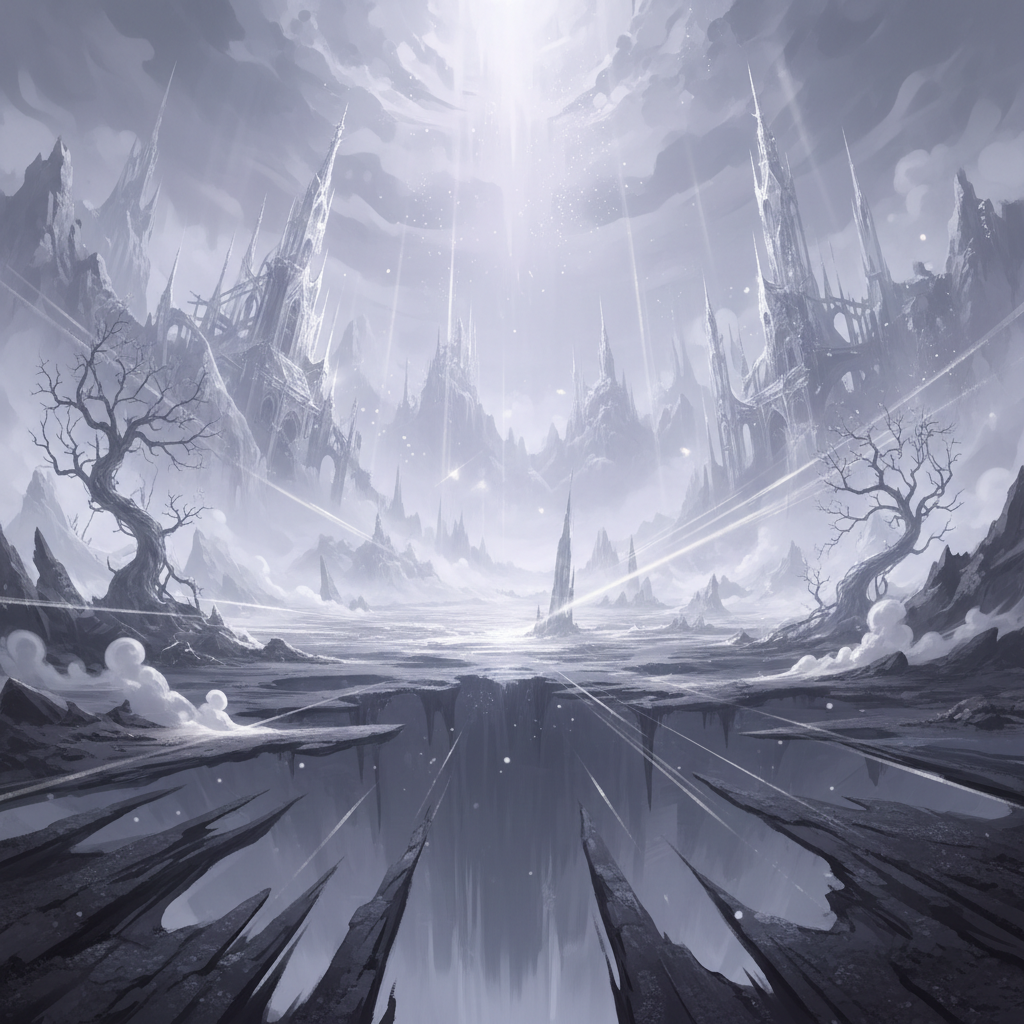
The Duessa are unlike any other race in Lumeris in the most fundamental possible way: they are not entirely here. Their world did not shatter in the Shattering of Eternities — it thinned, slowly and completely, until its physical substance became less real than the space between spaces, and its people became correspondingly less solid. The Duessa arrived in Lumeris already half-Veil, already familiar with the sensation of existing at the boundary between material and immaterial.
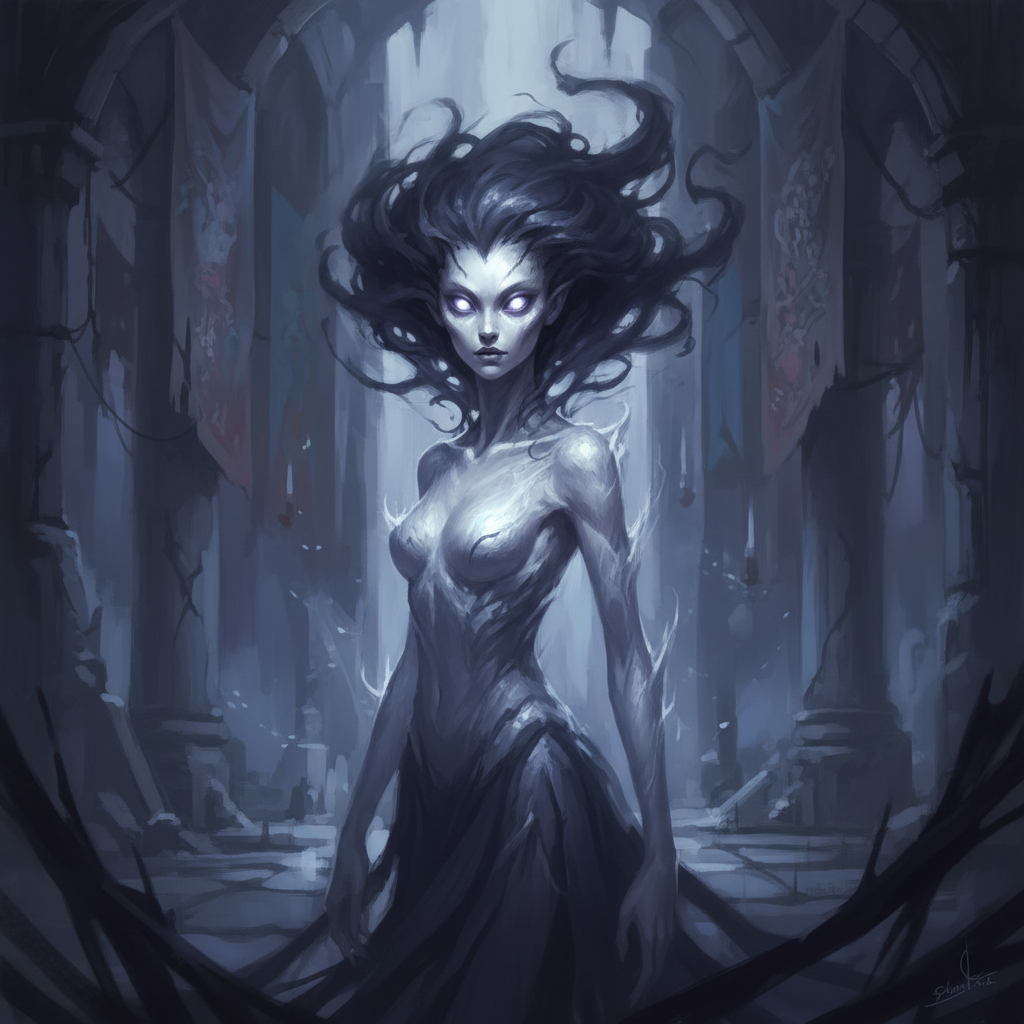
They are visible — mostly. In good light, a Duessa appears as a slightly translucent humanoid figure whose edges are subtly imprecise, whose shadow sometimes falls in directions that do not match the light source, and whose passage through a room leaves the air faintly cooler and the ambient magic faintly disturbed.
The Duessa themselves find the question of which world they truly belong to quietly interesting, like a riddle they have been working on for generations without urgency.
The Form of the Half-Real
Physical Appearance
The Duessa appear humanoid in their general proportions — two arms, two legs, an upright posture, a face with recognizable features — but the precise nature of their form resists definitive description. Their translucency varies with lighting, emotional state, and the density of ambient magic. Their coloring runs to pale and cool: ash-white skin with silver or blue-grey undertones, hair that appears to be made of darker shadow than solid substance. Their eyes are the most consistent feature — large and luminous with irises that glow faintly in shades of cold silver, pale violet, and grey-white.
Their edges are never quite crisp. The boundary between a Duessa and the air around them is a region of slight visual uncertainty. They feel slightly cold to the touch — not painfully, just consistently, regardless of ambient temperature. Their shadow, where present, does not perfectly mirror their body position. These features are sometimes the first confirmation other races have that what they assumed was a normal humanoid is, in fact, a Duessa.
- ◈Humanoid proportions — two arms, two legs, upright posture, recognizable features
- ◈Translucency varies with lighting, emotional state, and ambient magic density
- ◈In bright sunlight, roughly seventy percent solid in appearance
- ◈In darkness or magical spaces, may fade to near-invisibility while fully conscious
- ◈Coloring runs pale and cool — ash-white skin with silver or blue-grey undertones
- ◈Hair appears made of darker shadow rather than solid substance
- ◈Eyes glow faintly with interior light — cold silver, pale violet, grey-white
- ◈Edges are never quite crisp — a fraction of an inch of blurred transition
- ◈Feel slightly cold to the touch, regardless of ambient temperature
- ◈Shadow does not perfectly mirror body position
Origins of the Duessa
The Veil Between
The Veil Between was not a world with a Veil in it. It was a world that was gradually becoming Veil — a reality that had been thinning for millennia under the pressure of what Duessa scholars believe was a slow magical drain caused by proximity to a particularly dense section of the boundary between planes. Their world was positioned in a space where the membrane between existence and non-existence was under constant subtle stress.
The Duessa who lived through the thinning describe it not as catastrophe but as transformation — slow enough to adapt to, gradual enough to develop culture around. For generations they lived in a world of decreasing material solidity, developing traditions, magic, and philosophy suited to beings who existed in two states simultaneously.
When the thinning completed — when the last material substance of their world passed into pure Veil — the Duessa did not die. They drifted, semi-real in the spaces between planes, drawn by the Luminary Heart's light in the way that dim light draws a shadow toward definition. They condensed back toward materiality at the convergence point, arriving in Lumeris as partially material beings whose relationship to physical reality has never fully normalized. They do not consider this a problem to solve. They consider it a condition to inhabit.
The Age of Partial Return
Arrival in Lumeris
The Duessa did not arrive in Lumeris through a gate or a crossing. They drifted — drawn by the Luminary Heart's light in the way that dim light draws a shadow toward definition. Over decades, perhaps centuries, they condensed from pure Veil-state back toward partial materiality, gathering at the convergence point like fog forming on a cold surface.
Their arrival was not a single event but a slow accumulation. Other races noticed them gradually — a translucent figure in a marketplace, a cold spot in a room, a shadow that moved independently. By the time the Duessa were numerous enough to be recognized as a people rather than a phenomenon, they had already been present for generations.
They did not flee a catastrophe. They did not seek a new home. They simply became more real, slowly, because the light was warm enough to define them.
In Lumeris, the Duessa found a world with a boundary between material and immaterial that was stable but permeable — a condition that suited their nature perfectly. They settled into the spaces between things: the twilight quarters of cities, the liminal zones near Veil crossings, the places where reality wore thin. They have been here ever since, quietly present, quietly observing, and quietly unbothered by the question of whether they truly belong.
Their Way of Life
Culture
Duessa culture centers on what they call Threshold Philosophy — the ongoing practice of inhabiting the boundary between material and immaterial. They are deeply social within their clans but interact with other races with a patience that can feel unsettling. They do not consider their condition a problem. They consider it a position.
They Place Great Importance On
Duessa homes exist in a state of partial materiality — buildings that are solid at dawn and translucent at dusk, streets that rearrange themselves based on who is walking them. They build for comfort, not permanence, because they know better than any other race that nothing is truly solid.
The Way of the Threshold
Culture & Society
Threshold Philosophy
Duessa culture centers on what they call Threshold Philosophy — the ongoing practice of understanding the boundary between material and immaterial not as a barrier to be overcome but as a habitable space that produces unique perspective. A Duessa who has fully internalized Threshold Philosophy does not experience their partial incorporeality as a deficiency. They experience it as a position — one that allows them to observe both sides of a boundary that other beings can only see one face of.
Veil-Boundary Magic
Where other magical traditions reach toward external sources of power — elemental forces, divine connection, the Feywild — Duessa magic draws on the boundary itself. It is not a gentle practice. The boundary between real and unreal is an active thing, under constant subtle tension, and working with it directly produces effects that other traditions cannot replicate but also cannot safely approach without the conditioning of a lifetime of partial existence.
Relationships With Other Races
An affinity beyond the obvious shadow connection — both peoples operate in the spaces others prefer not to examine.
Find them scientifically fascinating. Considerable effort spent reconciling Bioveil theory with Duessa physiology, which the Duessa support with mild amusement.
Deeply interesting — two peoples who exist in modes other races do not fully understand, sharing a quiet mutual recognition.
The Divine
Religion & Spirits
The Between
Not a deity but a state of being — the boundary itself, worshipped as a concept. Duessa do not pray to the Between; they inhabit it. Their spiritual practice is the ongoing act of existing at the threshold, observing both sides without fully committing to either.
The First Shade
Legendary first Duessa to cross from pure Veil into partial materiality. Not remembered as a hero but as a pioneer — the one who proved that the boundary could be inhabited rather than merely crossed. Their true name is unknown; they are called only the First.
The Hollow Mother
A nurturing figure of the Veil — not warm in the way mortal mother-goddesses are, but present. She represents the comfort of existing between states, the relief of not having to be fully one thing. Invoked by Duessa who feel the pull of total materiality or total dissolution.
The Mirror
A mysterious entity said to exist on both sides of the boundary simultaneously. Neither god nor spirit, the Mirror is a philosophical concept used in Threshold Philosophy to describe the experience of seeing yourself from both perspectives at once. Some Duessa claim to have encountered it. They do not describe the experience.
Duessa believe that in death they undergo the Long Drift — a gradual dissolution back into the Veil, losing individual consciousness but gaining a kind of ambient awareness that persists at the boundary between worlds.
Where They Dwell
Major Duessa Cities
Greyhaven
The Twilight Quarter
Not a city of the Duessa's making but a district they have quietly claimed within a larger human settlement. A network of shadowed alleys, cellar temples, and rooftop gardens where the light never quite reaches. The Duessa here serve as information brokers, healers of unusual conditions, and quiet guardians of the boundary between the city and what lies beneath it.
Known For
Common Classes
Mistfall
The Shifting Settlement
A Duessa community that exists in a state of partial materiality — buildings that are solid at dawn and translucent at dusk, streets that rearrange themselves based on who is walking them. Visitors are advised to hire a Duessa guide. Those who do not frequently find themselves exiting through a wall they did not enter through.
Known For
Common Classes
Hollow Reach
The Border Post
A settlement built on the exact boundary where the material plane is thinnest. The Duessa here maintain the Veil anchors that keep the boundary stable — a task no other race can perform. Without Hollow Reach, the boundary between material and immaterial would fluctuate unpredictably across the region.
Known For
Common Classes
Shademarket
The Veiled Bazaar
An underground market that exists in the spaces between cellar walls. Accessible only to those who can pass through solid matter or who are guided by a Duessa. Trades in information, rare magical components, Veil-touched artifacts, and services that more respectable markets refuse to acknowledge.
Known For
Common Classes
The Gossamer Spire
The Scholar's Tower
A lone tower that appears solid from a distance but is revealed to be semi-translucent up close. Home to the Deepveil Commune's scholars, who study the nature of the boundary between planes. Its library contains knowledge gathered from both sides of the Veil — some of it written in languages that do not exist in the material world.
Known For
Common Classes
Communities of the In-Between
The Shadow Clans
Duessa society is organized around Shadow Clans — communities who share a particular attunement to a specific aspect of the boundary between material and Veil. These attunements are not chosen; they emerge in early life as the Duessa's partial incorporeality develops, shaping both capabilities and affinity.
The Pale Drift
The most commonly encountered Duessa community. Their attunement favors presence and communication: translucency is less extreme, physical interaction with material objects is more reliable, and their magic tends toward the perceptive and manipulative. They serve as the primary face of Duessa society in interactions with other races.
The Deepveil Commune
Duessa whose attunement favors deep immersion in the Veil-state: capable of near-complete incorporeality, movement through solid objects, and perception of magical phenomena invisible to any other race. They spend more time in a partial Veil-state and less in contexts requiring full material interaction. Their understanding of the space between planes is unmatched — consulted by scholars working on planar theory, convergence study, and the nature of the Luminous Veil.
The Waking Shadows
A relatively recent Duessa community — the generation born in Lumeris who have developed a more material orientation than their ancestors: more consistently present, more capable of sustained physical interaction, and more invested in relationships with other races. Whether this represents evolution, adaptation, or simply individual choice varies by individual. The older Duessa observe with interest.
Names of the People
Common Duessa Names
Feminine Names
Masculine Names
Neutral Names
Clan Surnames
Game Mechanics
Playable Race Traits
Starting Attributes
STR
+1
Strength
INT
+4
Intelligence
DEX
+5
Dexterity
CON
+1
Constitution
STA
+2
Stamina
WIS
+4
Wisdom
CHA
+3
Charisma
HP
+2
Health
SPL
+5
Spells
Upon creation, Duessa are allowed +5 SPL.
This can be used to buy more levels of a single spell, up to level 5, or to buy new spells available to their race.
Racial Abilities
Age
Duessa mature around age 16 and their lifespan is uncertain — some live a century, others simply fade back into the Veil after decades.
Size
Medium. Duessa stand between 5 and 6.5 feet tall, though their apparent size can shift with translucency.
Speed
30 feet.
Darkvision
Duessa can see in dim light and darkness as if it were bright light, and can perceive magical auras invisible to other races.
Phase Step
Once per short rest, move through a solid object up to 5 feet thick as part of movement. Cannot end movement inside solid matter.
Veil Sight
Perceive magical auras, invisible creatures, and Veil disturbances as clearly as physical objects. Magical invisibility does not work against Duessa.
Incorporeal Dodge
Once per encounter, as a reaction to being hit, become briefly incorporeal. The attack deals half damage instead of full.
Shadow Passage
In dim light or darkness, movement is completely silent and generates no visible trace. Stealth in darkness is automatic success.
Phantom Touch
Can physically interact with magical constructs, incorporeal beings, and Veil entities as if both parties were solid.
Languages
You can speak Common, Duessan, and Sylvan.
Allowed Classes
Advanced Classes
Advantages
- ▲Phase step — once per short rest, move through a solid object up to 5 feet thick as a move action
- ▲Veil sight — perceive magical auras, invisible creatures, and Veil disturbances as clearly as physical objects
- ▲Incorporeal dodge — once per encounter, cause an attack to pass partially through, reducing damage by half
- ▲Shadow passage — in dim light or darkness, movement is completely silent and generates no visible presence
- ▲Threshold magic — spells cast through the Veil boundary carry bonus damage or effect without additional components
- ▲Phantom touch — can physically interact with magical constructs, Veil entities, and incorporeal beings as if solid
- ▲Ambient awareness — detect living creatures within 30 feet through magical sense even through walls
Disadvantages
- ▼Material inconsistency — fine motor tasks requiring full physical solidity require concentration checks
- ▼Sunlight opacity — in direct sunlight, translucency is most visible; some find this uncomfortable
- ▼Iron disruption — iron disrupts the Veil-boundary attunement; iron weapons deal bonus damage
- ▼Social discomfort — passive translucency and cold touch create instinctive unease in some races
- ▼Anchoring cost — maintaining full material presence in anti-magic fields is exhausting; ability penalties apply
- ▼Limited carrying — cannot carry objects while in deep incorporeal state; must rematerialize to handle items
Duessa Are Often…
- ✦Perceptive
- ✦Philosophical
- ✦Patient
- ✦Adaptable
- ✦Honest
- ✦Observant
- ✦Comfortable with ambiguity
They May Struggle With…
- ◈Emotional detachment
- ◈Unsettling presence
- ◈Slow to act with urgency
- ◈Distrust of absolutes
- ◈Difficulty with physical intimacy
- ◈Social isolation
Society & Laws
Duessa law is clan-based and centered on threshold pacts — spoken agreements that carry the weight of the Veil itself. Disputes are judged by clan elders who exist partially in both states. Duessa justice emphasizes restoration over punishment, though exile from the clan means losing the anchoring presence that keeps a Duessa materially coherent.
The Worst Crimes
Relationships With Other Races
Humans
Find them solid and straightforward, sometimes refreshingly so.
Felari
Deeply interesting — both peoples exist between states, one of body and one of substance.
Centaurs
Find their physicality grounding and their memory impressive. The feeling is not always mutual.
Drakari
Respect their elemental power and their comfort with being unmistakably present.
Fae
Natural affinity — both peoples walk between material and immaterial, each from a different direction.
Elves
Respect their longevity but find them rigidly material in their worldview.
The Chronicle Ends… For Now
Final Lore Summary
The Duessa are walkers between the real — a people whose world thinned into Veil and who emerged as something neither fully material nor fully gone. They are spectral, perceptive, and possessed of perspectives on the nature of existence that no other race shares. They do not consider their condition a problem. They consider it a position — one that allows them to observe both sides of a boundary that other beings can only see one face of.
They are the shadow that thinks.
They are the edge that sees.
They are the Walkers Between the Real, and they have no urgency to choose a side.