The Dark Elves
Umbral Spires — Pale-skinned elves who mastered shadow and starlight in a world of endless dusk
Children of the Dying Star
The Dark Elves of Lumeris
Of all the peoples who arrived through the Luminous Veil, none carry their past more visibly than the Dark Elves. Their pale skin, their unhurried precision, their eyes that see perfectly in darkness and require adjustment in bright daylight — every physical characteristic is a record of a world that existed without meaningful sunlight for thousands of years and then lost even that.
Dark Elves are often misread by other races. Their stillness reads as threat. Their deliberate speech reads as concealment. Their formal social protocols read as arrogance. In truth, they are a people shaped by a world where carelessness was lethal — centuries of navigating political Houses, magical instabilities, and an environment where a wrong step in darkness could mean death produced a culture where nothing is done without forethought and nothing is said without consideration. This is not performance. It is survival encoded into behavior.
What they bring to Lumeris is formidable: star-reading traditions of unmatched depth, shadow magic that operates on principles no other school has replicated, intelligence networks of extraordinary precision, and a memory for astronomical and political pattern that makes their scholars invaluable to any ruler willing to ask the right questions.
Origins
The Umbral Spires
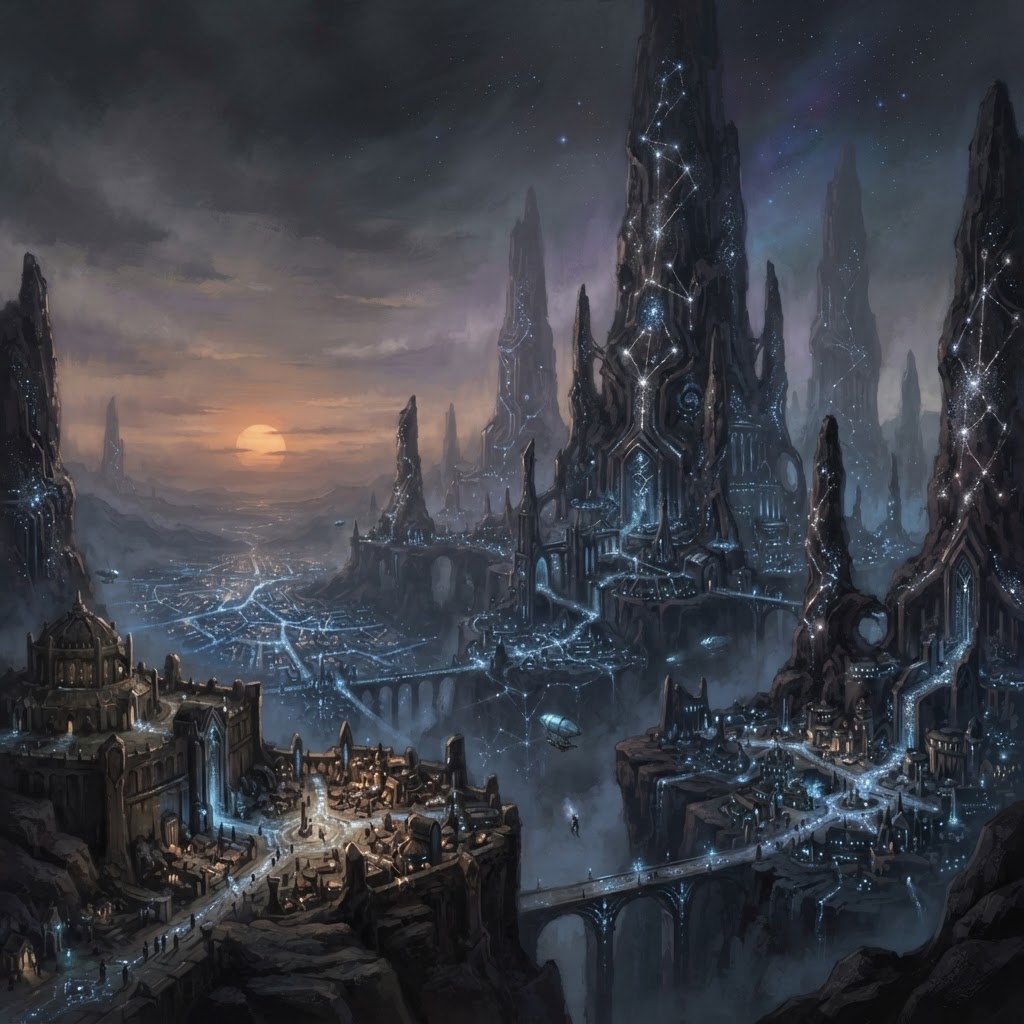
The Dark Elves came from a world in permanent twilight — a realm orbiting a dying star whose light had dimmed over millennia to a perpetual deep amber dusk. They called their world the Umbral Spires for the towers of black volcanic stone they built there, structures that absorbed starlight across the day and re-emitted it slowly across the night, creating self-illuminating cities mapped in constellations of mineral light.
Their civilization centered on two disciplines that intertwined so deeply as to become inseparable: star-reading, the practice of extracting knowledge, prophecy, and magical energy from the careful observation of stellar movement; and shadow magic, the art of manipulating the boundary between illuminated and dark space as a medium for both practical and arcane ends. Together, these traditions sustained a civilization of considerable sophistication for thousands of years.
When their star's final decline accelerated — a three-year dimming that their astronomers had predicted two generations in advance — the bioluminescent stone went dark for the first time in their history. The star-reading tradition collapsed without its observational basis. The shadow magic currents destabilized and fell silent. The Houses, built on these foundations, lost the power sources that had sustained their authority. The Dark Elves, having anticipated the collapse precisely, had prepared — not for mass migration, but for small-group dispersion. They filtered through the Luminous Veil over decades, individuals and groups navigating by the prismatic light of the Luminary Heart, the only star-equivalent visible from their dying world.
The Age of Settlement
Arrival in Lumeris
Unlike other races who arrived in great waves and established immediate territorial claims, the Dark Elves came in small groups over a long period — a migration pattern that suited their cultural disposition toward careful assessment before commitment. Their early encounters with established Lumeris inhabitants were complex. The High Elves offered cautious recognition, shared distant bloodlines creating an uneasy kinship neither people was fully comfortable with. The Humans found them unsettling. The Felari recognized their perceptiveness. The Vulpines identified them immediately as players in the same information game and began the negotiations that would make those two peoples unlikely but effective partners.
For the Dark Elves themselves, Lumeris presented a sensory challenge without precedent. Their world had no true sunlight; the sun of Lumeris was known only from historical records, and its reality was initially a physical hardship. Many spent their first years adopting nocturnal patterns, emerging after sunset and relying on star-reading techniques to manage daylight hours. Successive generations adapted more readily — Dark Elves born in Lumeris navigate daylight comfortably — but a cultural preference for evening, overcast days, and dimly lit interiors remains deeply embedded across all Houses.
Over generations, the Dark Elves established their five Great Houses in Lumeris, chose territories that offered both strategic defensibility and access to the night sky, and rebuilt the star-reading and shadow magic traditions on Lumeris's different stellar patterns. Their libraries became the continent's foremost repositories of astronomical data, and their shadow magic — now operating on a fully alive world's magical currents rather than a dying star's fading energy — proved significantly more powerful than it had been in their homeland.
The Form of the Starlight-Born
Physical Appearance
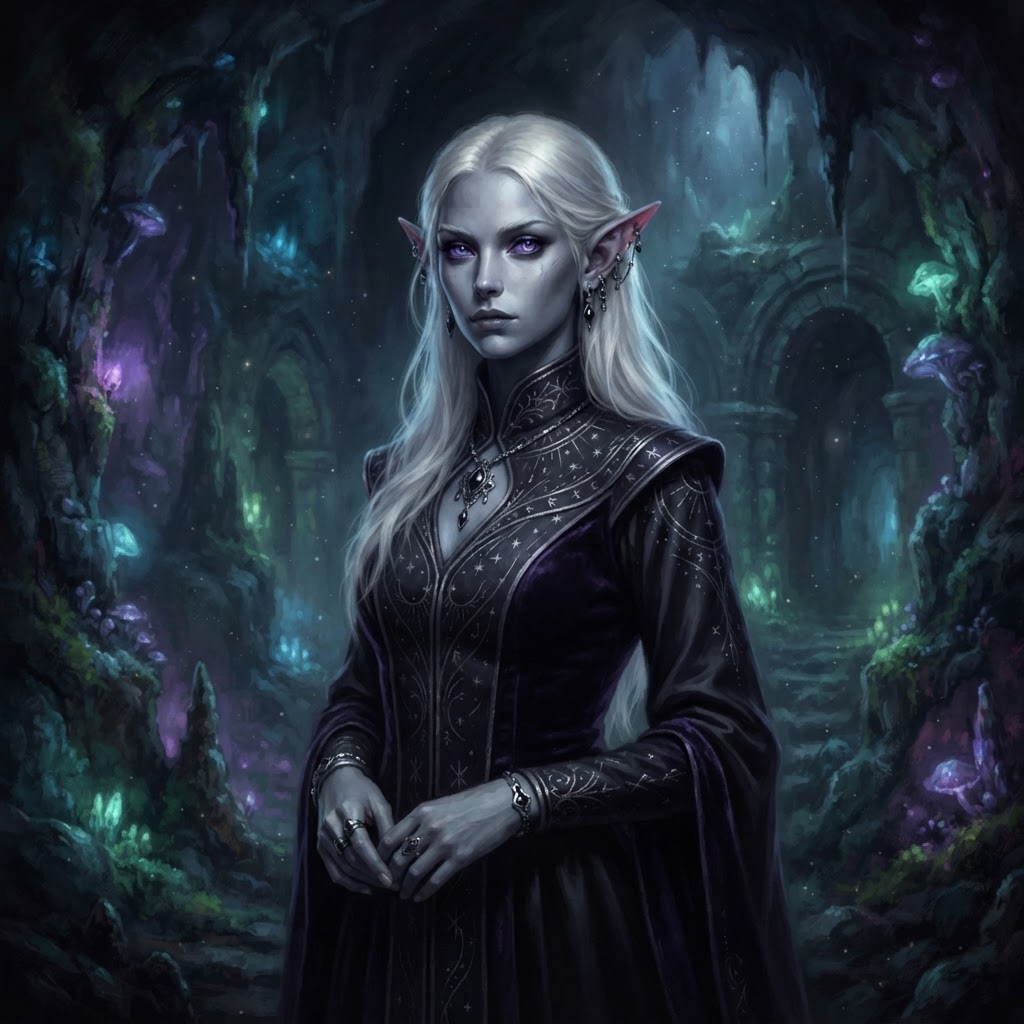
Dark Elves stand between five and a half and six and a half feet tall with the lean, efficient build characteristic of their people — not slight, but without the mass of races built for direct combat, moving with a deliberate precision that reads as graceful or threatening depending on context. Their movements do not telegraph intent the way more expressive races do, making them genuinely difficult to read in tense situations.
Their most immediately distinctive feature is their coloring — skin in shades of deep charcoal grey, ashen blue-grey, and pale silver-white, a palette entirely determined by thousands of years in a world without meaningful sunlight. Their hair runs to pure white, silver, and pale lavender, with black reserved for specific House lineages and considered a mark of distinction by those who carry it. Their eyes are large, adapted for darkness, with pupils that expand dramatically in low light — most commonly vivid violet, silver-white, or pale gold. The rarest Dark Elves have eyes that shift through the visible spectrum as light conditions change, a trait associated with exceptional aptitude for star-reading.
- ◈Stand between five and a half and six and a half feet tall with a lean, efficient build — not slight, but without the mass of races built for direct combat
- ◈Move with deliberate precision that reads as graceful or threatening depending on context — movements do not telegraph intent the way more expressive races do
- ◈Genuinely difficult to read in tense situations
- ◈Skin in shades of deep charcoal grey, ashen blue-grey, and pale silver-white — a palette entirely determined by thousands of years in a world without meaningful sunlight
- ◈Hair runs to pure white, silver, and pale lavender, with black reserved for specific House lineages and considered a mark of distinction
- ◈Eyes are large and adapted for darkness, with pupils that expand dramatically in low light — most commonly vivid violet, silver-white, or pale gold
- ◈The rarest Dark Elves have eyes that shift through the visible spectrum as light conditions change — a trait associated with exceptional aptitude for star-reading
- ◈Ears are longer than High Elf ears and more mobile, capable of rotating independently to track sound in darkness
- ◈Carry a perceptual depth that sets them measurably apart in low-light environments — superior night vision combined with a shadow-sense developed through generations of magical practice
Their ears are longer than High Elf ears and more mobile, capable of rotating independently to track sound in darkness. Combined with their superior night vision and the shadow-sense developed through generations of magical practice — an awareness of the boundary between light and shadow as a tangible presence — Dark Elves carry a perceptual depth that sets them measurably apart from other races in low-light environments.
The Way of Shadow and Star
Culture & Society
Dark Elf society is structured around three values held in careful balance: knowledge, precision, and discretion. Knowledge because their civilization was built on understanding things others could not perceive — stars, shadows, and the spaces between. Precision because their world demanded it, and carelessness in a dark environment is death. Discretion because information is power and power is only power if not everyone has it.
The shadow-walking tradition is the spiritual center of Dark Elf culture — the practice of moving through the metaphysical boundary between illuminated and dark space, which more skilled practitioners can use to travel short distances, evade detection, or strike from unexpected angles. Every Dark Elf learns the basic forms. True mastery requires decades of dedicated practice and a level of attunement to the shadow-boundary that not all possess. Those who achieve it are regarded with quiet reverence — not worship, but the acknowledgment of uncommon accomplishment.
Their relationships with other races have grown considerably warmer since the early Age of Settlement, largely through the patient work of House Duskmere and the demonstrated value of Umbraleth scholarship. The High Elves remain their most complicated relationship — shared ancestry, profoundly different civilization, and centuries of watching each other's choices from a respectful distance. The Vulpines are their most comfortable alliance — two peoples who regard information as currency and manipulation of perception as a legitimate art, with enough mutual respect not to waste effort on the game against each other.
A Dark Elf who shares unasked information with you — truly unasked, not in the context of any trade — is signaling trust of the highest order. In a culture where knowledge is the primary commodity and discretion its accompanying virtue, the gift of something not owed is the most personal gesture they know how to make.
The Houses That Shaped a People
The Five Great Houses
Dark Elf society is organized through the Noble House system — five ancient institutions that survived the fall of the Umbral Spires and reconstituted themselves in Lumeris. Each House controls specific cultural, magical, and political domains, and their collective council governs Dark Elf society through formal protocols that other races find either impressively sophisticated or bewilderingly complex. House representatives meet monthly in the Hall of Silence, a purpose-built chamber where the lighting is precisely calibrated to the twilight of the Umbral Spires as recorded in historical archives — a deliberate preservation of what was lost.
House Umbraleth
The ScholarsThe oldest of the five Houses, Umbraleth serves as the keeper of the star-reading tradition and the primary academic institution of Dark Elf society. Their archive holds the most complete astronomical records of any organization in Lumeris — data gathered across thousands of years, now being reconciled with Lumeris's different stellar patterns in an ongoing research project that will take generations to complete. Other races seeking astrological counsel, historical analysis, or prophetic interpretation come to Umbraleth scholars, who accept payment in knowledge, making their collection perpetually more comprehensive.
House Velanthar
The Shadow-WalkersIntelligence, assassination, and the practical application of shadow magic are the domain of House Velanthar — the least visible of the five Houses and the most actively present throughout Lumeris. Their agents maintain the largest intelligence network of any single organization on the continent, gathering and trading information with a precision that other intelligence operations study and struggle to replicate. They are not assassins for hire — they hold strict criteria for the contracts they accept — but when Velanthar accepts a commission, the outcome is not in doubt.
House Noctiveil
The MagesKeepers of the arcane tradition, House Noctiveil maintains the magical lineages that have been part of Dark Elf culture since before the Umbral Spires. They are the primary producers of Dark Elf Mages and the foremost researchers into shadow magic theory. Their arcane academies accept students from other races, and their approach to magical education — rigorous, precise, and deeply demanding — produces practitioners who are among the most technically accomplished on the continent.
House Duskmere
The DiplomatsTrade, external relations, and the management of how other races perceive Dark Elf society fall to House Duskmere. Their representatives are present in virtually every significant political center in Lumeris, maintaining relationships with Human courts, Centaur herds, and the commercial networks operated by Halflings and Vulpines. It is largely through Duskmere advocacy that Dark Elves have transitioned from a people viewed with wariness to a people respected as sophisticated partners.
House Shadowthorn
The WarriorsThe martial House. Shadowthorn maintains the dueling traditions that govern inter-House disputes and the warrior lineages that serve as Dark Elf society's military force. Their duelists are among the most technically skilled individual fighters in Lumeris, trained in a combat style that emphasizes precision, shadow-step positioning, and the exploitation of brief windows of vulnerability over brute force exchange.
Game Mechanics
Base Racial Stats
Starting Attributes
STR
+2
Strength
INT
+5
Intelligence
DEX
+4
Dexterity
CON
+1
Constitution
STA
+2
Stamina
WIS
+4
Wisdom
CHA
+6
Charisma
SPL
+4
Spellcraft
HP
+2
Health
Minds sharpened by starlight, reflexes by shadow — +5 INT and +4 DEX.
Dark Elves carry the perceptual depth of a people shaped by millennia of darkness and the magic it taught them.
Racial Traits
Shadow Veil
In low light or darkness, Dark Elves become significantly harder to detect. Stealth checks carry advantage.
Umbral Step
Once per encounter, step through the shadow boundary to evade an attack or move to an adjacent shadow location.
Star-Touched
Advantage on all knowledge checks relating to astronomy, divination, and magical theory.
Night Eyes
Complete night vision with no range penalty. Perception checks in darkness carry automatic advantage.
Shadow Sense
Detect the presence of living beings within shadow range through awareness of disrupted light boundaries.
Advantages
- +Perfect night vision — no penalties in complete darkness, advantage in low-light conditions
- +Shadow-step — once per encounter, briefly merge with shadow to dodge an attack or reposition
- +Star-sight — advantage on divination, pattern recognition, and astronomical knowledge checks
- +Shadow strike — bonus damage on backstabs and attacks from concealment
- +Shadow resistance — reduced damage from shadow and cold magic
- +Information network — advantage on gathering intelligence and social manipulation checks
- +Keen hearing — ears detect sounds in frequencies beyond most humanoid ranges
Disadvantages
- −Light sensitivity — prolonged direct sunlight causes discomfort and minor penalties
- −Social formality — difficulty building rapport quickly; trust is built slowly and deliberately
- −House obligation — inter-House politics may create conflicting loyalties
- −Conspicuous appearance — pale coloring makes blending into human populations difficult
- −Emotional distance — perceived as cold; penalties on empathy-based social checks
- −Fragile frame — lower physical resilience than combat-focused races
- −Oath of silence — certain House secrets create hard limits on what can be shared
Permitted Classes
Starter Classes
Advanced Classes
The Chronicle Ends… For Now
Final Lore Summary
The Dark Elves are the children of the dying star — pale-skinned elves who mastered shadow and starlight in a world of endless dusk. Born in the Umbral Spires, a civilization of black volcanic towers lit by bioluminescent mineral light, they came to Lumeris in small groups over decades when their star's final decline made their world uninhabitable. Organized across five Great Houses — scholars, shadow-walkers, mages, diplomats, and warriors — they rebuilt their twin traditions of star-reading and shadow magic on a living world's currents, finding their magic more powerful here than it had ever been at home. Precise, discreet, and carrying the perceptual depth of a people shaped by millennia of darkness, they watch, they remember, and they speak only when the words have been considered. The gift of their unasked knowledge is the trust they most rarely give.
They are the children of the dying star.
They are the shadow that remembers.
They are the Dark Elves — precise as starlight, patient as darkness, and watchful as the space between.