The Sylvan Elves
Verdant Weald — Forest elves bound in covenant with the wild
Children of the Living Canopy
The Sylvan Elves of Lumeris
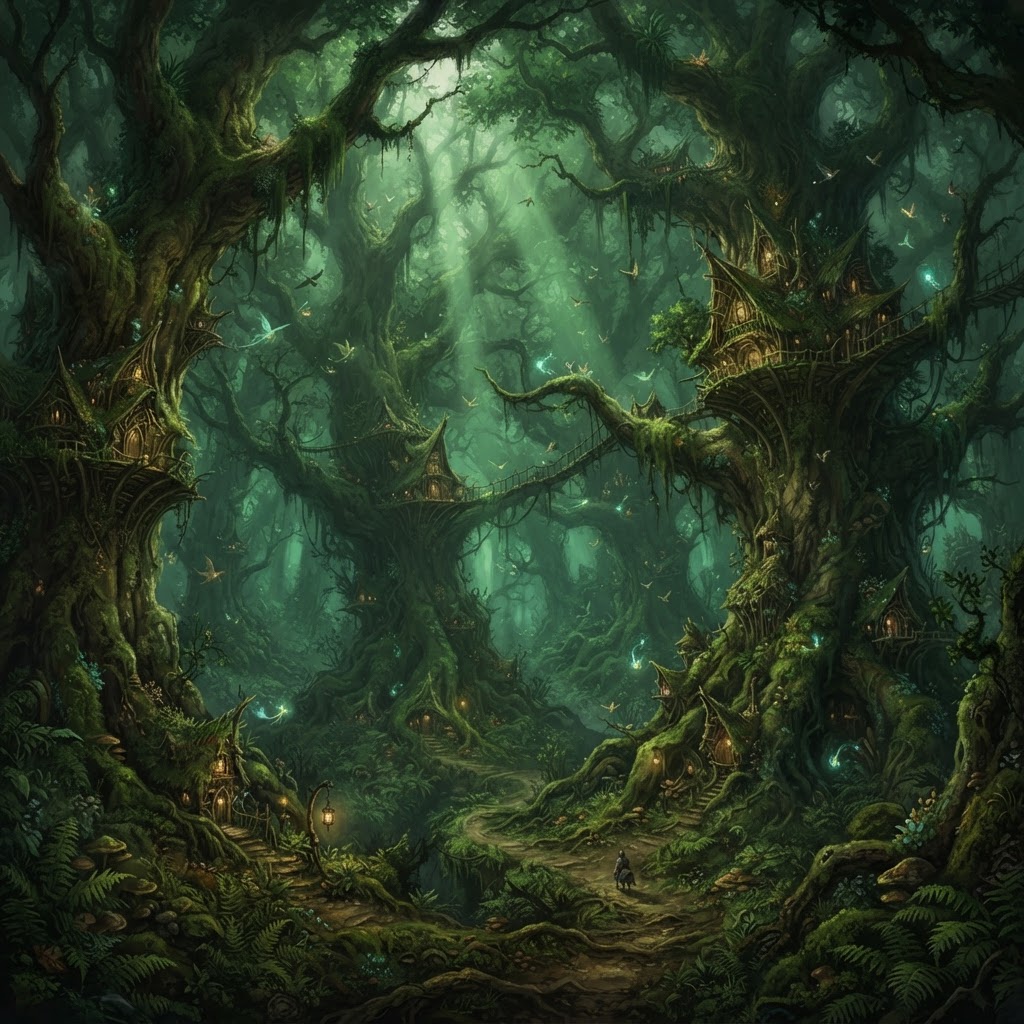
Of all the peoples who arrived through the Luminous Veil, the Sylvan Elves are the ones most completely unchanged by the crossing. Their High Elf kin rebuilt their civilization from its intellectual foundations. The Sylvan Elves simply walked into the nearest ancient forest, listened, and began again. Their covenant with the wild is not a cultural feature — it is something closer to a biological fact. Without a forest to belong to, a Sylvan Elf is not entirely present.
They are not a people of cities or armies or archives. They are a people of groves, of paths, of the particular silence that falls between two old trees when the wind stops. Their knowledge is vast but not written — it lives in the spoken tradition of the Grove Speakers, in the memory of trained animal companions, and in the Sylvan Elves' own bodies, which carry a sensitivity to the living world that no instrument made of metal or glass can replicate.
Other races encounter them most often in the deep forests that Sylvan communities have claimed and shaped since the earliest years of the Age of Arrival. They are not unwelcoming — but they observe for longer than most peoples find comfortable before they decide what kind of welcome to offer.
Origins
The Verdant Weald
The Sylvan Elves came from a world they called the Verdant Weald — a world almost entirely covered in living forest so dense that light reached the ground floor only in filtered, green-tinted shafts. Their civilization existed entirely within and among the trees: homes grown from living wood, paths maintained by trained creatures as much as by hand, communication carried across vast distances through the behavior of birds and the movement of the canopy itself.
They did not build cities. They cultivated territories — tracts of forest shaped over generations into something more than wild and less than constructed. A Sylvan territory of sufficient age is indistinguishable from deep wilderness to any outsider. To a Sylvan, it is as legible as a library.
When the Verdant Weald began to die — the canopy thinning, the forest floor going silent as the creatures that inhabited it felt the wrongness first — the Sylvan Elves did not immediately believe it. Their Covenant with the wild had always been mutual. The forest had always spoken back. When it stopped, they understood what that silence meant in a way that required no explanation.
The great trees gave up their seeds — a thing that happens naturally only once in many centuries — and the Sylvan Elves harvested them all. They came to Lumeris carrying those seeds like sacred relics, and the ancient forests that today ring certain regions of the new world were grown from those seeds in the early generations of the Age of Arrival.
The Form of the Weald-Born
Physical Appearance
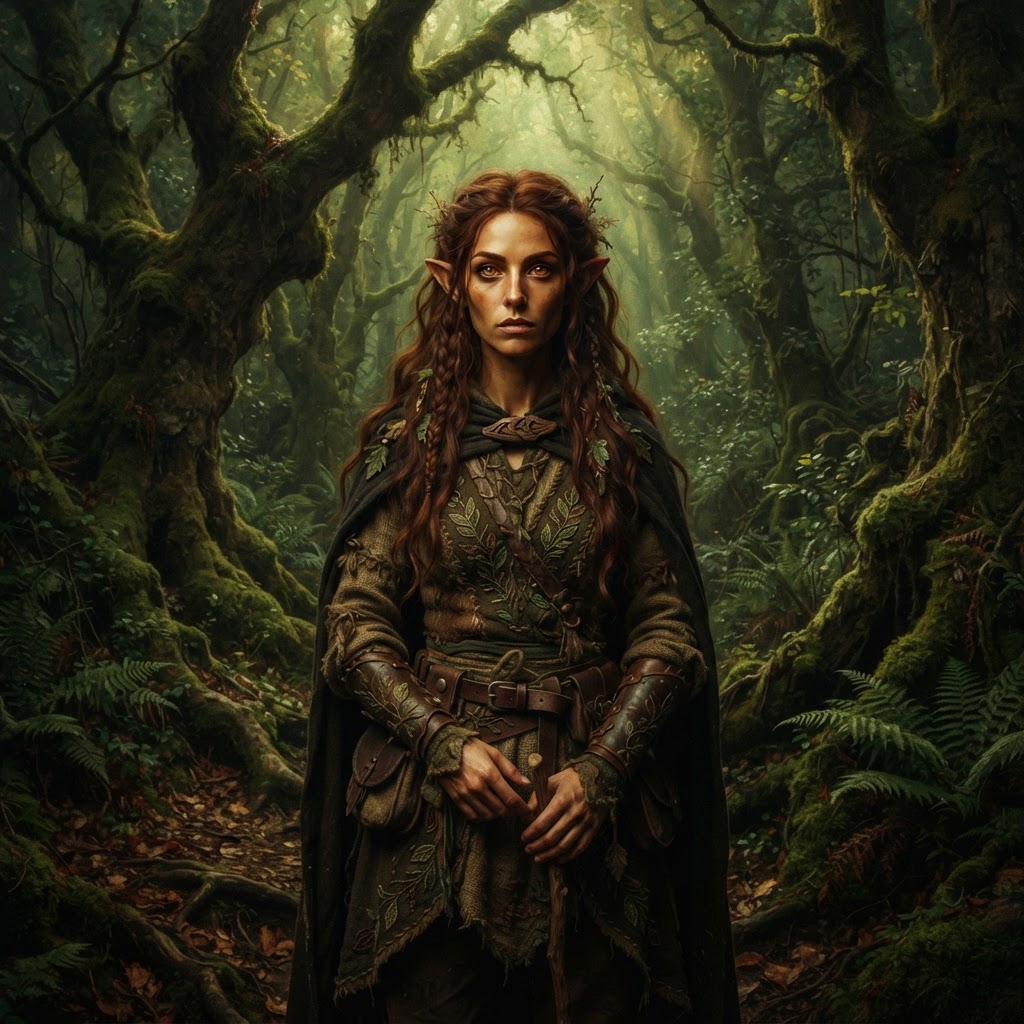
Sylvan Elves stand between five and six feet tall, lean and quick with a wiry strength that consistently surprises those who expect Elf physiques to be fragile. They are built for endurance movement through varied terrain — their joints are flexible beyond humanoid norms, their feet carry a sensitivity to surface that makes them effectively silent on most natural ground, and their grip strength for climbing far exceeds what their arm size suggests.
Their coloring reflects their woodland origins: skin tones in warm earth browns, sun-dappled golds, and muted olives that provide natural camouflage in forest settings. Their hair runs toward deep auburn, dark chestnut, and forest greens in certain rare lineages whose coloring is considered particularly attuned. Their eyes are most commonly deep amber, forest green, and warm brown — colors that seem almost designed for use in filtered light.
- ❧Stand between five and six feet tall, lean and quick with a wiry strength that consistently surprises those who expect Elf physiques to be fragile
- ❧Built for endurance movement through varied terrain — joints flexible beyond humanoid norms, feet sensitive to surface, effectively silent on most natural ground
- ❧Grip strength for climbing far exceeds what their arm size suggests
- ❧Skin tones in warm earth browns, sun-dappled golds, and muted olives that provide natural camouflage in forest settings
- ❧Hair runs toward deep auburn, dark chestnut, and forest greens in certain rare lineages whose coloring is considered particularly attuned
- ❧Eyes most commonly deep amber, forest green, and warm brown — colors that seem almost designed for use in filtered light
- ❧Ears slightly shorter than the High Elf's long taper but broader at the base — less aristocratic, more practically shaped for constant auditory work
- ❧Ears track independent of gaze, orienting toward sound instinctively in ways other races find quietly unsettling
- ❧Possess an uncanny quality of stillness — can remain absolutely motionless for periods that cross from impressive into unsettling
Their most distinctive feature, noted by every race that encounters them at length, is the quality of their stillness. A Sylvan Elf who has decided to watch something can remain absolutely motionless for periods that cross from impressive into uncanny. It is the stillness of a creature that grew up in an environment where movement attracts attention, and it remains even in Sylvan who have lived in cities for decades.
The Way of the Covenant
Culture & Society
The Covenant is the foundation of Sylvan Elf culture — not a written agreement or a religious doctrine, but a living relationship between their people and the wild world. It has no fixed terms because its terms are whatever the forest needs at any given time and whatever the Sylvan can provide. This reciprocity governs everything: how they hunt, how they build, how they travel, and how they die. Sylvan who break the Covenant — who take more than the forest can give, who harm without necessity — are not punished by their community. They are simply no longer spoken to by the forest. The Sylvan regard this as a worse outcome than any punishment their community could administer.
Their relationship with the High Elves is one of distant kinship with considerable mutual puzzlement. The High Elves built an archive; the Sylvan grew a forest. Both regard the other's approach as valid in its own terms and slightly incomprehensible in practice. Their warmest inter-racial relationships are with the Verdant Fae, who share their orientation toward living systems over constructed ones, and with the Deepmeadow Centaurs, whose slow patient movement through their forest territories echoes something the Sylvan recognize.
A Sylvan Elf who brings you into their grove — not just allows you to enter, but actively leads you in — is showing you something they do not show many. The grove is not a trophy or an attraction. It is a living record of their community across generations. Seeing it is being trusted with something that cannot be unforgotten.
Communities of the Living Forest
The Great Grove Circles
Sylvan Elf society in Lumeris is organized around Grove Circles — communities of related families centered on a cultivated forest territory. Each Circle is led by a Grove Speaker, an elder whose role combines territorial stewardship, oral history preservation, and the ongoing negotiation of the Covenant between the Circle and the living forest it tends. Grove Speakers are not elected or appointed — they emerge, recognized gradually by both community and forest over years of demonstrated attunement.
The Deepwood Circle
The Oldest Grove — Sacred Ground
The oldest established Sylvan community in Lumeris, founded in the first generation of the Age of Arrival from the original seeds of the Verdant Weald. Their forest has had centuries to develop and is considered sacred ground by Sylvan from every other Circle. No weapons are drawn within it. Disputes brought to the Deepwood Circle are resolved there permanently.
The Canopy Wardens
Rangers of the Outer Edges
Less a settled community than a distributed network of rangers and trackers who range the outer edges of Sylvan territory, maintaining the boundaries between cultivated forest and the wider world. The Wardens are the most frequently encountered Sylvan by other races — the ones most comfortable in mixed company, most capable in navigating the customs of non-Sylvan peoples.
The Seedkeepers
Custodians of the Ancient Seeds
Custodians of the original seeds brought from the Verdant Weald, who have made their life's work the cultivation of new forest territories from those ancient sources. Their Grove Speakers hold the deepest botanical and arboreal knowledge in Lumeris, and their advice is sought by Druids from every tradition when a forest ecosystem is failing.
The Stormroot Circle
Edge Territories & Highland Defenders
A Sylvan community that settled the edge territories between forest and highland, developing techniques for growing their covenant forests in difficult conditions. They are the most martial of the Sylvan communities, having defended their territories against encroachment more often than others. Their archers are considered among the finest in Lumeris.
Game Mechanics
Base Racial Stats
Starting Attributes
STR
+2
Strength
INT
+3
Intelligence
DEX
+5
Dexterity
CON
+2
Constitution
STA
+2
Stamina
WIS
+5
Wisdom
CHA
+4
Charisma
SPL
+3
Spellcraft
HP
+3
Health
Born of the forest, built for it — +5 DEX and +4 CHA.
Sylvan Elves carry endurance and agility that no constructed training can replicate — the body of a people shaped by the living world.
Racial Traits
Forest Step
Movement through natural terrain is completely silent and leaves no tracks. Stealth checks in forests are automatic successes.
Living Arrow
Ranged attacks in forest or natural terrain carry advantage. Effective range extended by one range band.
Grove Bond
Once per day, commune with plant life to learn what has passed through an area within the last day.
Canopy Sight
Cannot be surprised in forested terrain. Full awareness of all movement within 60 feet while in natural environments.
Beast Tongue
Communicate basic intent and receive impressions from non-magical animals. Animals will not attack you without magical compulsion.
Advantages
- +Forest step — movement through natural terrain generates no sound and leaves no tracks
- +Living arrow — ranged attacks in forest terrain carry advantage and extended effective range
- +Grove bond — commune with plant life to gather information about recent events in an area
- +Canopy sight — full situational awareness in woodland environments; cannot be surprised in forests
- +Covenant healing — once per long rest, draw from the forest to regain health equal to level + CON
- +Beast tongue — communicate intent and receive impressions from non-magical animals
- +Silent patience — advantage on all stealth and ambush checks in natural environments
Disadvantages
- −Urban displacement — penalties to navigation and social checks in dense cities or wholly artificial environments
- −Covenant bound — cannot harm forests or wildlife carelessly without social consequence within their community
- −Light dependence — arcane ability slightly reduced in underground or fully enclosed spaces
- −Fragile frame — lower resilience than combat-built races
- −Slow trust — warmth to outsiders is earned gradually; initial encounters carry social penalties
- −Distance from High Elf institutions — not recognized by Lorewright Courts; no access to High Elf political capital
Permitted Classes
Starter Classes
Advanced Classes
The Chronicle Ends… For Now
Final Lore Summary
The Sylvan Elves are the children of the living canopy — forest elves bound in covenant with the wild, unchanged by the crossing that reshaped every other people. Born in the Verdant Weald, a world of infinite forest, they came to Lumeris carrying the seeds of their dying home and grew new ancient forests from them in the first years of the Age of Arrival. Organized across four Great Grove Circles, led by elders who are recognized by forest as much as by community, they carry knowledge that lives in spoken tradition, animal memory, and their own forest-shaped bodies. Without a forest, they are not entirely present. Within one, they are the silence between the trees, the arrow that never misses, and the stillness that watches.
They are the children of the living canopy.
They are the covenant that does not break.
They are the Sylvan Elves — patient as the forest, silent as the space between trees, and bound to the wild that gave them form.