The Elysian
Heralds of the Eternal Light
Heralds of the Eternal Light
Overview
The Elysian are a race of celestial-blooded humanoids whose most unmistakable features — great feathered wings, an inner luminosity that bleeds through the skin in moments of strong emotion, and a bearing that makes even the tallest races feel somehow shorter — announce their origin before a word is spoken. They are not angels, though other peoples have called them such since the Age of Arrival. The Elysian have never been able to fully correct the impression, partly because they lack the vocabulary to describe what they are in terms that shorter-lived races find satisfying.
They come from a realm that had no single name — their own language uses a phrase that translates roughly as the place that was always bright. In that realm, the concept of darkness was theoretical. Shadows existed as aesthetic curiosities, not threats. Night had never occurred in their history. The Elysian who arrived in Lumeris, with its deep purple skies and its comfortable relationship with dark, spent their first generation simply learning what it felt like to stand in the absence of light and not be afraid.
They are not perfect beings. The legends of other races imagine them as incorruptible, wrathful, or blindly obedient to divine will. The Elysian find these projections both flattering and exhausting. They experience pride, grief, jealousy, longing, and error just as any mortal people does. What they do carry is a particular orientation toward purpose — the deep cultural conviction that a life without service to something larger than itself is a life half-lived.
The Form of the Light-Born
Physical Appearance
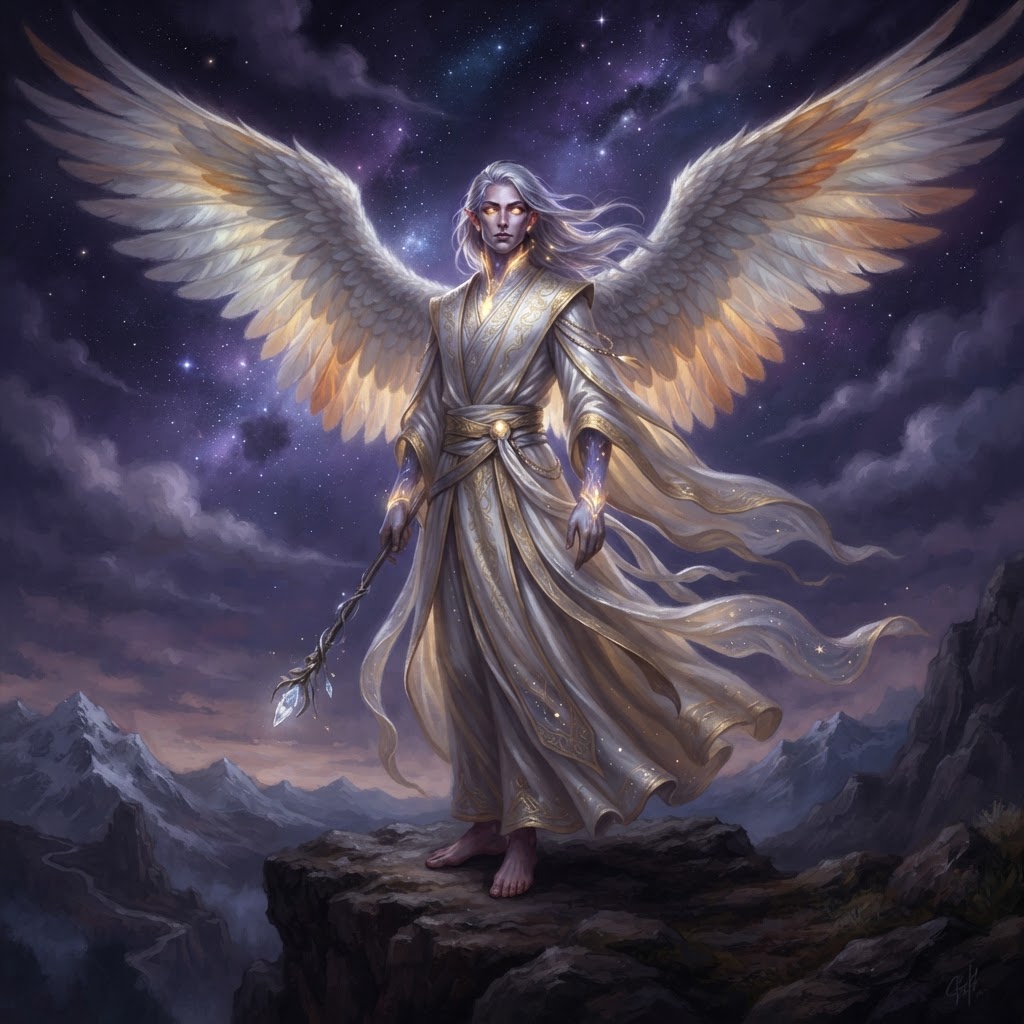
Elysian are tall — most stand between six and seven feet — with lean, precise builds that reflect generations of aerial evolution. Their bone structure is finely made: high cheekbones, a sharp jaw, large eyes with exceptional range of expression, and a quality of stillness in their faces at rest that other races often mistake for coldness before they see an Elysian laugh.
Their wings are the defining physical feature — spanning twelve to eighteen feet when fully extended, feathered in colors that reflect their spiritual lineage. The common wing shades include white, ivory, cream, silver, and pale gold, with some lineages producing wings in softer colors: the faintest blush of rose, the lightest wash of blue, feathers that shade to warm amber near the primary tips. Wing patterns — barring, spotting, tipping in contrasting tones — are a primary identifier of family lineage, and Elysian can read an individual's ancestry in their wing markings as precisely as a written genealogy.
The inner luminosity — the bioluminescent quality that gives the Elysian their otherworldly glow — manifests differently by individual and emotional state. At rest, it is subtle: a warmth visible just beneath the skin at temples, throat, and wrists, like candlelight through fine cloth. Under strong emotion or during the use of light-aligned magic, it intensifies dramatically — the skin brightening, the eyes filling with radiance, the feathers along the leading edge of the wings illuminating from root to tip in a display that other races describe as genuinely breathtaking and occasionally terrifying.
Their hair tends toward pale tones — white, silver, platinum, and very light gold — with a natural luminosity that makes it appear to catch light even in dim conditions. Their eyes are their most striking individual feature: large, luminous, and commonly gold, silver, pale blue, or white, with irises that seem to contain a gentle inner fire. Elysian who have spent significant time in darkness develop a faint ring of contrast around their irises — a marker other Elysian read as a sign of spiritual broadening.
- ◈Tall — most stand between six and seven feet with lean, precise builds
- ◈Great feathered wings spanning twelve to eighteen feet when fully extended
- ◈Wing shades: white, ivory, cream, silver, pale gold, with rarer rose, blue, and amber tints
- ◈Wing patterns — barring, spotting, tipping — identify family lineage as precisely as written genealogy
- ◈Inner luminosity visible at temples, throat, and wrists — intensifies dramatically with emotion
- ◈Hair tends toward pale tones — white, silver, platinum, very light gold — with natural luminosity
- ◈Large, luminous eyes — gold, silver, pale blue, or white — with irises containing a gentle inner fire
- ◈Time in darkness develops a faint iris ring — a marker of spiritual broadening
- ◈Fine bone structure: high cheekbones, sharp jaw, exceptional range of expression
- ◈Movement is precise and spatially aware — a product of aerial evolution, not supernatural
Origins of the Elysian
The Luminant Expanse
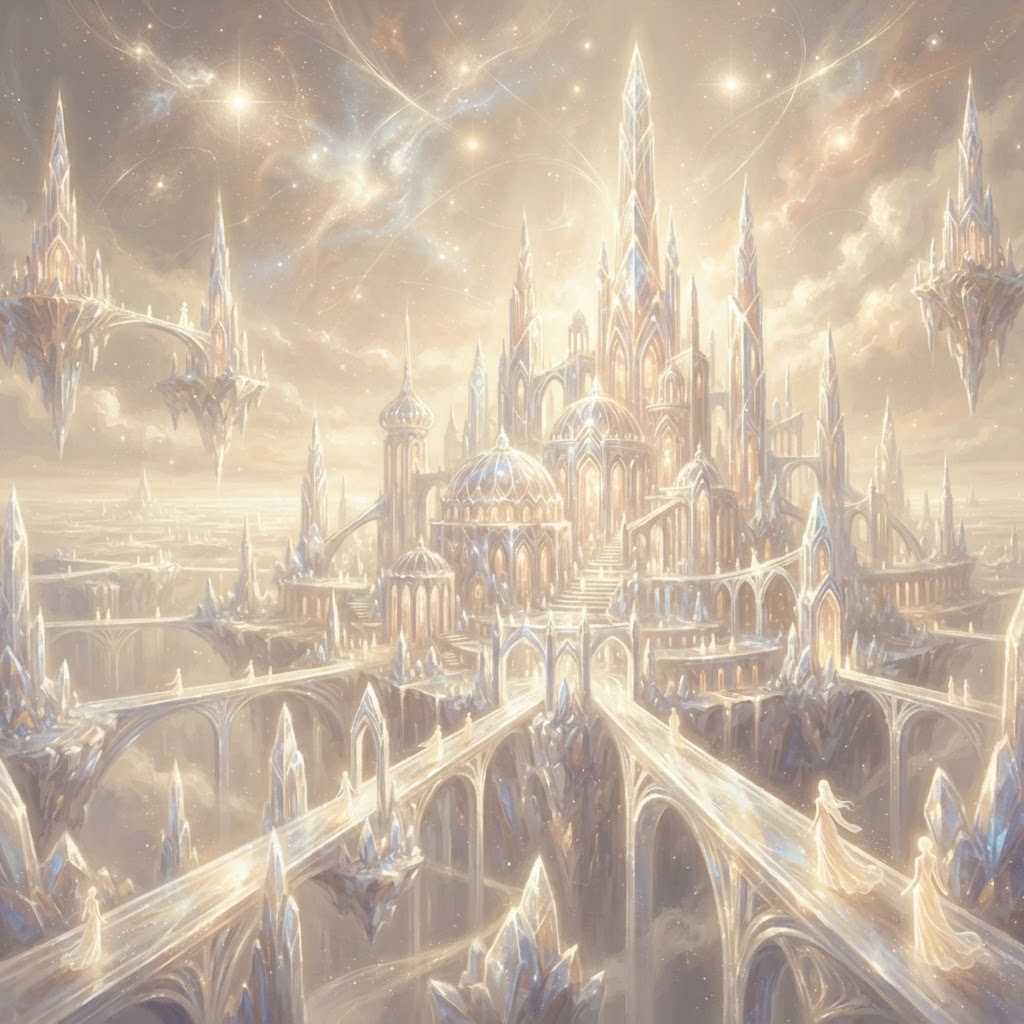
The world the Elysian came from was called, in their oldest records, Auraveil — a name that their scholars believe translates most accurately as the Shining Membrane. It was a realm of perpetual radiance: not the hard brilliance of a midday sun, but a diffuse, sourceless light that saturated everything. No shadows fell in Auraveil. Surfaces did not distinguish between lit and unlit sides. The sky was a constant warm silver-gold, and the stars — though they existed — were visible as subtle brightnesses within the light rather than points against darkness.
In this world, the Elysian built a civilization oriented entirely around the manipulation and study of light itself. Their architecture used refraction rather than structure — buildings shaped to direct, split, and concentrate the ambient radiance into patterns of meaning. Their language evolved a vocabulary for types and qualities of light that has no equivalent in any other tongue. Their spiritual practice centered on what they called the Luminant Covenant — the belief that all living things are temporary concentrations of light that the cosmos loans into physical form, and that a well-lived life returns that light to the world enriched.
Their wings emerged over millennia as a natural extension of this philosophy. In a world where movement through light-saturated air carried spiritual significance, flight was not merely practical — it was sacred. Elysian who could not fly were regarded with profound compassion, the way other peoples regard those born without a sense others take for granted. Wing shape, span, and feather quality became the primary marker of social lineage, and the art of wing-care developed into a discipline as complex as medicine.
When the Shattering of Eternities reached Auraveil, it manifested differently than in most worlds. There was no explosion or collapse. Auraveil simply began to go dark — not violently, but inexorably, the sourceless light dimming like embers cooling over a generation. The Elysian understood what was happening before most races recognized the signs. Their scholars of light had spent centuries theorizing about what happened to a world from which light withdrew. When it began, they were perhaps the most prepared people in the multiverse to face it with clarity rather than panic.
Arrival in Lumeris
The Dimming and the Descent
Unlike many races who arrived in Lumeris disoriented and scrambling for territory, the Elysian arrived with unusual calm. The dimming of Auraveil had been gradual enough that they had prepared — archiving their civilization's accumulated knowledge of light, carrying their sacred instruments, and establishing a migration order that placed their Luminants (the spiritual scholars) at the center of each group, protected by those whose wings were strongest.
Their first act in Lumeris was not to claim territory or seek allies. It was to be still. The Elysian spent their first months simply observing their new world — cataloguing its light sources, mapping how shadows moved across surfaces, documenting the behavior of fire and moonlight and bioluminescence. Other races found this behavior deeply alien. The Centaur scouts who first made contact reported that the Elysian seemed to be studying the darkness more carefully than anything else.
They were. For a people who had never experienced night, the discovery that darkness could be beautiful rather than merely absent was a genuine revelation — one that many Elysian describe as the most spiritually significant experience of their people's history. The encounter with moonlight in particular became a foundational cultural moment: a Luminant named Aevris is credited in their oral tradition with the insight that Lumeris's darkness was not the death of light but a different form of it, and that Auraveil's perpetual brightness had made their people incapable of seeing half of what light actually was.
This insight transformed the Elysian in Lumeris. They did not attempt to recreate Auraveil.
They became students of a world that contained what their homeland never had, and the encounter with shadow made them more complete than the light ever had. The Elysian who gather the last light of Auraveil and carried it through the convergence did not mourn what was lost — they understood that what they carried was not the light of a dead world but a seed that had needed darkness to germinate.
Their Way of Life
Culture
Elysian culture is organized around the Luminant Covenant — the belief that existence is borrowed radiance that carries an obligation. What that obligation means in practice is the central question their society has spent its history debating, and the diversity of answers has produced the four Orders, countless philosophical schools, and the occasional schism that other races would call a civil war but that the Elysian prefer to describe as a sustained disagreement conducted at volume.
They Place Great Importance On
They are a people of extremely long memory and considerable longevity — most Elysian live between two and four centuries — which means their culture moves slowly and takes its commitments seriously. An Elysian who makes a promise considers it binding in ways that shorter-lived races often find difficult to calibrate. They do not make casual commitments. They also do not forget a debt, a kindness, or a betrayal.
The Way of the Shining Purpose
Culture & Society
Elysian culture is organized around the Luminant Covenant — the belief that existence is borrowed radiance that carries an obligation. What that obligation means in practice is the central question their society has spent its history debating, and the diversity of answers has produced the four Orders, countless philosophical schools, and the occasional schism.
The Luminant Covenant
The central belief of Elysian civilization: that all living things are temporary concentrations of light that the cosmos loans into physical form, and that a well-lived life returns that light to the world enriched. What 'enriched' means is the subject of millennia of philosophical debate. The four Orders each represent a different answer.
Long Memory & Binding Promises
Elysian live between two and four centuries, and their culture moves accordingly. An Elysian who makes a promise considers it binding in ways that shorter-lived races find difficult to calibrate. They do not make casual commitments. They also do not forget a debt, a kindness, or a betrayal. Other peoples who deal with Elysian consistently report that the experience improves dramatically once they understand this and adjust their approach accordingly.
Choral Flight-Music
Music is the art the Elysian regard most highly — specifically choral music produced by large groups in flight, whose harmonics are shaped by the singers' movements through air. Their concerts, when they choose to share them with other races, are described by all who have witnessed them as the most affecting performances Lumeris has produced. The Elysian are characteristically modest about this compliment, noting that the music sounds considerably better when you can fly.
Vertical Architecture
Their communities are architecturally elevated — built into clifftops, canyon walls, and mountain faces at altitudes that require either flight or significant climbing to reach. Non-Elysian visitors are welcomed and accommodated with care, but the physical inaccessibility of their settlements is not accidental. The Elysian value vertical space with the instinct of a people whose first response to any situation is to gain altitude.
An Elysian who includes you in a promise is offering you something that will outlive your grandchildren. Among a people who measure commitment in centuries, a spoken word carries the weight of stone.
The Divine
Religion & Spirits
The Luminant Covenant
Not a deity but the central spiritual framework of Elysian civilization — the belief that all living things are temporary concentrations of light loaned into physical form by the cosmos, and that a well-lived life returns that light enriched. It is not worshipped; it is inhabited. Every Elysian act is, in theory, an expression of it.
Aevris the Light-Bearer
The Luminant credited with the foundational insight that Lumeris's darkness was not the death of light but a different form of it. Not a goddess but a historical figure whose words transformed Elysian civilization. Her name is spoken at dawn rituals and at the conclusion of philosophical debates, as a kind of benediction.
The First Radiance
The primordial light from which all things emerged — not a being but a state, the original brightness that preceded form. Elysian cosmology holds that the First Radiance still exists within all living things as the borrowed light of the Covenant. To study light is to study the First Radiance's echo.
The Dimming
Not a spirit but a transformative event revered as a spiritual awakening. The slow darkening of Auraveil is regarded not as a catastrophe but as a necessary revelation — the moment that taught the Elysian that light without shadow is incomplete. The Dimming is invoked at funerals and at the initiation of Veilwards.
Elysian believe that in death, their borrowed light returns to the cosmos — not diminished but enriched by the life it lived. The glow that fades from an Elysian's skin at the end is said to join the starlight, brighter than it began.
Where They Dwell
Major Elysian Cities
Aetherspire
The Clifftop Citadel
The greatest Elysian settlement, built into the sheer face of a mountain that rises above the cloud line. Its towers and bridges of pale stone catch the first light of dawn and the last of dusk. Home to the Council of Orders, where representatives of all four gather to deliberate. Non-Elysian visitors are welcomed via a carved switchback road that takes most of a day to climb.
Known For
Common Classes
Lumengarde
The Canyon Archive
A settlement built into the walls of a vast canyon, where the Elysian maintain the archives of Auraveil. Crystalline tablets of refracted light store knowledge in patterns no other race can read. The Luminants who tend the archive are among the oldest Elysian in Lumeris, and their counsel is sought by scholars of every race.
Known For
Common Classes
Dawnreach
The Bridge Between Worlds
The primary settlement of the Dawnwalkers, built lower than most Elysian communities — accessible, open, and designed to welcome non-Elysian visitors. Its markets, schools, and diplomatic halls are the primary point of contact between Elysian civilization and the broader world. More non-Elysian live here than in any other Elysian settlement.
Known For
Common Classes
Veil's Edge
The Twilight Keep
The rarest and least understood Elysian settlement, perched at the boundary where light fails entirely. Home to the Veilwards, who study the spaces between light and shadow. Its architecture uses shadow as deliberately as other cities use stone. Other Elysian visit rarely. Other races frequently mistake its inhabitants for something else entirely.
Known For
Common Classes
The Amber Heights
The Warrior's Roost
The fortress-city of the Radiants, built on a high plateau where the wind never stops. Its training grounds produce the finest light-based combatants in Lumeris. The Radiants who dwell here serve as protectors of Elysian communities and, increasingly, as defenders of non-Elysian peoples who have earned the Order's regard.
Known For
Common Classes
The Pillars of Elysian Society
The Celestial Orders
Elysian society is organized around four Orders, each representing a different orientation toward the Luminant Covenant. These are not castes — an Elysian may shift Orders across their lifetime, and the choice is regarded as a spiritual declaration rather than an administrative category.
The Luminants
The scholars and spiritual leaders of Elysian society. They maintain the archives of Auraveil and continue its tradition of light-study in Lumeris. Primary keepers of the Luminant Covenant and interpreters of its application in a world their philosophy was not originally designed for. Other races consult them as healers, oracles, and sources of historical knowledge.
The Radiants
Warriors and guardians whose light-based combat techniques were developed in Lumeris rather than Auraveil. They serve as protectors of Elysian communities and, increasingly, as defenders of non-Elysian peoples who have earned the Order's regard. Their fighting style emphasizes blinding light bursts, precise aerial strikes, and full effectiveness in any light condition — darkness included.
The Dawnwalkers
The Elysian who most fully embraced the lesson of Aevris and chose to learn darkness rather than avoid it. Diplomats, explorers, and scholars of the non-Elysian world. They spend years living among other races, learning their languages and customs, serving as the primary bridge between Elysian communities and the broader world. The most commonly encountered Elysian, and the most likely to form lasting bonds with non-Elysian companions.
The Veilwards
The rarest and least understood of the four Orders. They study the boundary between light and what lies beyond it — a practice that emerged from Elysian encounters with the Duessa and the Luminary Veil itself. They work with shadow magic, twilight attunement, and the spaces where light fails entirely. Other Elysian regard them with a mixture of respect and discomfort. Other races frequently mistake them for fallen Elysian, which the Veilwards find both reductive and mildly amusing.
Names of the People
Common Elysian Names
Feminine Names
Masculine Names
Neutral Names
Order Surnames
Game Mechanics
Playable Race Traits
Starting Attributes
STR
+2
Strength
INT
+5
Intelligence
DEX
+3
Dexterity
CON
+2
Constitution
STA
+3
Stamina
WIS
+5
Wisdom
CHA
+5
Charisma
HP
+6
Health
SPL
+6
Spells
Upon creation, Elysian are allowed +6 SPL.
This can be used to buy more levels of a single spell, up to level 5, or to buy new spells available to the race. Elysian who choose the Luminant or Veilward Order receive an additional +1 SPL.
Racial Abilities
Age
Elysian mature around age 30 and live between two and four centuries.
Size
Medium. Elysian stand between 6 and 7 feet tall.
Speed
30 feet. 60 feet flight speed at high altitude.
Darkvision
Elysian can see in all lighting conditions, including magical darkness, as if it were bright light.
Celestial Flight
True feathered flight to high altitude. Elysian can sustain flight for hours without fatigue and maintain full combat effectiveness while airborne. Wings fold flat against the back in confined spaces.
Inner Luminance
Elysian produce ambient light that scales with emotional intensity. At will, emit light in a 20-foot radius. In darkness, this glow is always faintly present unless actively suppressed by a concentration check.
Radiant Ward
Once per short rest, as a reaction to taking damage, release a burst of radiant energy that reduces the triggering damage by half and deals a small amount of radiant damage to the attacker.
Light Sense
Elysian perceive light at a granularity other races cannot. They automatically detect invisible magical light sources, detect illusions using light manipulation, and have advantage on saves against blindness.
Covenant Touch
Once per long rest, touch a creature to stabilize them from dying or remove the frightened condition. Healing variant: restore hit points equal to Charisma modifier plus level.
Languages
You can speak Common, Celestial, and Sylvan.
Allowed Classes
Advanced Classes
Advantages
- ▲Celestial flight — sustained feathered flight to high altitude, full combat capability maintained
- ▲Inner luminance — ambient radiance suppresses magical darkness and exposes hidden threats
- ▲Radiant ward — once per short rest, halve incoming damage and retaliate with radiant energy
- ▲Light sense — detect magical light manipulation, illusions, and invisible sources automatically
- ▲Covenant touch — stabilize dying allies or cleanse the frightened condition once per long rest
- ▲Longevity — two to four century lifespan; advantage on checks involving ancient history and lost lore
- ▲Imposing presence — advantage on persuasion and intimidation checks in formal or diplomatic contexts
Disadvantages
- ▼Inner glow — luminance cannot be fully suppressed; stealth in darkness requires sustained concentration check
- ▼Wing span — twelve to eighteen foot wingspan creates severe penalties in confined or underground environments
- ▼Shadow sensitivity — Elysian in deeply magical darkness suffer unease penalties; Veilward training negates this
- ▼Covenant weight — breaking a made promise or oath imposes significant social and spiritual penalties within Elysian communities
- ▼Conspicuous — wings, glow, and bearing make anonymity nearly impossible; blending into crowds is not an option
- ▼Slow to trust — Elysian commitment is rarely given quickly; relationship-dependent bonuses come later than other races
- ▼Slow cultural change — long lifespan makes Elysian tradition deeply entrenched; advantage checks penalized when acting against cultural values
Elysian Are Often…
- ✦Purposeful
- ✦Loyal
- ✦Patient
- ✦Generous
- ✦Honorable
- ✦Wise
- ✦Compassionate
They May Struggle With…
- ◈Pride
- ◈Slow to trust
- ◈Conspicuousness
- ◈Rigid commitments
- ◈Cultural stubbornness
- ◈Distant bearing
Society & Laws
Elysian law centers on the Luminant Covenant and the binding weight of spoken oaths. The four Orders each maintain their own internal codes, but all recognize the authority of the Council of Orders for disputes that cross Order lines. Elysian justice emphasizes restoration and service over punishment, though Covenant-breaking carries spiritual consequences that no sentence can mitigate — the breaker's inner luminance visibly dims until amends are made.
The Worst Crimes
Relationships With Other Races
Humans
Find them brief and brilliant, like sparks. Respect their ambition but mourn their brevity.
Felari
Appreciate their grace and moonlight-touched nature. Share a love of high places and solitude.
Centaurs
Deep mutual respect — both peoples value memory, longevity, and spoken oaths. Centaur scouts made first contact with the Elysian.
Drakari
Complex kinship — both are winged peoples from dying worlds. The Elysian study the Drakari's comfort with fire; the Drakari study the Elysian's comfort with light.
Fae
Recognize them as the oldest beings in Lumeris. The Fae, in turn, recognize the Elysian as the closest thing to primordial light the younger races have produced.
Duessa
Natural philosophical partners — the Elysian study light, the Duessa study the boundary where it fails. The Veilwards and the Duessa have a working relationship neither race fully explains to outsiders.
The Chronicle Ends… For Now
Final Lore Summary
The Elysian are a people of paradox: luminous beings who learned more about light from darkness than from the world of perpetual day that made them. They carry the memory of Auraveil not as grief but as foundation — a starting point from which their civilization has grown more complete than it ever was in the realm where it began. In Lumeris they found not a lesser world but a fuller one, and the best of them have spent every generation since arriving trying to understand what that means.
They are the warmth behind the clouds at dawn.
They are the feather found at the foot of the mountain.
They are the people who flew out of the dying light and discovered, on landing, that the dark had been waiting to teach them something the light never could.