The Humans
Architects of the Possible
Architects of the Possible
Overview
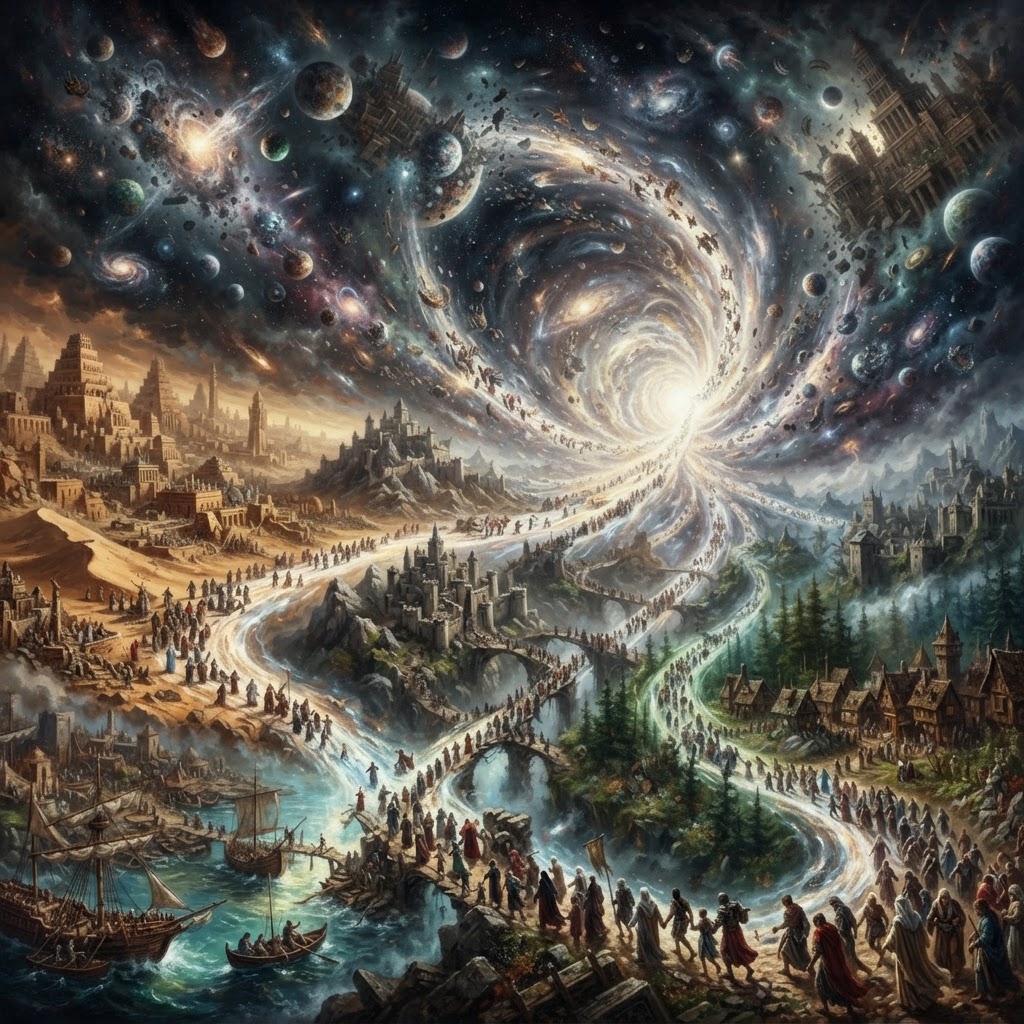
Among all the peoples gathered into Lumeris by the chaos of the Luminous Veil, none are more varied, more restless, or more difficult to summarize than Humans. They arrived without a single homeland to mourn, without a unifying spiritual tradition, and without consensus on what they were supposed to become. They arrived, instead, with ambition — raw, unformed, and pointed in every direction at once.
What makes Humans remarkable is not any single trait but the absence of a ceiling. Where other races excel at what their nature shaped them for, Humans excel at deciding what they want to be and then becoming it. A Human born to farmers becomes a knight. A Human born to knights becomes a scholar. A Human born to scholars becomes a general. The arc bends in directions no other race bends it — and bends faster.
Other peoples find Humans exhausting, compelling, dangerous, indispensable, and infuriating in roughly equal measure, often simultaneously. The Centaurs respect their ambition but consider their lack of patience a civilizational flaw. The Elves regard them with the particular fondness reserved for things that burn brightly and briefly. The Dwarves trust them about as far as the length of a specific, witnessed, written oath. Most Humans consider all of this reasonable.
Humans build institutions the way other races build monuments — because Human lifespans are short enough that the absence of institutional continuity is existentially threatening. Everything a Human builds, they build knowing they will not see how it ends.
The Form of the Adaptable
Physical Appearance
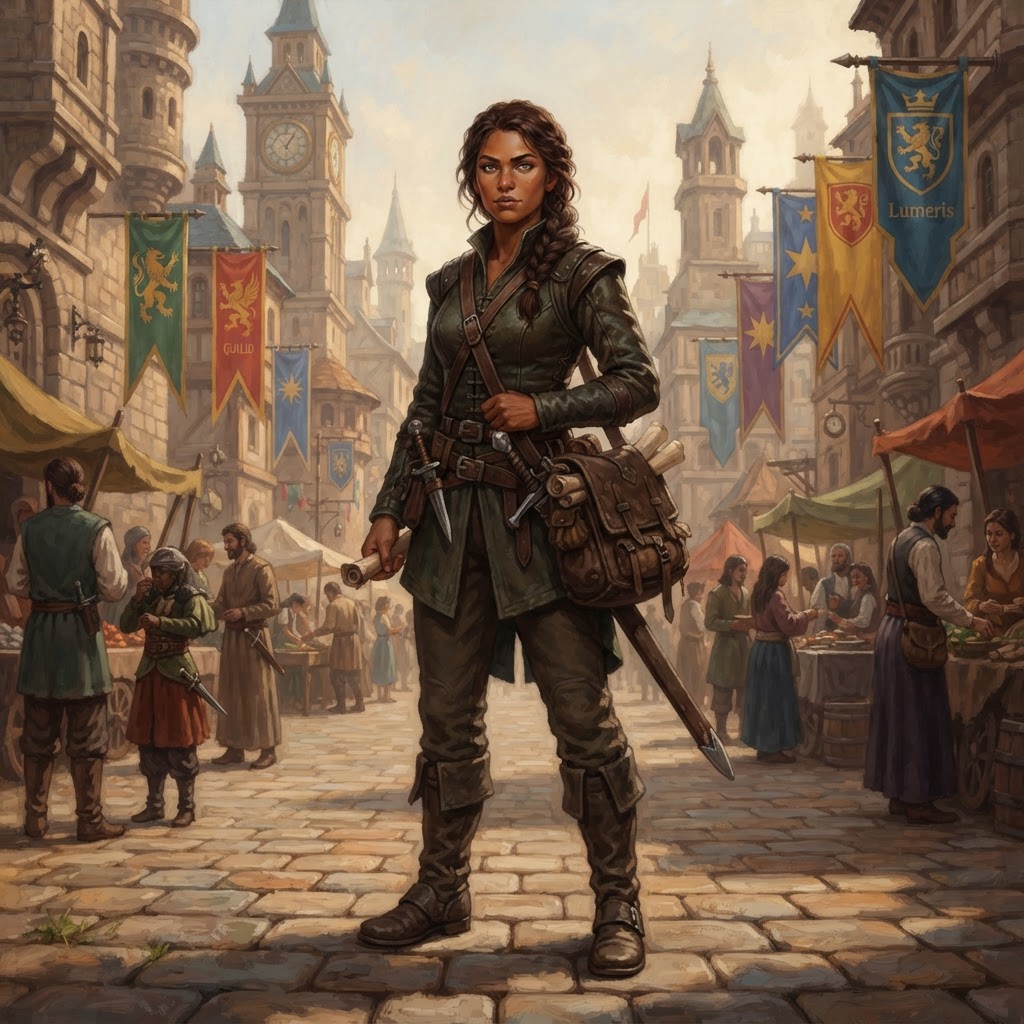
Humans are entirely humanoid in form — bipedal, bilaterally symmetric, warm-blooded, and possessed of the full range of sensory and cognitive apparatus common to the species. They lack the wings of the Drakari or Elysian, the feline traits of the Felari, the equine lower body of the Centaur, or the translucency of the Duessa. In a world of striking physical variety, the Human body is the reference point — the form that other races are described as resembling or departing from.
What Humans have instead of distinctive physical features is range. Human heights run from under five feet to over six and a half. Builds range from lean and swift to broad and powerful. Skin tones span the full warm-to-cool spectrum in every depth and saturation. Hair comes in every natural color and texture. Eyes appear in brown, grey, green, blue, hazel, and every intermediate shade. No two Human populations look the same, and within any single population the individual variation is considerable.
This physical diversity is itself a consequence of the many-worlds origin. Human populations from different original worlds had adapted to different conditions over millennia, producing the full breadth visible in Lumeris today. In the centuries since the Age of Arrival, intermingling between these populations has produced new combinations that no single original world ever saw.
Humans age visibly and relatively quickly compared to most other races. A Human who has lived fifty years looks fifty. An Elf who has lived five hundred may look thirty. This mortality is visible in Human culture at every level — it drives the urgency, the ambition, the political creativity, and the particular Human relationship with legacy. You cannot outlive your mistakes in the way an Elf can. You have to get things right on a shorter schedule.
- ◈Entirely humanoid — bipedal, bilaterally symmetric, warm-blooded, the reference point other races are described against
- ◈Heights run from under five feet to over six and a half
- ◈Builds range from lean and swift to broad and powerful
- ◈Skin tones span the full warm-to-cool spectrum in every depth and saturation
- ◈Hair comes in every natural color and texture
- ◈Eyes appear in brown, grey, green, blue, hazel, and every intermediate shade
- ◈No two Human populations look the same — individual variation within any population is considerable
- ◈Physical diversity is a consequence of the many-worlds origin — populations adapted to different conditions over millennia
- ◈Age visibly and relatively quickly — a Human who has lived fifty years looks fifty
- ◈No wings, feline traits, equine body, or translucency — in a world of striking variety, the Human body is the baseline
Origins of Humanity
The Many Worlds Before
Unlike most races, Humans do not trace their origins to a single world. They came from many — scattered across collapsing realities in countless variations, each population carrying the marks of the specific world that had shaped it. The desert Humans who arrived with the Centaurs carried different bones and different gods than the maritime Humans who came through with the Merfolk. The mountain Humans of the high kingdoms bore almost no cultural resemblance to the forest-dwelling Humans who arrived alongside the Fae.
What they shared was biology and the particular cognitive trait that defines the species: adaptability. Human minds are uniquely plastic. Where other races have deep instinctual affinities — the Drakari's elemental attunement, the Felari's connection to moonlight and memory, the Dwarves' relationship with stone — Humans have none. This is not a deficiency. It is a design. Human consciousness is built to find its shape in response to its environment rather than arriving pre-formed.
This is why Human civilizations on their original worlds were so varied. Each had developed entirely differently in response to their specific conditions. The cosmopolitan Human empires of some worlds had built sprawling trade networks. The clan-based Humans of others had refined warfare to an art. The theocratic Humans of still others had developed magical traditions built entirely around divine covenant. None of these were the same people, culturally — but they were recognizably the same species.
When those worlds began to die, the Humans on each of them responded in characteristically Human fashion: with improvisation, disagreement, desperate creativity, and an almost absurd faith that it was possible to get through this if they just figured it out fast enough. Most of them did. Not all. They arrived in Lumeris fragmented, multilingual, and immediately began the process of both integrating with each other and arguing about how to do it.
Arrival in Lumeris
The Age of Flags
The Human arrival in Lumeris was the messiest of any race and produced the most immediate, lasting impact on the shape of the new world. Where other peoples arrived as coherent cultural units — the Centaur herds, the Drakari flight lineages, the Dwarven holds — Humans arrived as dozens of distinct groups with no shared authority, no unified plan, and no agreed-upon relationship to each other.
What followed was called the Age of Flags by later historians: a period of roughly two generations in which Human groups claimed territory, founded settlements, fought each other, formed alliances, broke them, invented new forms of governance, collapsed them, and generally produced more political change per decade than any other race managed in a century. It was chaotic, brutal, and extraordinarily productive.
The settlements that survived this period did so by developing something the original migrant groups had lacked: institutions. Written law. Inherited governance. Bureaucratic record-keeping. Diplomatic protocol. The tools that allow a community to persist across generations without depending on the particular qualities of any individual leader. Humans invented and refined these tools faster than any other race, driven by the urgent need to make their unstable situation stable.
By the end of the Age of Flags, several large Human kingdoms had emerged — the foundations of the five Great Kingdoms recognized across Lumeris today.
The process left marks on Human culture that persist. Humans are the most politically sophisticated people in Lumeris — the most experienced with the mechanics of negotiation, succession, bureaucracy, and statecraft. They did not develop this sophistication from leisure. They developed it because civilizational survival required it, repeatedly, within living memory.
Their Way of Life
Culture
Human culture in Lumeris is not one thing. It is a conversation between dozens of things, ongoing and unresolved, producing new syntheses faster than any other species manages. What can be said about Human culture in aggregate is limited to a handful of tendencies that appear across the diversity: the premium placed on individual achievement, the deep investment in institutional continuity, the tendency to record everything, and the particular Human relationship with death.
They Place Great Importance On
Their relationship with legacy is tied to mortality in a way that other long-lived races find poignant. A Dwarf or Elf can outlive the institutions they founded, can watch their own legacies evolve or decay over centuries. A Human cannot. Everything a Human builds, they build knowing they will not see how it ends. This produces a particular kind of urgency and a particular kind of humility — the best Human builders design for successors they will never meet.
The Way of the Unfinished Story
Culture & Society
Human culture in Lumeris is not one thing. It is a conversation between dozens of things, ongoing and unresolved, producing new syntheses faster than any other species manages. Humans build institutions the way other races build monuments — laws, guilds, churches, universities, banking houses, and diplomatic protocols — because Human lifespans are short enough that the absence of institutional continuity is existentially threatening.
Three tendencies appear across the full diversity of Human cultures: the premium placed on individual achievement, the deep investment in institutional continuity, and the particular Human relationship with legacy and death.
Ambition
The defining Human trait across every culture and background. Humans want things — specific, achievable things — and they organize their lives around getting them. This is not always admirable. It produces overreach, exploitation, and conflict. It also produces every significant piece of cross-racial cooperation in Lumeris's history, because Humans are willing to work with anyone who can help them get where they are going.
The Written Record
Humans write everything down. Laws, contracts, histories, recipes, personal letters, astronomical observations, tax records, and the proceedings of every meeting of consequence. Their libraries are the most extensive in Lumeris, and their archival tradition has preserved knowledge that other races' oral traditions lost. Other peoples sometimes find this obsessive. The Humans consider it basic competence.
Coalition-Building
No other race builds alliances across racial lines as readily as Humans. Not from altruism — from pragmatism. Humans recognized early in the Age of Flags that they were not the most powerful race in Lumeris individually and that their best advantage lay in assembling coalitions. The Goldenveil Compact is the most visible expression of this tendency, but it appears at every level of Human society.
To be named in a Human historical record — specifically to be written into the formal chronicles maintained by a Great Kingdom — is to be made part of the permanent institutional memory of a civilization that may outlast everything else in Lumeris. The Humans cannot offer the longevity the Elves have or the oral completeness the Centaurs carry. What they offer is systematic preservation: your name, your deeds, and your context, recorded and cross-referenced and copied into backup archives in three separate locations.
The Divine
Religion & Spirits
The Hundred Gods
Humans arrived in Lumeris without a unifying spiritual tradition — and they did not acquire one. Their faiths are as varied as their many-world origins: the desert Humans carried different gods than the maritime Humans, the mountain Humans different gods than the forest Humans. There is no Human pantheon. There are hundreds of them, coexisting, competing, syncretizing, and splitting along the same lines as Human culture itself. A Human temple district in any major city contains a dozen faiths under a dozen roofs.
The Divine Covenant
The most organized of the Human religious traditions, brought from the theocratic world of the Ashenveil's origin. The Covenant tradition holds that the relationship between the divine and the mortal is contractual — a binding exchange of worship for protection, obedience for grace. The Ashenveil Covenant governs through this principle, and its temples serve as centers of healing, scholarship, and social support regardless of race. Their clerics are among the most respected healers in Lumeris. Their inquisitors are among the most feared investigators.
The Chronicler's Hand
The uniquely Human practice of seeking immortality not through lifespan but through the written record. To be written into a Great Kingdom's chronicles is to be made permanent — preserved in institutional memory that may outlast stone. This is not formally a religion, but it functions as one. Human archivists are treated with a reverence other races reserve for clergy, and the destruction of a primary archive is considered an act of cultural murder. The Chronicler's Hand is the closest thing Humans have to a universal spiritual practice.
The Mortal Flame
The Human relationship with death — not a faith but a stance. Humans know their fire burns briefly, and they have built an entire civilization around the implications. The Mortal Flame represents the awareness that everything a Human builds, they build knowing they will not see how it ends. This produces urgency, ambition, and a particular humility. Human funerals are less about mourning the dead than about recording them — ensuring the flame's light is written down before it goes out.
Humans seek immortality not in years but in legacy — in the institutions that outlast them, the records that preserve their names, and the successors they will never meet but design for anyway. An Elf can outlive what they built. A Human cannot. Everything they make is a letter to a future they will not see.
Where They Dwell
Major Human Cities
Vel'Tharis
The Lawbound Crown
The capital of the Kingdom of Vel'Thari and the seat of its constitutional monarchy. The Vel'Thari Accords — the most comprehensive body of Human law in Lumeris — are archived here in the Hall of Precedent, where every ruling since the kingdom's founding is recorded and cross-referenced. The city's courts, diplomatic colleges, and legal archives make it the first stop for any cross-racial negotiation. Other races negotiate here because the rules are written down.
Known For
Common Classes
Ironhold
The Soldier's Throne
The fortress-capital of the Ironmark Dominion, built from the ruins of the wars that forged the kingdom. Ironhold is a city organized around military discipline — its districts are named by regiment, its clock towers synchronize the daily drills, and its forges never quiet. The Dominion's professional military is garrisoned here, maintained during peace with a discipline other kingdoms find excessive. What other kingdoms call imperialism, Ironhold calls stability.
Known For
Common Classes
Goldenveil
The Merchant's Gate
The wealthy capital of the Goldenveil Compact and the primary nexus of cross-racial trade in Lumeris. Governed by the rotating Council of Factors, Goldenveil's citizenship is open to any race willing to register with the guild system. Its markets, banking houses, and trade halls contain the most racially diverse populations of any Human-founded settlement. If something can be bought or sold on the continent, it passes through Goldenveil.
Known For
Common Classes
Ashenveil
The Temple Spire
The holy capital of the Ashenveil Covenant, governed through the dual structure of secular administration and ecclesiastical authority. Its great temples serve as centers of healing, scholarship, and social support open to all races. The Covenant's clerics train here in the healing arts; its inquisitors train here in investigation. The city is not unkind, but it has strong views about the nature of order — and the spires watch everything.
Known For
Common Classes
Thornreach
The Free Port
The largest of the Thornreach Alliance's seven free cities and the seat of its mutual defense council. Thornreach governs itself as a direct democracy — every citizen votes on matters of trade and defense — and its port is the most commercially free in Human Lumeris. The Alliance's collective wealth flows through here, and its common defense pact is coordinated from the Hall of Seven. Other kingdoms call it unstable. Thornreach calls them inflexible.
Known For
Common Classes
Meridian
The Neutral Ground
A diplomatically neutral city built at the crossroads of the five Great Kingdoms, founded by treaty to serve as a meeting ground where no single kingdom holds sovereignty. Meridian houses the embassies of every Human kingdom and most non-Human peoples, the Lumeris Concordance Hall where cross-racial treaties are negotiated, and the Great Archive — the most comprehensive library on the continent. It is governed by a council of ambassadors and exists because Humans recognized that neutral ground was a prerequisite for lasting peace.
Known For
Common Classes
The Thrones That Shaped a People
The Five Great Kingdoms
The Kingdom of Vel'Thari
The Lawbound Throne
The oldest and most politically sophisticated of the Great Kingdoms, Vel'Thari is built on the principle that law precedes the ruler. Their written legal code — the Vel'Thari Accords — is the most comprehensive body of Human law in Lumeris and has served as the template for dozens of smaller polities. The current monarchy is constitutional in practice if not always in name: the Crown is powerful but operates within a framework of rights and obligations that the nobility and merchant class have defended for generations. Vel'Thari is the kingdom most other races negotiate with first.
The Ironmark Dominion
The Soldier-State
Born from the wars of the Age of Flags, the Ironmark Dominion was forged by a coalition of military commanders who decided that the only way to stop the fighting was to win it permanently and then govern what remained. Their culture prizes martial excellence, institutional loyalty, and the kind of order that comes from knowing exactly who commands whom. The Ironmark produces the finest professional military in Human Lumeris and maintains it during peace with a discipline that other kingdoms find excessive and occasionally threatening. What other kingdoms call imperialism, the Ironmark calls stability.
The Goldenveil Compact
The Merchant Republic
The Goldenveil Compact is not a monarchy and has never been one. It is governed by a rotating Council of Factors — representatives elected by guild membership across its territories — and operates on the principle that prosperity is more reliable than ideology as a basis for governance. The Compact is the wealthiest Human polity in Lumeris and the primary nexus of cross-racial trade. Its citizenship is open to any race willing to register with the guild system, and its cities contain the most racially diverse populations of any Human-founded settlements on the continent.
The Ashenveil Covenant
The Theocratic Order
Built around the religious traditions the Ashenveil Humans brought from their original world, the Covenant governs through a dual structure of secular administration and ecclesiastical authority that has been in productive tension since its founding. Their temples are centers of healing, scholarship, and social support that serve regardless of race or origin. Their clerics are among the most respected healers in Lumeris. Their inquisitors are among the most feared investigators. The Covenant is not unkind, but it has strong views about the nature of order and is willing to act on them.
The Thornreach Alliance
The Free Cities
Not a kingdom in the conventional sense but a mutual defense and trade treaty between seven independent city-states, the Thornreach Alliance represents the most decentralized of the Human political experiments. Each city governs itself according to its own traditions — one is a hereditary duchy, one a direct democracy, one a meritocratic technocracy. What they share is a common defense pact and a free-trade agreement that has made the Alliance collectively wealthy and militarily capable without requiring any of them to surrender sovereignty. Other Human kingdoms consider the Alliance unstable. The Alliance considers other kingdoms inflexible.
Names of the People
Common Human Names
Feminine Names
Masculine Names
Neutral Names
Kingdom Surnames
Game Mechanics
Playable Race Traits
Starting Attributes
STR
+3
Strength
INT
+3
Intelligence
DEX
+3
Dexterity
CON
+2
Constitution
STA
+3
Stamina
WIS
+3
Wisdom
CHA
+4
Charisma
HP
+8
Health
SPL
+3
Spells
Upon creation, Humans are allowed +3 SPL and may distribute +2 bonus points across any two stats of their choice.
SPL can be used to buy more levels of a single spell, up to level 5, or to buy new spells available to the race. The bonus stat points reflect the adaptability of the human form.
Racial Abilities
Age
Humans mature around age 16 and live between 70 and 100 years.
Size
Medium. Human heights run from under five feet to over six and a half.
Speed
30 feet.
Adaptable
Once per long rest, gain proficiency in any one skill for the duration of the next encounter. Humans learn quickly under pressure.
Determined
Once per short rest, reroll a failed check with a +2 bonus and take the new result. Human persistence has a mechanical weight.
Coalition Instinct
When adjacent to at least two allies of different races, gain a +1 bonus to all checks. Humans perform best in diverse company.
Legacy Drive
When completing a significant narrative milestone, gain a permanent +1 to a stat of your choice. Human ambition compounds over time.
Mortal Urgency
Humans act first in initiative ties. The awareness of a finite lifespan produces a decisive, immediate quality of action.
Versatile
At character creation, Humans may distribute +2 bonus points across any two stats of their choice, reflecting the adaptability of the human form.
Languages
You can speak Common and one additional language of your choice.
Allowed Classes
Humans have the widest class access of any race in Lumeris — every starter and advanced class is open to them.
Starter Classes
Advanced Classes
Advantages
- ▲Adaptable — once per long rest, gain temporary proficiency in any skill for an encounter
- ▲Determined — once per short rest, reroll any failed check with a +2 bonus and take the new result
- ▲Coalition Instinct — +1 to all checks when adjacent to at least two allies of different races
- ▲Widest class access — can enter every starter and advanced class available in Lumeris
- ▲Legacy Drive — gain a permanent +1 stat point at each significant narrative milestone
- ▲Mortal Urgency — act first in all initiative ties; decisive instinct under pressure
- ▲Political acumen — advantage on diplomacy, negotiation, and governance checks
Disadvantages
- ▼No elemental attunement — cannot access innate elemental magic without class training
- ▼Short lifespan — 70 to 100 years; cannot outlast long-game political or magical consequences
- ▼No natural armor — entirely dependent on crafted equipment for physical protection
- ▼No darkvision — standard human vision; penalties in darkness without a light source
- ▼Institutional dependency — Humans outside their political and social networks lose significant advantages
- ▼Ambition liability — ambition-driven behavior creates social penalties with races that value restraint
- ▼Lower base stats — individually outmatched by most specialized races in their area of natural excellence
Humans Are Often…
- ✦Ambitious
- ✦Adaptable
- ✦Versatile
- ✦Determined
- ✦Pragmatic
- ✦Innovative
- ✦Courageous
They May Struggle With…
- ◈Restless
- ◈Short-lived
- ◈Ambition overreach
- ◈Institutional dependency
- ◈No innate magic
- ◈Impatient
Society & Laws
Human law is institutional and written. Each Great Kingdom maintains its own legal code, but all share the foundational principle that law precedes the ruler and survives them. Disputes are judged by courts of record, with precedents archived for future reference. Human justice emphasizes written contract, witnessed oath, and institutional continuity — the tools that allow a community to persist across generations without depending on the qualities of any individual leader. The heaviest sentences involve the destruction of records or the breaking of institutional trust.
The Worst Crimes
Relationships With Other Races
Centaurs
Respect their ambition but consider their lack of patience a civilizational flaw. Both peoples value oral record and coalition-building.
Elves
Regard them with the particular fondness reserved for things that burn brightly and briefly. Humans find Elven patience beautiful and occasionally maddening.
Dwarves
Trust them about as far as the length of a specific, witnessed, written oath. Humans consider this reasonable and have learned to put things in writing.
Felari
Fascinated by their wandering nature and find their melancholy compelling. Both peoples understand what it is to be defined by what was lost.
Drakari
Respect their elemental mastery and forge-work. The Ironmark Dominion maintains cautious diplomatic relations, recognizing a fellow people shaped by survival.
Fae
Deeply wary of Fae bargains, which feel like contracts without the Human safeguards of written record and institutional backup. The feeling is mutual.
Halflings
Get along famously — both peoples value community, adaptability, and a good meal. Humans are the most frequent non-Halfling guests at Halfling hearths.
Elysian
Fascinated by their luminous purpose and slightly envious of their conviction. The Elysian find Human restlessness exhausting but their ambition impressive.
The Chronicle Ends… For Now
Final Lore Summary
The Humans of Lumeris are the great variable — the race whose presence in any situation changes what is possible. Not because they are the strongest, or the oldest, or the most magically gifted, but because they refuse to accept that what has been must be what is. They arrived in Lumeris with nothing but adaptability and ambition, and within a few generations had built kingdoms, forged cross-racial alliances, and begun reshaping the world with a speed that the longer-lived races still find slightly alarming.
They are the fire that does not know it should have gone out.
They are the treaty signed in the ruins of the last war.
They are the people who look at the end of the world and ask what happens next.