The Merfolk
Singers of the Drowned Depths
Singers of the Drowned Depths
Overview
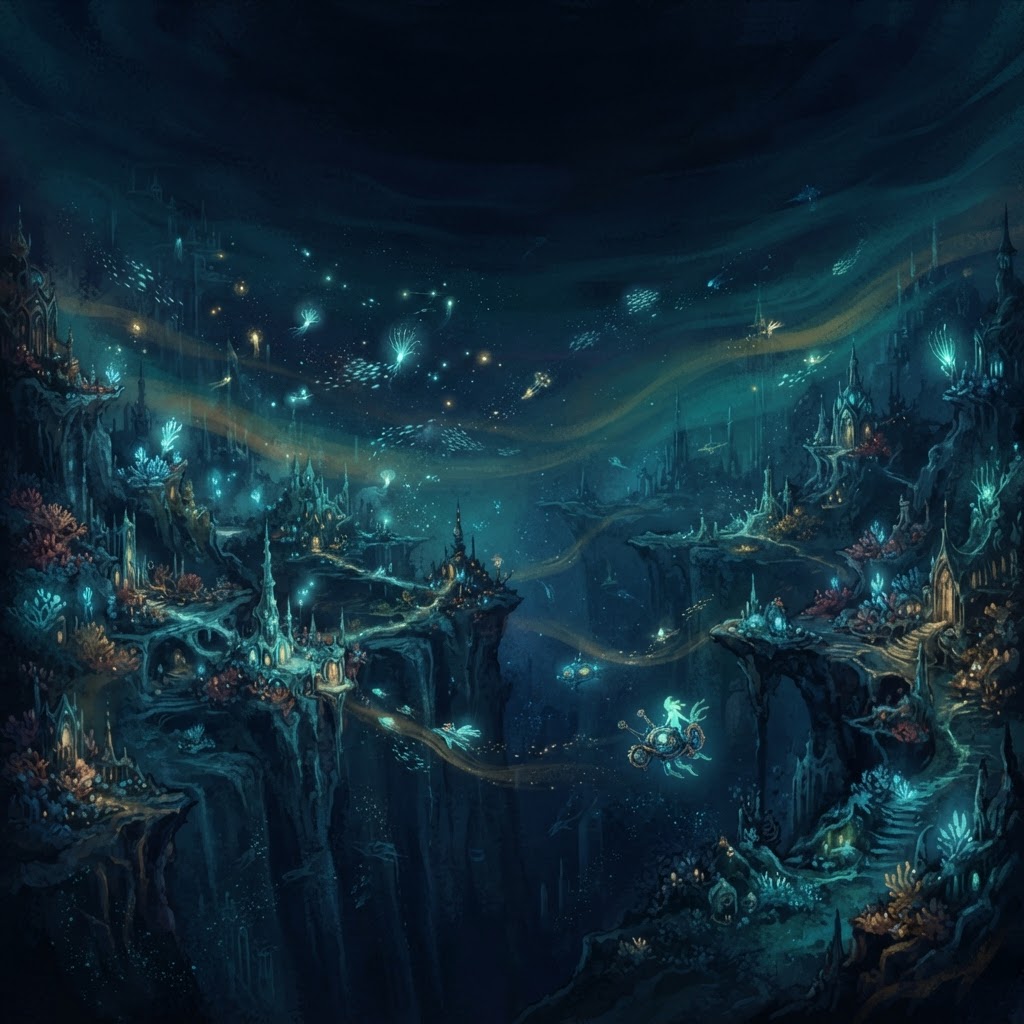
Of all the races that arrived in Lumeris through the chaos of the Luminous Veil, the Merfolk came from deepest — from a world that had no sky, no surface, and no concept of shore. They are a people of abyssal pressure and bioluminescent dark, shaped across millennia by the specific demands of a world where light was something you carried on your own body, not something the heavens provided.
They are humanoid from the waist up, with all the breadth of expression and craft of any surface race, and tailed from the waist down with powerful iridescent fins built for sustained deep-water speed. On land they walk with the careful, deliberate grace of someone navigating a medium that was never designed for them, which is accurate. Most Merfolk consider the surface world a fascinating, slightly uncomfortable place — the way other races might regard a visit to a foreign court.
What sets the Merfolk apart is not their form but their voice. Merfolk song is not metaphor — it is magic, the primary vehicle through which they conduct ritual, negotiation, memorial, and combat. A Merfolk who cannot sing is regarded with the same profound compassion that the Elysian reserve for those who cannot fly. The voice is the seat of the self. The song is the shape of the soul.
The Merfolk could go deeper than any other race could survive. This was not a comparable advantage in territorial terms, but it produced a similar result: a space that was unambiguously theirs. The voice is the seat of the self. The song is the shape of the soul.
The Form of the Tideborn
Physical Appearance
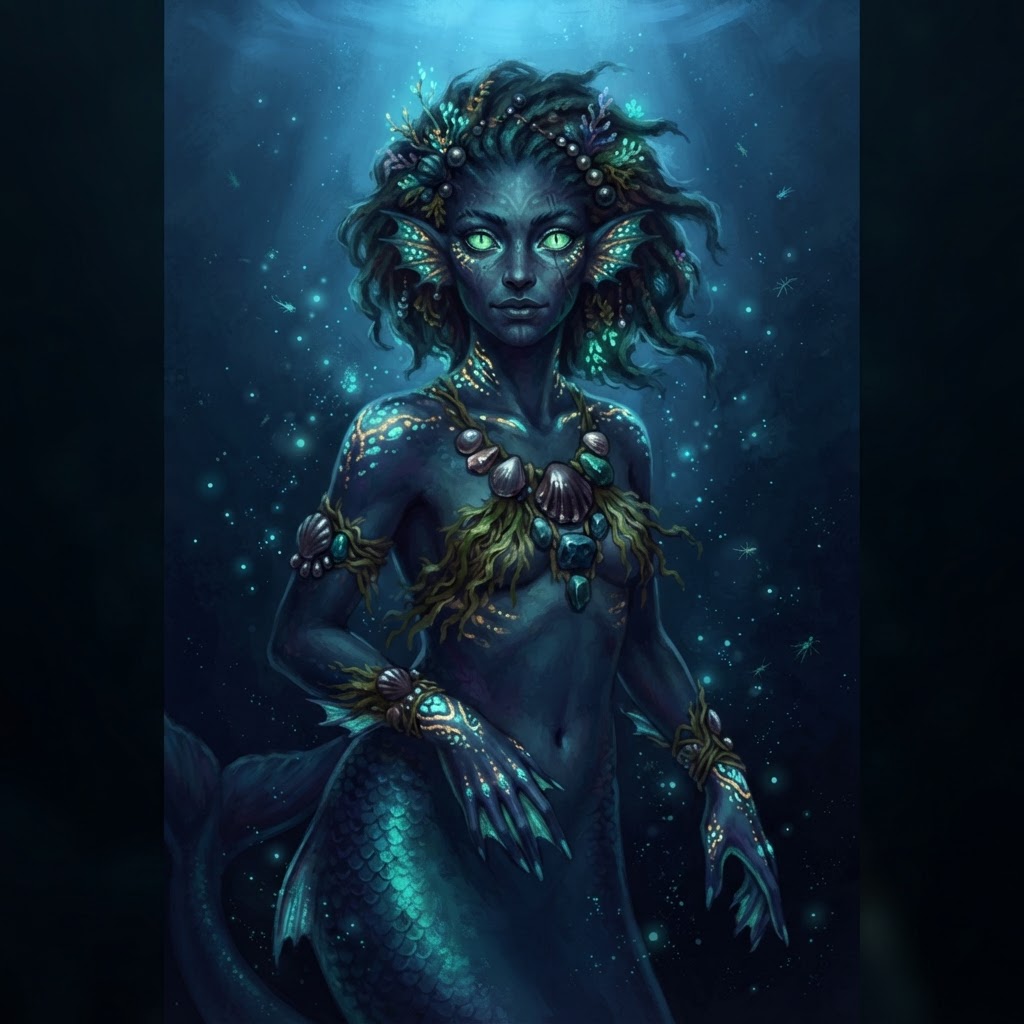
The Merfolk are humanoid above the waist — upright torso, forward-facing head, two arms of standard humanoid proportion, hands with full manual dexterity — and tailed below, with a single powerful lower body ending in a broad, horizontally-oriented fin. The tail is not fish-like in its movement but cetacean: it drives through water with an up-and-down motion that produces speeds no surface swimmer can match over distance. On land, most Merfolk use the tail as a prop and the arms to move, which they accomplish with unhurried dignity.
Their skin tones draw from the full spectrum of the ocean's color vocabulary: deep navy blues, midnight teals, rich violets, pale silver-greens, warm coral pinks, and the occasional storm-grey of deep-water lineages. The tail typically presents in a complementary or contrasting tone, with iridescent scaling that shifts color under different lighting conditions. No two Merfolk carry exactly the same scale pattern — these are as individual as fingerprints and serve a similar social function, allowing immediate identification across distances too great for facial recognition.
The bioluminescence is the most immediately striking feature. All Merfolk carry photophores — light-producing organs embedded in their skin — distributed in patterns unique to their Court lineage. At rest, the glow is subtle: a soft pulse along the collarbone, a faint radiance at the fingertips, a gentle luminosity at the temples. In emotional states — joy, anger, fear, deep concentration — the patterns activate fully, producing displays of shifting light that travel down the arms and across the tail in waves. Merfolk who have spent time on the surface learn to suppress this response, but suppression requires attention, and emotion catches them unaware.
Their eyes are adapted for the full pressure range of a deep-ocean world: large, with vertically adjustable pupils that can contract to near-invisibility in bright surface light or dilate to capture the faintest bioluminescent signal in the abyss. The iris coloring tends toward luminous tones — phosphorescent greens, electric blues, soft golds, and silver-whites that seem to contain their own faint light source regardless of external conditions. Other races find Merfolk eyes deeply compelling and slightly difficult to look away from, a response the Merfolk are aware of and relate to with the amusement of people accustomed to being stared at.
Their voices — both their singing and their speaking voices — are their most distinctive feature in practical terms. Merfolk vocal anatomy includes structures that do not exist in any surface race, capable of producing harmonics, overtones, and subsonic registers that human-built instruments cannot reproduce. When a Merfolk sings at full register in water, the vibration is felt before it is heard. In air, the effect is more contained but no less striking: a quality of resonance that other races describe as feeling the sound in their chest rather than merely hearing it with their ears.
- ◈Humanoid above the waist — upright torso, forward-facing head, two arms of standard humanoid proportion
- ◈Tailed below the waist with a single powerful lower body ending in a broad, horizontally-oriented fin
- ◈Tail moves cetacean — up-and-down motion producing speeds no surface swimmer can match over distance
- ◈Skin tones draw from the ocean's color vocabulary: deep navy, midnight teal, rich violet, pale silver-green, coral pink, storm-grey
- ◈Tail presents in complementary or contrasting tones with iridescent scaling that shifts color under different lighting
- ◈No two Merfolk carry the same scale pattern — as individual as fingerprints, used for identification at distance
- ◈Bioluminescent photophores embedded in skin, distributed in patterns unique to Court lineage
- ◈At rest the glow is subtle — collarbone, fingertips, temples. In emotion it activates fully in waves down arms and tail
- ◈Eyes adapted for full pressure range — large, vertically adjustable pupils, luminous iris tones of green, blue, gold, silver-white
- ◈Vocal anatomy includes structures no surface race possesses — harmonics, overtones, and subsonic registers instruments cannot reproduce
Origins of the Merfolk
The Drowned Expanse
The world the Merfolk came from had no name in their oldest records — or rather, it had a name in a frequency too low to reproduce in air, a subsonic vibration their scholars translate simply as The Deep. It was an ocean world with no land: a global sea so vast and so deep that even the Merfolk, who had lived in it for thousands of years, had never fully mapped it. Light from a distant sun reached only the shallowest strata. Below that, everything was dark, and warm, and alive in ways that the surface world still struggles to categorize.
The Merfolk arose in the middle depths — not in the lightless abyss where the greatest pressure dwelled, and not in the sunlit shallows where life was visible and vulnerable, but in the transitional zone where darkness and diffuse light met. This in-between origin shaped everything about them: their bioluminescence adapted to serve in spaces where neither full darkness nor full light prevailed, their social structures built around the management of information across distances too great for visual contact, and their magic rooted in sound — the one medium that travelled reliably through every stratum of their world.
Their civilization was not built in one place but woven across the entire middle-depth of their world in a network of coral cities, trench settlements, and nomadic deep-current routes. The Tidal Courts — the five great governing bodies of Merfolk civilization — were not territorial governments but frequency-councils: bodies whose jurisdiction extended to every Merfolk within range of their characteristic resonant broadcasts, regardless of physical location. A Merfolk could change which Court governed them simply by swimming out of one frequency range and into another.
Their scholars believe the Drowned Expanse began to die from the inside — the warm currents that sustained the middle depths cooling slowly, the bioluminescent organisms that formed the base of their food chain dimming generation by generation. The Tidal Courts detected it early and spent two centuries debating what to do before the consensus emerged: follow the warmth toward the gathering light of the Luminous Veil.
The migration was the largest organized movement of any race through the Veil. The Merfolk did not flee in panic — they traveled in ordered Current Runs, massive schooling formations navigated by the Tidecallers, following the resonant signal of the Luminary Heart the way their ancestors had always followed warm-water currents. They arrived in Lumeris's newly converged seas as an intact civilization, already singing.
Arrival in Lumeris
The Tidal Convergence
The Merfolk arrived in Lumeris's oceans, and the oceans were not ready for them. The seas of Lumeris had formed from the convergence of dozens of different worlds' water bodies — overlapping chemistries, clashing temperature gradients, and bioluminescent ecosystems from multiple realities competing for the same water column. For any other race this would have been an obstacle. For the Merfolk, it was a familiar problem. They had spent millennia managing a complex multi-layer ocean. What Lumeris offered was a more complicated version of what they already knew.
Within the first generation they had claimed the deepest reaches of Lumeris's primary ocean as their own — not through conquest but through the simple fact that no other race could follow them there. The Drakari could fly higher than any other race could climb; the Merfolk could go deeper than any other race could survive. These were not comparable advantages in territorial terms, but they produced similar results: a space that was unambiguously theirs.
Their relationships with surface races began at the shoreline — the one zone where both worlds overlapped. The Merfolk who chose to engage with the surface spent their early decades in Lumeris developing the vocal technique required to produce audible-range speech in air, a different physical challenge than singing in water. The first Merfolk ambassadors to surface courts were celebrated not for their diplomacy but for the sheer spectacle of their voice — a Merfolk speaking aloud in air for the first time was, according to every account, an event that stopped rooms and left witnesses struggling to explain what they had heard.
Over the generations of the Age of Settlement, the Tidal Courts established their authority over Lumeris's seas with the quiet thoroughness of people accustomed to governing vast spaces.
The surface races who built ports discovered that the most reliable maritime guidance, storm prediction, and deep-water salvage came from Merfolk who had mapped the convergence-seas more completely than any surface civilization could hope to match. The relationship that formed from this exchange — information for access, guidance for respect — remains the primary structure of Merfolk interactions with land-dwelling peoples today.
Their Way of Life
Culture
Merfolk culture is organized around three things that their civilization has never been without: the Song, the Current, and the Tide. These are not metaphors — they are the literal structural foundations of Merfolk social life, each representing a different relationship between the individual and the forces larger than themselves.
They Place Great Importance On
Their governance through the Tidal Courts means that Merfolk citizenship is fluid in a way that no surface race fully grasps. A Merfolk can move between Courts by changing their resonant attunement — a process that takes years of dedicated practice but is not uncommon. Their relationship with surface races has always been characterized by asymmetry: the Merfolk know more about the surface world than surface races know about the deep, because they have been listening to everything that happens near water for centuries, and sound travels extraordinarily well through both water and the stones that water touches. Songs outlast cities. Resonance outlasts stone.
The Way of the Living Current
Culture & Society
Merfolk culture is organized around three things that their civilization has never been without: the Song, the Current, and the Tide. These are not metaphors — they are the literal structural foundations of Merfolk social life, each representing a different relationship between the individual and the forces larger than themselves.
Their governance through the Tidal Courts means that Merfolk citizenship is fluid in a way that no surface race fully grasps. A Merfolk can move between Courts by changing their resonant attunement — a process that takes years of dedicated practice but is not uncommon. The body politic is not a territory but a frequency.
The Song
The primary medium of Merfolk civilization. Law is sung, not written. History is preserved in resonance, not text. Diplomatic agreements are sealed with a shared harmonic that both parties must reproduce accurately to confirm understanding. A Merfolk who cannot sing cannot participate fully in their own civilization, which is why vocal training begins before a Merfolk child can speak in air and never truly ends.
The Current
The organizing metaphor and practical reality of Merfolk social movement. Merfolk do not belong to fixed places — they belong to currents. Family groups follow generational routes. Court affiliations move with frequency patterns. Even grief is expressed through the metaphor of current: to lose someone is to be pulled into still water.
The Tide
The Merfolk relationship with cyclical time — the belief that nothing is permanently lost but moves in and out of presence like the tide itself. This gives Merfolk culture an unusual relationship with endings: they do not grieve permanence the way many surface races do, because they do not experience time as permanently linear. What recedes will return. What is lost is in the out-going tide.
To be sung into the Tidal Archive — the practice of incorporating a non-Merfolk's name and deeds into the formal resonance record maintained by a Court's Loresingers — is to be preserved in the most durable medium Merfolk civilization possesses. Songs outlast cities. Resonance outlasts stone. Among a people who believe that existence persists as long as it is remembered in song, this is the deepest permanence they can offer.
They Place Great Importance On
The Divine
Religion & Spirits
The Deep
Not a deity but the oldest name the Merfolk carry for the world they came from — a subsonic frequency too low to reproduce in air, translated by their scholars simply as The Deep. It represents the totality of origin: the warm currents, the bioluminescent dark, the pressure that shaped them. The Deep is not worshipped but acknowledged as the source from which all Merfolk song descends. When a Merfolk sings the lowest registers, they are said to be touching the memory of The Deep.
The First Tidecaller
The legendary figure who first navigated the Current Runs through the Luminous Veil, leading the Merfolk migration from the dying Drowned Expanse to Lumeris's seas by following the resonant signal of the Luminary Heart the way their ancestors had always followed warm-water currents. Not worshipped but honored as the architect of survival. Invoked by navigators and by any Merfolk beginning a long journey, representing the courage to follow a signal into the unknown.
The Loresingers
Not one figure but an office — the keepers of the Tidal Archive, the formal resonance record maintained by each Court. Loresingers are part historian, part priest, part living archive. Their memories hold songs that predate the crossing, and their voices are trained to reproduce resonances exactly as they were first sung. To have your name sung into the Tidal Archive by a Loresinger is the deepest permanence Merfolk civilization can offer — preservation in a medium that outlasts stone.
The Luminary Heart
Not a Merfolk figure but a force they revere — the cosmic signal the Tidecallers followed through the Veil, which the Merfolk perceive as a resonant tone rather than a light. The Merfolk relationship with the Luminary Heart is acoustic where other races' is visual or theological. They believe the Heart's resonance sustains the currents that keep their civilization alive, and the Veilsong Circle attunes specifically to the deep-water proximity of its ley lines.
Among a people who believe that existence persists as long as it is remembered in song, there is no true death — only still water. What recedes will return. What is lost is in the out-going tide. The Merfolk carry their dead forward in resonance, sung into the Archive, preserved in a medium that outlasts cities and stone alike.
Where They Dwell
Major Merfolk Cities
Nyrethis
The Spire City
Built across a massive coral formation in the warm shallows where Lumeris's largest ocean meets the continent's southern coast, Nyrethis is the most visible Merfolk city and the primary point of contact between Merfolk civilization and the surface world. Its upper spires extend to within a few feet of the surface at low tide, and its markets — conducted half-submerged in the tidal zone — are the strangest and most varied trading floors on the continent. Nyrethis hosts the largest non-Merfolk population of any underwater settlement.
Known For
Common Classes
Shellavar
The Memory City
Deep in the oldest trench of Lumeris's primary ocean, Shellavar is the archive-city of Merfolk civilization — the place where the Abyssal Court maintains its oral and sung records. The city's acoustic properties are deliberately engineered: its chambers are shaped to preserve resonance indefinitely, and a song sung in the deepest hall of Shellavar will echo for days. The Archives of the Deep Singing, maintained here without interruption since the Age of Arrival, are considered the most complete record of pre-Lumeris Merfolk history in existence.
Known For
Common Classes
Lumendeep
The Radiant City
Situated in the heart of the largest convergence zone in Lumeris's seas, Lumendeep glows with the concentrated bioluminescence of thousands of Merfolk living in close proximity to overlapping magical currents. Its architecture uses living bioluminescent organisms as both structural material and light source, producing a city that changes color with the tides and pulses in patterns that convergence-scholars have spent decades attempting to decode. Lumendeep is the foremost center of magical research in Merfolk civilization and the most welcoming of scholarly visitors from any race.
Known For
Common Classes
Tidecairn
The Navigator's Rest
The administrative hub of the Tidecrown Court, Tidecairn is less a fixed city than a permanent meeting point on the greatest current circuit in Lumeris — a deep-water crossroads where the major oceanic currents converge and diverge. It is rebuilt in each generation as the currents shift, always at the same point in the circuit but not always in the same physical location. Tidecairn's market deals in route data, weather pattern archives, and navigational services. Every major maritime power on the continent maintains a representative here.
Known For
Common Classes
Veilthroat
The Boundary Deep
The primary gathering place of the Veilsong Circle, located where a submarine cave system extends from the deep ocean toward the ley lines of the Luminary Heart. Veilthroat is not a city in any conventional sense — it is an acoustic space, a resonant chamber where magical current and physical water meet. Veilsong Merfolk gather here to attune to the boundary waters where ocean borders on something other than ocean. Non-Merfolk who reach this place are considered to have been called by the current itself.
Known For
Common Classes
Currentgate
The Shoreward Embassy
The primary Merfolk embassy to the surface world, built in the tidal zone of a major southern port where Merfolk and surface civilization maintain their most structured ongoing relationship. Currentgate is half-submerged by design — its lower chambers are aquatic, its upper chambers open to air — and it is here that the Coralspire Court conducts formal diplomacy with surface kingdoms. The most skilled air-speaking Merfolk serve here, and the vocal performances that accompany treaty-signings are themselves considered binding resonance.
Known For
Common Classes
The Governing Frequencies of the Deep
The Five Tidal Courts
Merfolk civilization is organized not by territory but by resonance — five Tidal Courts whose jurisdiction extends to every Merfolk attuned to their characteristic harmonic broadcast. Each Court represents a different depth-philosophy and a different orientation toward the relationship between the deep and the surface world.
The Abyssal Court
The Deepest Waters
The oldest and most conservative of the five Courts, the Abyssal govern the deepest-dwelling Merfolk — those whose lineages have never willingly approached the surface and who regard the shallow waters with the wariness of people who have learned that most dangers travel downward. They maintain the oldest oral archives in Merfolk civilization and are the primary keepers of memory from the Drowned Expanse. Their bioluminescent patterns run to the deepest blues and blacks, with cold white pulses that move slowly and irregularly.
The Coralspire Court
The Reef Shallows
The most outward-facing of the five Courts, the Coralspire govern the reef shallows and coastal waters where Merfolk civilization and surface civilization most frequently intersect. They produce the majority of Merfolk diplomats, traders, and the scholars who study surface cultures. Their bioluminescence is the most expressive and variable of any Court — warm golds, vivid teals, and bright pinks that activate visibly in social contexts, which surface races find spectacular and other Merfolk find slightly undignified.
The Tidecrown Court
The Open Ocean Currents
The navigators and current-riders of Merfolk society, the Tidecrown govern the open ocean — the vast middle distance between coast and abyss that forms the majority of any ocean's volume. They are the most mobile of the Courts, their jurisdiction following the great oceanic current circuits of Lumeris rather than fixed territories. Tidecrown Merfolk are the finest maritime navigators on the continent, and their Current Charts — maps of subsurface water movement annotated with magical current data — are among the most valuable documents in Lumeris.
The Driftborn Collective
The Convergence Zones
A Court that emerged specifically in response to Lumeris — there was no Driftborn Collective in the Drowned Expanse. They represent Merfolk who settled the convergence zones where oceans from different worlds overlap, developing new attunements to the hybrid magical currents that flow through these spaces. The Driftborn are the most magically experimental of the Courts, producing the highest concentration of Mages and Healers, and their understanding of convergence-magic is unmatched by any other group.
The Veilsong Circle
The Boundary Waters
The rarest and most mysterious of the five Courts, the Veilsong Circle attune to the places where ocean borders on something other than ocean — the submarine entrances to cave systems that extend into other planes, the deep-water proximity to the Luminary Heart's ley lines, and the acoustic boundary where physical water ends and magical current begins. They are the Merfolk most likely to be encountered by non-Merfolk in unexpected contexts, having followed underwater magical currents into spaces where no ocean should logically reach.
Names of the People
Common Merfolk Names
Feminine Names
Masculine Names
Neutral Names
Court Surnames
Game Mechanics
Playable Race Traits
Starting Attributes
STR
+2
Strength
INT
+4
Intelligence
DEX
+4
Dexterity
CON
+2
Constitution
STA
+3
Stamina
WIS
+4
Wisdom
CHA
+4
Charisma
HP
+6
Health
SPL
+5
Spells
Upon creation, Merfolk are allowed +5 SPL.
SPL can be used to buy more levels of a single spell, up to level 5, or to buy new spells available to the race. Merfolk of the Veilsong Circle receive an additional +1 SPL.
Racial Abilities
Age
Merfolk mature around age 20 and live between 150 and 250 years.
Size
Medium. Humanoid above the waist, tailed below — broadly comparable in height to Humans when upright.
Speed
20 feet on land (tail-walking). 60 feet swim speed underwater (triple walking speed).
Aquatic
Breathe water as easily as air. Full combat effectiveness and movement speed underwater. Tail-driven swim speed is triple walking speed.
Bioluminescence
Produce controllable light from skin photophores. Illuminate a 20-foot radius at will, or suppress entirely with a concentration check. Emotional spikes cause involuntary activation.
Tidecall
Once per long rest, call a localized tidal surge — a rush of conjured water that knocks targets prone and pushes them back 15 feet. Effective indoors and outdoors.
Depth Sense
Perceive pressure, current, and the presence of living creatures through water within 60 feet. Cannot be surprised while in or adjacent to water.
Song Resonance
Merfolk voice carries magical weight. Once per short rest, use a sung phrase to charm, calm, or unsettle a target within 30 feet who can hear. Target must make a Wisdom save.
Veilsong Attunement
Merfolk of the Veilsong Circle receive an additional +1 SPL at character creation, reflecting their attunement to the boundary waters where magical current and physical water meet.
Languages
You can speak Common, Merfolk, and Aquan.
Allowed Classes
Merfolk gravitate toward magic, healing, and the performing arts — their vocal anatomy and aquatic nature favor spellcraft and song over heavy arms.
Starter Classes
Advanced Classes
Advantages
- ▲Aquatic — full combat effectiveness and triple movement speed underwater; breathe water freely
- ▲No drowning risk — can operate in any aquatic environment indefinitely
- ▲Bioluminescence — controllable natural light source; advantage on intimidation or charm in darkness
- ▲Tidecall — once per long rest, conjure a tidal surge that knocks enemies prone and pushes them back 15 feet
- ▲Depth Sense — perceive living creatures through water within 60 feet; cannot be surprised near water
- ▲Song Resonance — magical voice usable once per short rest to charm, calm, or unsettle a target
- ▲Aquatic combat mastery — bonus to attack and dodge rolls when fully submerged
Disadvantages
- ▼Land movement — tail-walking is slow and conspicuous; movement speed on land is significantly reduced
- ▼Desiccation — extended time without water contact imposes increasing ability penalties; full immersion required daily
- ▼Involuntary glow — strong emotion activates bioluminescence; stealth in darkness requires sustained concentration checks
- ▼Armor incompatibility — standard armor interferes with tail movement and bioluminescent organs; requires specialized aquatic-forged equipment
- ▼Terrain dependency — effectiveness drops sharply in arid, underground, or high-altitude environments far from water
- ▼Cold vulnerability — deep cold impairs tail mobility and suppresses bioluminescence; significant penalties in frost environments
Merfolk Are Often…
- ✦Resonant
- ✦Adaptable
- ✦Patient
- ✦Luminous
- ✦Deep-seeing
- ✦Memory-keeping
- ✦Fluid
They May Struggle With…
- ◈Land-bound slowness
- ◈Desiccation
- ◈Involuntary glow
- ◈Terrain dependency
- ◈Cold vulnerability
- ◈Armor limits
Society & Laws
Merfolk law is sung, not written. Disputes are judged by Loresingers who invoke precedent through resonance — reproducing the exact harmonic of past rulings preserved in the Tidal Archive. Diplomatic agreements are sealed with a shared harmonic that both parties must reproduce accurately to confirm understanding. The heaviest crimes involve the disruption of song itself — silencing a singer, falsifying a record, or breaking a harmonic-sealed treaty. Among a people whose civilization exists in resonance, to silence a voice is the deepest violence.
The Worst Crimes
Relationships With Other Races
Humans
A structured diplomatic relationship built on information for access, guidance for respect. The Merfolk know more about Human coastal politics than Humans know about the deep.
Elves
Mutual respect between ancient peoples. The Elves regard Merfolk song as the finest music in Lumeris; the Merfolk regard Elven patience as the closest surface equivalent to their own relationship with deep time.
Drakari
An acknowledged parallel — the Drakari fly higher than any race can climb; the Merfolk go deeper than any race can survive. Both understand what it means to claim a space no one else can follow into.
Fae
Fascinated curiosity. The Fae recognize something primordial in Merfolk resonance — an ancient magic that predates the convergence. The Veilsong Circle maintains quiet contact with the Fae courts.
Centaurs
Limited contact but genuine mutual respect between two peoples who govern by movement rather than territory — the Centaurs across the steppe, the Merfolk across the currents.
Elysian
An unspoken kinship of the luminous. Both peoples carry their own light — the Elysian in their blood, the Merfolk in their skin. They understand each other in ways neither fully articulates.
Dwarves
Rare but genuine cooperation in deep places — Dwarven delves and Merfolk trenches occasionally meet at the boundary where stone and water touch. Both peoples respect what the other builds in the dark.
Halflings
Warm if infrequent contact at shoreline ports. Halflings find Merfolk fascinating; Merfolk find Halfling warmth genuine and their stories worth preserving in the Tidal Archive.
The Chronicle Ends… For Now
Final Lore Summary
The Merfolk are an ancient people shaped by pressures most races will never feel and illuminated by a light they carry within themselves. They came from the deepest dark and built a civilization of resonance, memory, and living radiance — a world where law is sung and history never falls silent. In Lumeris they found new depths to plumb, new currents to follow, and a surface world that had never heard anything like their voice.
They are the light that moves in the dark water.
They are the song that travels farther than sound.
They are the tide that carries everything with it, and returns what it takes.