The Minotaurs
Architects of the Undying Stone
Architects of the Undying Stone
Overview
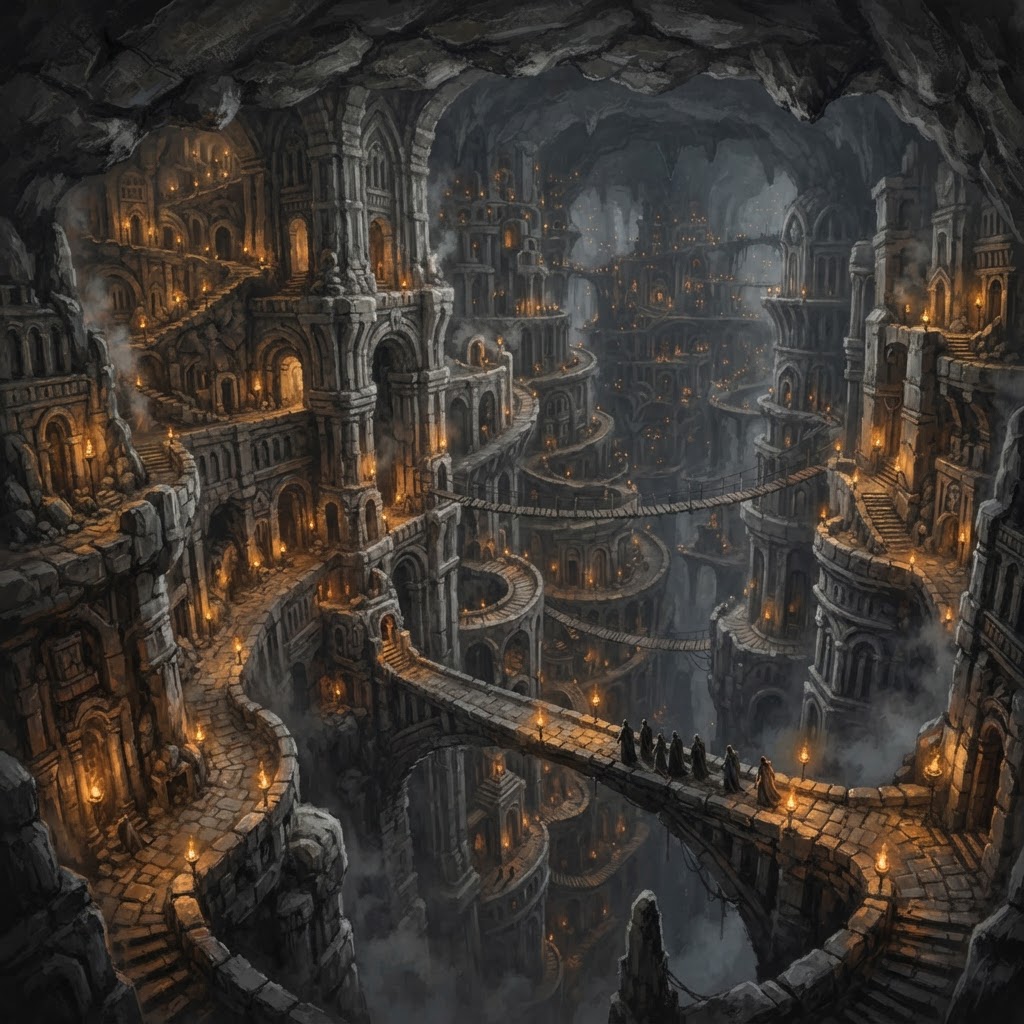
The Minotaurs of Lumeris are a race defined by contradiction: they are among the most feared warriors on the continent and among its most meticulous architects. They built a world of stone corridors stretching thousands of miles in every direction, and they knew every passage by heart. They came from a place where getting lost meant death — so they never got lost. They came from a place where strength was the only reliable currency — so they developed strength beyond what other races thought necessary.
Meeting a Minotaur for the first time, most races focus on the horns. What the horns represent — a history of being the largest, strongest, and most spatially aware people in any room — is usually what matters more. The Minotaurs do not require other races to understand them. They require only that other races stay out of their way when they are working, and be honest when they are talking.
They are not the brutes their reputation suggests. Or rather — they are, and more than that, and the more is what matters.
They came from a place where getting lost meant death — so they never got lost. They came from a place where strength was the only reliable currency — so they developed strength beyond what other races thought necessary. They are, and more than that, and the more is what matters.
The Form of the Labyrinth-Born
Physical Appearance
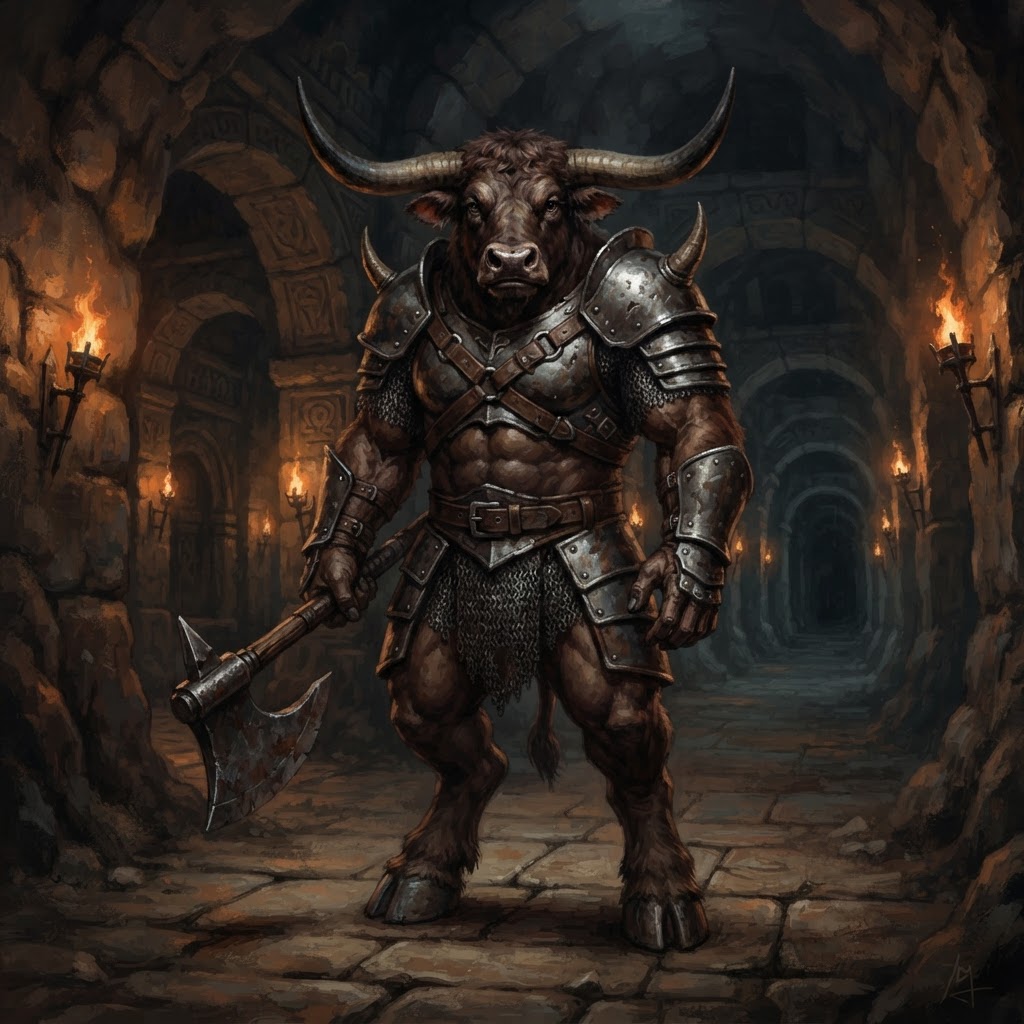
Minotaurs stand between seven and nine feet tall, with builds that make even Centaurs regard them with a degree of caution. Their upper bodies are enormous — barrel-chested, broad-shouldered, with arms built for sustained labor over extended time rather than explosive bursts. Their legs are powerful and slightly digitigrade, ending in heavy hooves that strike stone floors with a resonance other races describe as deeply, instinctively attention-commanding.
Their heads are bovine — heavy-muzzled, wide-nostriled, with large dark eyes that carry more emotional complexity than most races expect on first meeting. Their horns are the primary marker of age and Brotherhood in Minotaur culture: growing from youth into increasingly impressive formations that vary by bloodline from forward-curving bull-horns to the dramatic swept-back rack of the highland lineages. The horn span of an elder Minotaur may exceed four feet across. Most Minotaurs regard this with the quiet satisfaction of someone whose credentials are visible from across the room.
Dense fur covers their bodies in patterns that vary by bloodline — some carry short, sleek coats in blacks, deep browns, and dark reds; others have longer, shaggier coats suited to cold climates. The color distribution across Lumeris's Minotaur population reflects the range of Stonedeep environments their ancestors inhabited: pale grey coats from the upper passages, near-black from the deep levels, warm chestnut and roan from the mid-layer holds.
Their hands are humanoid in structure, five-fingered and capable of considerable fine work despite their size. Minotaur artisans are underestimated by races who assume the scale of their hands precludes delicacy — this assumption is consistently and memorably corrected the first time one watches a Minotaur stonecutter work at detail scale. Their overall bearing is one of contained mass — the posture of a people accustomed to moving through spaces barely large enough to accommodate them, which has produced a cultivated economy of motion that reads, to other races, as either menace or dignity depending on the context. Experienced observers of Minotaur body language note it is most often both simultaneously.
- ◈Stand between seven and nine feet tall with enormous builds that make even Centaurs cautious
- ◈Upper bodies are barrel-chested and broad-shouldered, arms built for sustained labor over extended time
- ◈Legs are powerful and slightly digitigrade, ending in heavy hooves that strike stone with attention-commanding resonance
- ◈Heads are bovine — heavy-muzzled, wide-nostriled, with large dark eyes carrying more emotional complexity than expected
- ◈Horns are the primary marker of age and Brotherhood — growing from youth into increasingly impressive formations
- ◈Horn span of an elder Minotaur may exceed four feet across, varying by bloodline from forward-curving to swept-back racks
- ◈Dense fur covers the body in bloodline-specific patterns — short sleek coats or longer shaggier coats for cold climates
- ◈Color distribution reflects Stonedeep environments: pale grey from upper passages, near-black from deep levels, chestnut and roan from mid-layer holds
- ◈Hands are humanoid in structure, five-fingered and capable of considerable fine work despite their size
- ◈Overall bearing is one of contained mass — cultivated economy of motion that reads as menace or dignity depending on context
Origins of the Minotaurs
The Stonedeep
The Minotaurs came from a world they called the Stonedeep — not a world with caves and labyrinths in it, but a world that was itself a labyrinth. The Stonedeep had no open sky. Its surface was solid rock, and beneath that rock, stretching down through layer after geological layer, wound a vast network of connected passages, chambers, and carved corridors that spanned the entire planet.
The Stonedeep labyrinths were not natural. They were built — over millions of years by forces the Minotaurs called the First Architects, beings of enormous scale whose purpose and nature are debated in every generation. What is agreed is that when the first Minotaur ancestors emerged into awareness in the deepest levels of the Stonedeep, the passages were already there, already ancient, and already full of things that needed to be fought.
The Minotaur civilization developed entirely in relationship to the labyrinth. Navigation was the first science. Architecture — extension, repair, and deliberate modification of the existing passages — was the first art. Combat was the first profession, because the Stonedeep was not empty, and its deeper levels had never been entirely cleared.
The Proving — the Minotaur coming-of-age ritual — required every young Minotaur to navigate alone through a designated section of unmapped passage and return with proof they had reached its center. Not all returned. The ones who did were considered adults. The ritual produced, over millennia, a people with spatial awareness, endurance, and combat instinct so deeply embedded they operate at full effectiveness in environments that would disorient any other race completely.
When the Stonedeep began to collapse — not from below but from above, as the geological structure holding the labyrinth together for millions of years finally failed — the Minotaurs knew before anyone told them. They felt it in the vibration of the passages, read it in the particular quality of the air pressure changes, and their Pathwardens had been tracking structural instabilities for a generation.
Arrival in Lumeris
Out of the Stone
The evacuation of the Stonedeep was characteristically efficient. The Brotherhoods organized their people by hold, sealed passages behind them to slow the collapse, and moved toward the convergence point with the same unhurried, ground-covering stride that carries a Minotaur forty miles in a day on open terrain. They did not run. They moved with purpose, and they arrived in Lumeris intact.
Their first impression on other races was significant. The Minotaurs entered Lumeris through passages in the convergence geography that no other race had thought to use — underground routes that the Stonedeep's collapse had connected to Lumeris's existing cave systems. They emerged from the stone rather than crossing through a visible gate, which produced a memorable moment in the early Age of Arrival that several oral traditions describe in considerable detail.
They claimed the deep places first — the mountain interiors, the great cave networks, the underground river systems — not because they were forced there but because these spaces felt like home in a way that open sky did not. Most Minotaurs experience their first year in Lumeris as a sustained effort to find a ceiling, and their relief when they finally work underground is profound and genuine.
Over the generations of the Age of Settlement, the Brotherhoods expanded their underground holds into the mountainsides and eventually into the highland terrain above.
The Minotaurs who now walk Lumeris's surface do so with full competence — but they sleep better when they can hear stone on three sides.
Their Way of Life
Culture
Minotaur culture is organized around three principles: Strength With Purpose, Memory Through Stone, and Brotherhood Before Self. These are not abstract values — they are operative guidelines that shape how Minotaurs make decisions, resolve disputes, and structure their days.
They Place Great Importance On
Minotaur holds record their histories, laws, agreements, and significant decisions in stone carving rather than written text or oral tradition. The stone can be damaged, but it cannot be misremembered or embellished over time. The act of carving itself is considered a form of commitment — you do not put something in stone unless you mean it to last. Minotaur contracts are literally carved. Their marriages are recorded in stone. Their dead are commemorated with carved memorial corridors that expand with each generation. Stone outlasts memory, outlasts story, and outlasts the carver.
The Way of the Carved Stone
Culture & Society
Minotaur culture is organized around three principles: Strength With Purpose, Memory Through Stone, and Brotherhood Before Self. These are not abstract values — they are operative guidelines that shape how Minotaurs make decisions, resolve disputes, and structure their days.
Minotaur holds record their histories, laws, agreements, and significant decisions in stone carving rather than written text or oral tradition. The act of carving itself is considered a form of commitment — you do not put something in stone unless you mean it to last.
Strength With Purpose
Strength is not admirable for its own sake. It is admirable when directed toward something meaningful — protection, creation, navigation, or service. A Minotaur who uses strength without purpose has wasted the most valuable thing they own.
Memory Through Stone
Important things are carved — literally. Stone cannot be misremembered or embellished over time. Laws, contracts, marriages, and the dead are all recorded in carved stone corridors that expand with each passing generation. You do not put something in stone unless you mean it to last.
Brotherhood Before Self
Individual achievement is celebrated, but individual achievement at the cost of Brotherhood cohesion is not. A Minotaur who achieves something magnificent alone when they could have achieved something greater together has made a philosophical error.
To have your name carved into a Minotaur hold's memorial corridor — added by the Bloodhorn Circle's decision to the official stone record of the Brotherhood — is to be made permanent in the only medium Minotaurs trust completely. Stone outlasts memory, outlasts story, and outlasts the carver. Among a people who build for centuries rather than years, this is the most durable recognition they can offer anyone.
They Place Great Importance On
The Orders That Shape a People
The Five Ironhoof Brotherhoods
Minotaur society is organized around the Brotherhoods — warrior-philosopher orders that serve simultaneously as military force, cultural institution, and spiritual community. Membership is the defining fact of a Minotaur's identity. Five Brotherhoods are recognized as the Great Orders, each tracing lineage to the earliest Stonedeep holds and sending a Warchief to the Council of Horns.
The Ironhoof Vanguard
The Foremost Blade
The foremost military Brotherhood in Minotaur society, the Vanguard are the shock troops, the front line, and the reason other races have concluded that fighting Minotaurs in enclosed spaces is categorically inadvisable. Their philosophy is direct: the fastest path through a problem is usually straight through it, and strength applied with precision is a form of art. They are honest, blunt, reliable, and deeply dangerous to underestimate.
The Stonepath Wardens
Navigators and Architects
The navigators and architects of Minotaur civilization, the Stonepath Wardens carry the tradition of the Stonedeep's Pathwardens into Lumeris. A Stonepath Warden who has walked a route once recalls it with perfect accuracy decades later. They are the primary administrators of Minotaur holds, the builders of their underground settlements, and the advisors called when any race needs something built in stone that will last.
The Bloodhorn Circle
Keepers of Sacred Memory
The spiritual leaders of the Minotaur people, the Bloodhorn Circle maintain the oral traditions of the First Architects and the ritual practices that connect present-day Minotaurs to the history of the Stonedeep. They conduct the Proving, mediate Brotherhood disputes, and serve as primary keepers of Minotaur law. Despite their name, they are the most philosophically inclined Brotherhood — their initiates spend years in deliberate stillness before taking on spiritual leadership.
The Dustmane Rangers
Scouts of the Open World
The scouts, hunters, and long-range specialists of the Minotaur forces, the Dustmane adapted fastest of any Brotherhood to Lumeris's open terrain — a significant adjustment for a people whose tactical doctrine developed entirely underground. They have embraced the continent's open grasslands and highland approaches, developing a style of overland pursuit and ambush that borrows from Centaur scouting methods while remaining distinctly Minotaur in execution.
The Ashgrip Covenant
Forge-Masters of the Deep
The artificers, smiths, and weapon-crafters of Minotaur civilization. In the Stonedeep, the Ashgrip maintained the tools — not just weapons but the mining equipment, structural supports, and navigational instruments that kept the labyrinth functioning. In Lumeris, they have emerged as skilled metalworkers whose deep-forge techniques rival the Dwarves, and whose preference for oversized, heavily functional weapons has produced some of the most distinctive arms on the continent.
Game Mechanics
Playable Race Traits
Starting Attributes
STR
+7
Strength
INT
+2
Intelligence
DEX
+1
Dexterity
CON
+4
Constitution
STA
+6
Stamina
WIS
+2
Wisdom
CHA
+2
Charisma
HP
+8
Health
SPL
+2
Spells
Upon creation, Minotaurs are allowed +2 SPL.
SPL can be used to buy more levels of a single spell, up to level 5, or to buy new spells available to the race.
Racial Abilities
Age
Minotaurs mature around age 18 and live between 100 and 140 years.
Size
Large. Minotaurs stand between seven and nine feet tall with enormous builds.
Speed
30 feet. Hooved legs cover ground with a deliberate, ground-eating stride.
Labyrinth Sense
Cannot become lost in any enclosed or underground space. Perfect spatial memory in tunnels, caves, and constructed interiors. Advantage on all navigation checks underground.
Rampage Charge
Once per encounter, charge in a straight line dealing massive impact damage. Targets in the path must save or be knocked prone and pushed aside.
Stone Resilience
Dense constitution and natural hide provide passive damage reduction to all physical strikes. Equivalent to light natural armor.
Tremor Sense
Detect vibrations through stone and earth. Sense movement within 30 feet through solid surfaces, even through walls. Cannot be surprised in stone or earth environments.
Horn Strike
Natural horn weapon attack deals piercing damage. Usable as a bonus action. Against restrained or prone targets, horn strikes deal bonus damage.
Languages
You can speak Common and Minotaur.
Allowed Classes
Minotaurs gravitate toward martial, architectural, and spiritual disciplines — their physical dominance and underground heritage favor arms and craft over arcane subtlety.
Starter Classes
Advanced Classes
Advantages
- ▲Labyrinth Sense — cannot become lost underground or in enclosed spaces regardless of conditions
- ▲Rampage Charge — once per encounter, devastating straight-line charge dealing massive impact damage
- ▲Stone Resilience — passive physical damage reduction from dense constitution and natural hide
- ▲Tremor Sense — detect movement through solid surfaces within 30 feet; cannot be surprised underground
- ▲Horn Strike — natural horn weapon usable as a bonus action, deals piercing damage
- ▲Highest base STR and HP — raw physical dominance in direct confrontations
- ▲Imposing presence — advantage on all fear-based checks and intimidation against smaller races
Disadvantages
- ▼Low DEX — cannot match faster races in speed or precision-based contests
- ▼Large frame — cannot pass through standard humanoid doorways without ducking or squeezing; penalty in very tight spaces
- ▼Horn formations — horn span causes complications in very confined urban environments and some combat scenarios
- ▼Limited SPL — lowest base spell allocation reflects the race's physically dominant nature
- ▼Open terrain disorientation — accustomed to enclosed spaces; penalties on checks requiring spatial orientation under open sky
- ▼Brotherhood obligation — may be called to Brotherhood duty at inconvenient narrative moments
- ▼High caloric need — consume significantly more food than humanoid races; supply requirements are considerable in the field
Minotaurs Are Often…
- ✦Strong
- ✦Resolute
- ✦Loyal
- ✦Methodical
- ✦Honest
- ✦Enduring
- ✦Spatially aware
They May Struggle With…
- ◈Low agility
- ◈Large frame
- ◈Open-sky disorientation
- ◈High caloric need
- ◈Brotherhood obligation
- ◈Limited magic
Society & Laws
Minotaur law is carved, not written. Disputes are mediated by the Bloodhorn Circle, who invoke precedent through the stone record — rulings preserved literally in the corridors of the hold. Minotaur contracts are carved in stone, their marriages recorded in stone, their dead commemorated in expanding memorial corridors. The heaviest crimes involve the betrayal of Brotherhood, the falsification of stone record, or the destruction of carved memory. Among a people who trust only what is carved, to damage the stone is to damage the civilization itself.
The Worst Crimes
Relationships With Other Races
Dwarves
Deep mutual respect between two peoples who build in stone and live underground. The Ashgrip Covenant's deep-forge techniques rival Dwarven craft, and there is genuine professional admiration in both directions.
Centaurs
A parallel recognized by both peoples — the Centaurs command the open plains, the Minotaurs command the deep places. The Dustmane Rangers have borrowed from Centaur scouting methods, and Centaurs respect the acknowledgment.
Humans
Practical, transactional respect. Humans hire Minotaur Stonepath Wardens when they need something built to last, and Minotaurs find Human ambition understandable if occasionally reckless.
Drakari
An acknowledged parallel of physical power and heritage. Both peoples understand what it means to carry the weight of a fading ancestry, and they regard each other with cautious professional respect.
Elves
Find them impressive if occasionally overwhelming in close quarters. The Elves respect Minotaur stone-carving as an art form and Minotaur spatial memory as something close to magic.
Felari
Mutual appreciation for directness. The Felari find Minotaur honesty refreshing after the elaborate diplomacy of surface courts, and Minotaurs find Felari straightforwardness a relief.
Halflings
A size contrast that produces genuine amusement on both sides. Halflings find Minotaurs fascinatingly enormous; Minotaurs find Halfling warmth genuine and their hearth-cooking worth the visit.
Merfolk
Rare contact but philosophical kinship — both peoples govern spaces other races cannot follow into. The Minotaurs go deep in stone; the Merfolk go deep in water. Both understand what that means.
The Chronicle Ends… For Now
Final Lore Summary
The Minotaurs of Lumeris are a people who built a civilization in the dark, at the intersection of impossible architecture and constant danger, and emerged from it as something the rest of the world is still learning to understand. They carry the weight of a lost world in their horn-tips and their stone-carved memories, and they rebuild it, corridor by corridor, in the body of Lumeris. They do not ask to be feared. They simply are what they are, and they have decided that is enough.
They are the sound of hooves on stone in the dark.
They are the hand that holds the passage open when everything else is collapsing.
They are the people who walked out of the labyrinth and built another one, because a home without walls has never been home at all.