The Orcs
Children of the Ashen Marches
Children of the Ashen Marches
Overview
Among all the peoples who came through the Luminous Veil, none have been more consistently misunderstood by other races than the Orcs. Their size — standing between six and seven and a half feet, with muscle density that makes them capable of feats of strength no other race can match — and their directness of manner created an early impression of threat that their actual behavior has never supported. The Orcs did not arrive as conquerors. They arrived as survivors, and the distinction matters.
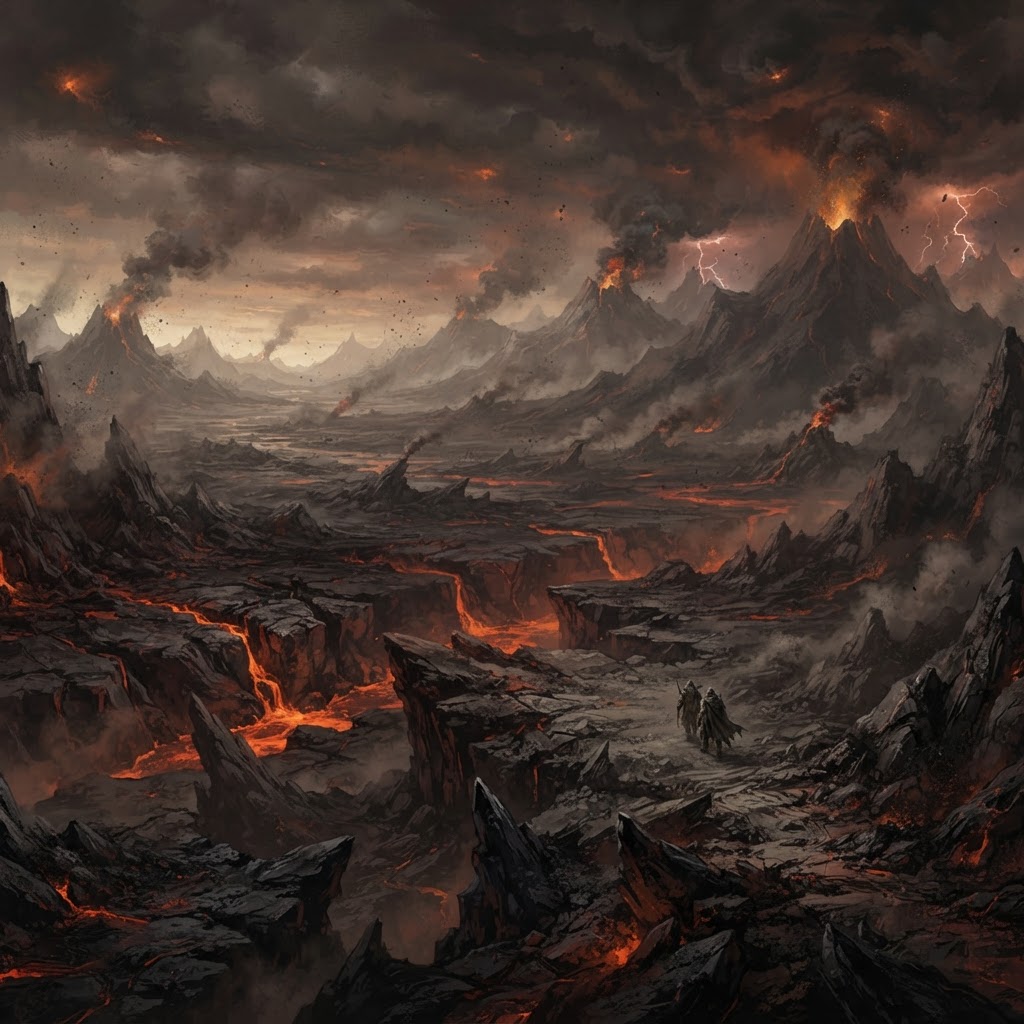
The war-band structure that defines Orc society was not designed for war — it was designed for survival in a world that actively tried to kill everything living within it. The Ashen Marches were volcanic hellscape, perpetually wracked by eruptions, toxic ash-storms, and geological instability that made permanent settlement impossible. In this environment, the band was the minimum viable social unit: a group large enough to cover all essential roles, small enough to move quickly, bound by loyalty absolute enough to function under conditions that would fracture larger, looser organizations.
What the Orcs brought to Lumeris was that bond and the Shamanic tradition that sustained it. In a world of relative stability and abundance, both of these have only grown more powerful. An Orc who calls you band-kin means something by it that most other races spend years trying to find a comparable word for.
The war-band structure was not designed for war — it was designed for survival in a world that actively tried to kill everything living within it. The band was the minimum viable social unit: large enough to cover all essential roles, small enough to move quickly, bound by loyalty absolute enough to function under conditions that would fracture larger, looser organizations.
Origins of the Orcs
The Ashen Marches
The Ashen Marches was a world of volcanic plains — a landscape of hardened lava flows, ash-fields stretching to every horizon, and mountain ranges that smoked and occasionally erupted without warning. Resources were scarce and unpredictable. The ground itself was unreliable. The sky was frequently obscured by particulate clouds that blocked sunlight for weeks at a time. In this environment, the Orcs developed over millennia into a people for whom efficiency was survival.
The war-band structure emerged from ecological necessity rather than military ambition. A band needed front-line fighters to handle threats, Shamans to predict geological activity and maintain spiritual relationships with the Marches' elemental forces, scouts to map safe routes through newly erupted terrain, healers to maintain the band's combat effectiveness, and crafters to maintain equipment that the harsh environment wore down constantly. Every role was essential. The Orcs who survived were those who understood that no single contribution could be devalued without weakening the whole.
The Shamans held a position of particular importance — their elemental magic drew on the volcanic forces of the Marches with a directness that made them the most powerful practitioners in their world, and their ability to predict eruptions and read geological signs gave them a strategic function that transcended the spiritual. When the escalating volcanic catastrophe that marked the Shattering's approach began, it was the Shamans who recognized it years in advance and organized the evacuation that saved most of their people.
Arrival in Lumeris
The Age of Settlement
The Orcs crossed the Luminous Veil in organized bands, guided by Shamans who had been tracking the Veil's position for years. They arrived intact, organized, and ready to assess a new environment — not in flight, but in deliberate relocation. Their first territorial claims in Lumeris were driven by the same logic that had governed their choices in the Marches: secure defensible ground, establish resource access, protect the band.
Other races who encountered these territorial claims in the early Age of Settlement often interpreted them as aggression. The Orcs were claiming land that was, from their perspective, essential for their bands' survival. The other races saw large, heavily armed people declaring territory. This fundamental misunderstanding shaped decades of tense relations before diplomatic contact — largely brokered by Centaur Lorekeepers and High Human scholars — established that the territorial claims were not expansion but security.
Over generations, as Lumeris's relative stability became understood rather than merely observed, the war-bands adapted. Their territories became permanent settlements. Their mobile resource systems became agriculture and trade.
The Great Bands that exist today are the evolved forms of the original war-bands — still organized around the same principles of mutual role-value and absolute loyalty, but operating in a world where those principles can build something rather than merely sustain survival.
The Form of the Marches-Born
Physical Appearance
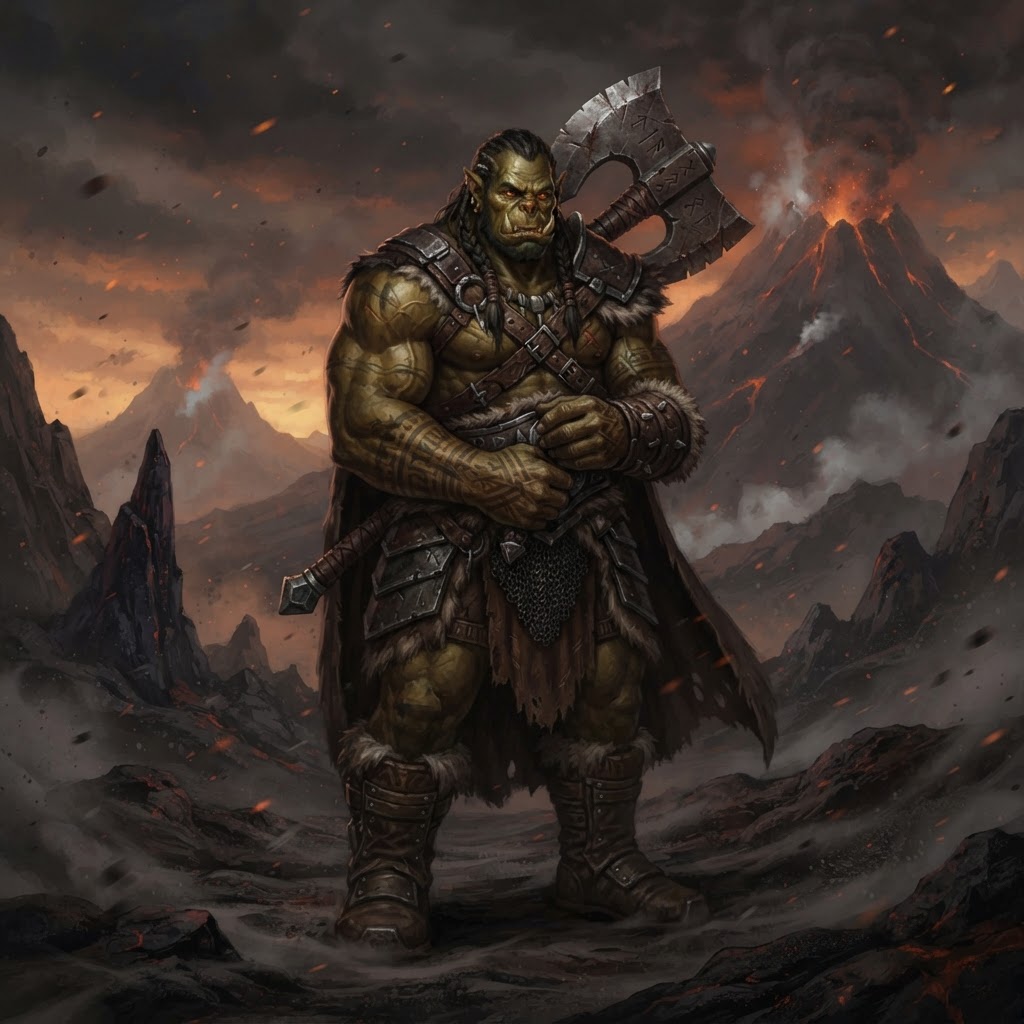
Orcs are among the largest humanoid races in Lumeris, standing between six and seven and a half feet tall with a build that prioritizes raw physical power. Their frames are heavily muscled with proportionally longer arms than most humanoid races, and their natural grip strength exceeds even Minotaurs of comparable build when measured per unit of mass. Despite their size, Orcs are not slow — they move with the purposeful efficiency of a people who learned that wasted motion in a hostile environment is a form of resource expenditure.
Their skin tones range across greens from deep forest through warm olive to muted grey-green, with some lineages showing brownish undertones that intensify in sunlight. Their facial features are defined by prominent lower jaws, tusks that range from subtle upward curve to significant protrusions — more pronounced in males — and broad noses built for filtering ash-heavy air. Their hands and forearms are typically marked with scar patterns or deliberate brands that record significant events in their personal history — a practice so universal that an Orc without body-marks is either very young or has lived an unusually sheltered life.
Their eyes are the feature that most unsettles other races — large, deeply pigmented in reds, ambers, oranges, and yellows that seem to generate their own light in dim conditions. Shamans sometimes develop violet or silver eyes through sustained elemental magical development, a visible sign of power that earns automatic respect across all bands.
- ◈Among the largest humanoid races, standing between six and seven and a half feet tall
- ◈Build prioritizes raw physical power — heavily muscled frames with proportionally longer arms
- ◈Natural grip strength exceeds even Minotaurs of comparable build when measured per unit of mass
- ◈Not slow despite their size — move with purposeful efficiency, as wasted motion is resource expenditure
- ◈Skin tones range across greens from deep forest through warm olive to muted grey-green
- ◈Some lineages show brownish undertones that intensify in sunlight
- ◈Facial features defined by prominent lower jaws and broad noses built for filtering ash-heavy air
- ◈Tusks range from subtle upward curve to significant protrusions — more pronounced in males
- ◈Hands and forearms marked with scar patterns or deliberate brands recording significant personal history
- ◈An Orc without body-marks is either very young or has lived an unusually sheltered life
- ◈Eyes are large and deeply pigmented in reds, ambers, oranges, and yellows that seem to generate their own light
- ◈Shamans sometimes develop violet or silver eyes through sustained elemental magical development
- ◈Violet or silver eyes are a visible sign of power that earns automatic respect across all bands
The Bands That Shaped a People
The Five Great Bands
When the Orcs settled in Lumeris, they maintained their separate band identities rather than merging into a single nation. Over the Age of Settlement, five bands grew large and distinctive enough to be recognized across the continent as the Great Bands. Their representatives meet once per generation at the Shattering Stone — a volcanic formation that emerged through the Luminous Veil during the Orcs' own crossing and has been treated as sacred ground ever since.
The Ironmaw Band
The Highland Borderlands
The most militarily formidable of the Great Bands, the Ironmaw established themselves in the contested highland borderlands where conflict with other races and other bands was essentially constant in the early Age of Settlement. This environment produced warriors of exceptional skill, and the Ironmaw's fighting style — overwhelming aggression, iron discipline in holding a front line, and Shamans fighting alongside warriors rather than behind them — has not been successfully countered by any force that has faced them in the field. They produce more Warlords than any other band. Their berserkers are the most feared individual fighters in Lumeris. Their mercenary companies are hired by nations and factions who need something destroyed and know that negotiation has already failed.
The Bloodstone Covenant
The Elemental Convergence Zones
The most spiritually powerful of the Great Bands, the Bloodstone settled near points where multiple worlds' elemental energies overlap — sites of magical instability that their Shamans navigate with relative ease and that most other races avoid entirely. The Covenant's Shamans command elemental magic with battlefield precision that places them among the most powerful magical practitioners in Lumeris, drawing on techniques developed across thousands of years in the Ashen Marches and refined in the high-energy convergence zones of their new homeland. Their oral archive of elemental lore is unmatched by any other Orc band and is actively consulted by practitioners of other traditions.
The Ashfang Riders
The Open Plains
The fastest of the Great Bands, the Ashfang developed their identity as mounted scouts and raiders in the Ashen Marches, where mobility across unpredictable terrain was a survival advantage. When their original ash-wolf mounts could not survive Lumeris's ecology, the Ashfang adapted their mounted combat tradition to work with whatever the new world offered — and proved their discipline was in the rider, not the mount. They now operate the fastest intelligence and scouting network of any band, with raiding capacity that consistently outpaces defenders' ability to respond. Their information on terrain, troop movements, and resource locations is considered among the most reliable available.
The Grimtide Warders
The River Valleys
The fortress builders of the Great Bands, the Grimtide established themselves in the strategic river valleys that control water access across their region of Lumeris. Their fortification tradition was developed in the Marches as a technique for creating temporary defensive positions rapidly under fire — in Lumeris, applied to permanent construction, it has produced some of the most formidable defensive architecture on the continent. The Grimtide's river valley fortresses have never been taken by siege. They control transit rights through their territory with the same careful balance the Ashpeak Dwarves use in the mountain passes, charging reasonable fees and maintaining absolute security for traders who pay them.
The Stonehide Brotherhood
The Agricultural Plains
The largest of the Great Bands by population and the most economically productive, the Stonehide represent what Orc bands became when the survival pressure of the Ashen Marches was replaced by the relative stability of Lumeris. They were the first band to develop systematic agriculture, the first to establish permanent trade networks with other races, and the primary producers of Orc crafted goods that have found markets across the continent. The Brotherhood maintains the most extensive commercial relationships of any band — Dwarves, High Humans, and Halflings all trade with them regularly — and their prosperity has allowed investment in infrastructure that benefits all bands whose territory borders theirs.
The Way of the Band
Culture & Society
Orc society is organized around the band and governed, at the highest level, by the Shaman Council — a rotating assembly of each Great Band's senior Shamans who meet monthly to coordinate inter-band agreements, resolve territorial disputes, and interpret the elemental omens that guide Orc strategic decision-making. The Grand Conclave at the Shattering Stone supersedes the Shaman Council on fundamental questions and operates by consensus — decisions reached there are binding on all bands without appeal.
Band loyalty is the absolute foundation of Orc ethics. An Orc who abandons their band in crisis has violated the core of what Orc culture means. The consequences are permanent. Conversely, an Orc who has extended band-kinship to someone outside their race means it with the same totality they mean it toward their born kin.
The Rite of Blooding
The central coming-of-age ceremony: a combat trial conducted in the presence of the full band, in which the young Orc faces a structured challenge scaled to their individual capability. The specific form varies by band — the Ironmaw conduct single combat against an experienced warrior, the Bloodstone conduct a three-day elemental endurance trial, the Ashfang conduct a solo scouting mission. What is universal is the requirement to face genuine difficulty alone and return having met it.
Band Loyalty
The absolute foundation of Orc ethics. An Orc who abandons their band in crisis — leaves when they are needed, withholds contribution when contribution is essential, saves themselves at a band-mate's expense — has violated the core of what Orc culture means. The consequences are permanent. Conversely, an Orc who has extended band-kinship to someone outside their race means it with the same totality they mean it toward their born kin. Those who have earned that status describe it consistently as the most unambiguous form of acceptance they have encountered anywhere in Lumeris.
An Orc who calls you band-kin means something by it that most other races spend years trying to find a comparable word for. Those who have earned that status describe it consistently as the most unambiguous form of acceptance they have encountered anywhere in Lumeris. It is given with totality, and it is not revoked.
They Place Great Importance On
Game Mechanics
Playable Race Traits
Starting Attributes
STR
+6
Strength
INT
+1
Intelligence
DEX
+2
Dexterity
CON
+3
Constitution
STA
+5
Stamina
WIS
+2
Wisdom
CHA
+2
Charisma
HP
+6
Health
SPL
+1
Spells
Upon creation, Orcs receive +1 SPL.
SPL can be used to buy more levels of a single spell, up to level 5, or to buy new spells available to the race.
Racial Abilities
Battle Fury
Combat effectiveness increases as a fight extends. Damage output improves in sustained engagements.
War-Band Bond
Significant combat bonuses when fighting alongside recognized band-mates or sworn allies.
Shaman's Blood
Natural attunement to elemental magic. Elemental spells cost less and carry more force.
Iron Skin
Dense muscle and hardened hide provide natural damage reduction against physical attacks.
Volcanic Endurance
Resistance to fire and heat. Reduced fatigue from physical exertion in extreme conditions.
Permitted Classes
Orcs gravitate toward disciplines that honor strength, endurance, and the elemental forces of their volcanic heritage — warrior traditions, shamanic practice, and the magical paths that channel fire and earth with direct, unflinching force.
Starter Classes
Advanced Classes
Advantages
- ▲Raw power — exceptional strength and carrying capacity exceeding most races
- ▲Battle fury — combat effectiveness increases as the fight continues; sustained combat favors Orcs
- ▲War-band bond — combat bonuses when fighting alongside bonded band-mates
- ▲Shamanic attunement — natural affinity for elemental magic, particularly fire and earth
- ▲Iron skin — natural damage reduction from dense muscle and hardened hide
- ▲Enduring march — reduced fatigue penalties on long marches and sustained physical effort
- ▲Volcanic resilience — resistance to fire, heat, and ash-based environmental hazards
Disadvantages
- ▼Imposing presence — social penalties when subtlety is required; difficult to pass unnoticed
- ▼Band-first — tactical judgment may be overridden by loyalty to specific band-mates
- ▼Cultural directness — diplomacy checks with formality-sensitive races are harder
- ▼Weight disadvantage — buoyancy in water is significantly reduced; swimming is hazardous
- ▼Honor-bound — cannot strike a surrendered foe without severe social consequence
- ▼Early reputation — historical misreadings create initial wariness in some races
- ▼Instinctive territorial — checks required when established band territory is threatened
A Subrace of the Orcs
The Lunari
Star-Touched Children of the Moon
By blood and lineage, Orcs — yet they took a different inheritance: the slow, observant patience of a people who lived for generations beneath a dying moon. Smaller, finer-featured, with eyes that carry a faint inner luminosity. When they say something is coming, it comes.
Explore the LunariThe Chronicle Ends… For Now
Final Lore Summary
The Orcs of Lumeris arrived not as conquerors but as survivors — a people forged in a world that tried to kill everything within it, who built their civilization around the bond and the Shamanic tradition that sustained them through it. They brought that bond into a world of relative stability, and in doing so they have only grown more powerful. Their military might is undeniable, their Shamanic traditions respected by every magical community, and their commercial presence significant. What remains is the slower work of correcting the early misreadings — a project the Orcish bands approach with the same patient efficiency they apply to everything else.
They are the wall that does not break when everything else does.
They are the bond that holds when the ground gives way.
They are the people who survived a world that tried to kill them, and who carry the strength of that survival into every bond they forge.