The Lunari
Star-Touched Children of the Moon
Star-Touched Children of the Moon
Overview
The Lunari are, by blood and lineage, Orcs. This is not a claim other clans challenge — the curved tusks mark them, as they mark every branch of Orcish kind. But where the great bands built their identities around strength, endurance, and the bond of the war-band, the Lunari took a different inheritance: the slow, observant patience of a people who lived for generations beneath a dying moon, counting its dimming light and reading what it meant.
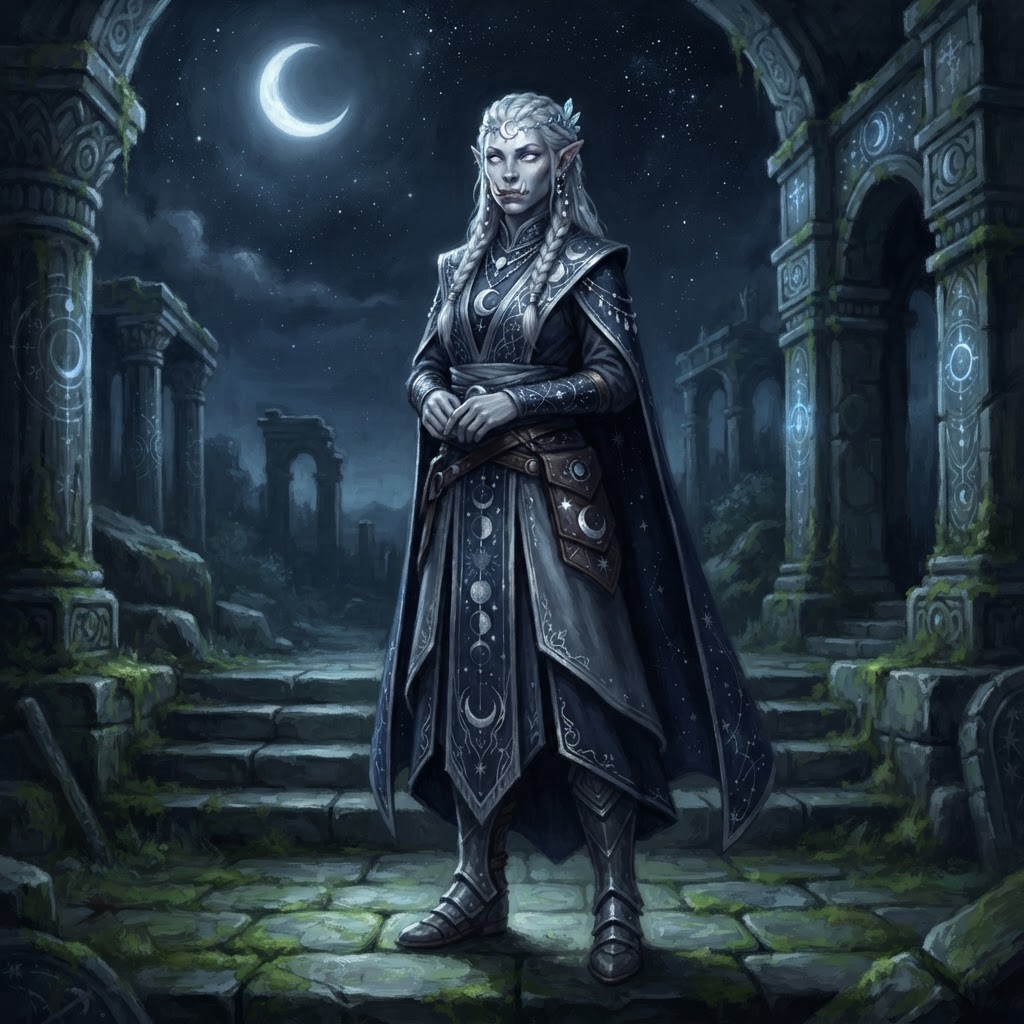
They are smaller than other Orcs — leaner, finer-featured, built for endurance of a different kind. Their eyes carry a faint inner luminosity that brightens in darkness. Their speech is measured and deliberate, their posture upright in a way that reads as elegant rather than imposing. In any gathering, a Lunari stands out not by size or ferocity but by the quality of their attention. They are always watching. They see things other races pass over.
To traditional Orc clans, this can be unsettling. Too calm. Too knowing. Too interested in stars and memory when the war-band demands focus on the ground beneath your feet. Yet even the most skeptical war-chief acknowledges one truth about the Lunari: when they say something is coming, it comes.
Outsiders frequently mistake them for Dark Elves or strange Fae-touched beings — the pale skin, refined features, and luminous eyes confusing the pattern until the tusks are noticed. The Lunari rarely correct the mistake immediately. They find it more informative to observe how the assumption shapes the interaction first.
Origins of the Lunari
The Dying Moon
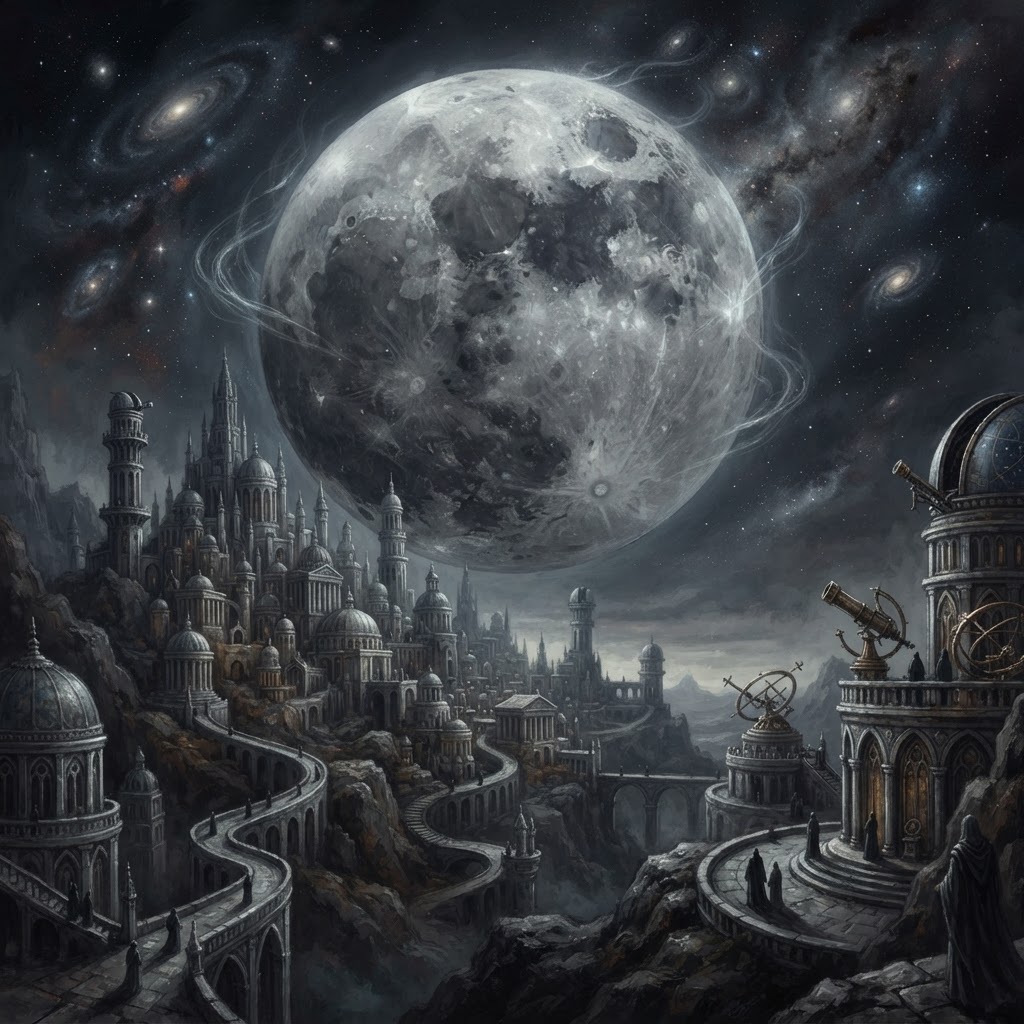
The Lunari trace their descent from the peoples of a moon-world — a vast silver satellite whose reflected light was the sole source of power for an entire civilization. They called their home the Silver Moon, and for thousands of years they built their culture entirely around lunar cycles, celestial observation, and the slow magical current that the moon's reflected light carried across their world.
When the Silver Moon began to die — its core cooling, its light dimming over decades until what had once been brilliant silver became a dull and fading grey — the Lunari knew it before any instrument could measure it. Their Moon-Readers felt it in the way the magic thinned. They had two generations to prepare, and they used them: not in panic, but in the deliberate, methodical accumulation of everything they could carry across a collapse that could not be stopped.
They crossed into Lumeris alongside the Orc bands whose world had also been consumed by the Shattering of Eternities. Whether by accident of convergence gate or by the Luminary Heart's own design, many Lunari arrived through the same fractures as the Orcish clans — and despite the profound differences between them, they found in those clans the same core value: the band holds. You stay with your people.
Over generations in Lumeris, Lunari bloodlines intertwined with Orcish ones to a degree that makes strict separation impossible. A Lunari may have Ironmaw or Bloodstone ancestry. An Orc Shaman may carry a thread of Lunari celestial attunement without knowing it. What the Lunari preserved — deliberately, carefully — was not purity of blood but continuity of knowledge: the star-charts, the moon-cycles, the observational traditions that sustained them across their world's dying.
The Form of the Moon-Touched
Physical Appearance
The Lunari are immediately recognizable — not despite being Orcs, but because they combine unmistakably Orcish features with a physical profile that contradicts most expectations of what that means. They stand between five and a half and six and a half feet tall, notably shorter than the range typical of Orcish kin, with lean and efficient builds that prioritize sustained focus and endurance rather than raw physical power.
Their skin tones range across a palette that echoes the world they came from: pale ash-white, moonlit silver, slate grey, deep charcoal, and near-obsidian hues that absorb light in low conditions and seem almost to glow under direct illumination. These tones are consistent regardless of sun exposure — Lunari skin does not darken or tan. It reflects its lunar origin as permanently as the stars reflect their positions.
Their facial features are narrower than other Orcs — sharper cheekbones, defined jaw lines, and the distinctive wide-set eyes that carry a faint inner luminosity. Colors most commonly appear as silver-white, pale violet, or cold blue, with the glow intensifying during celestial events, strong emotional states, or active magical use. The effect is subtle in daylight and striking in darkness: a Lunari's eyes are always slightly lit from within.
Their tusks are what give them away. Smaller and more refined than those of other Orc lineages, the Lunari's curved lower tusks protrude with an almost deliberate elegance — and they are never plain. Lunari tusk-decoration is a tradition as old as their civilization: silver rings at measured intervals, crystal dust pressed into etched channels, celestial symbols traced in pale ink, constellation maps rendered in minute detail along the outer face. A Lunari's tusks are a biographical record of their study, their rank among Moon-Readers, and the celestial events they have personally witnessed. Other races who learn to read them describe the experience as holding a library in the span of two curved inches.
- ◈Immediately recognizable — not despite being Orcs, but because they combine Orcish features with a contradictory physical profile
- ◈Stand between five and a half and six and a half feet tall, notably shorter than typical Orcish kin
- ◈Lean and efficient builds that prioritize sustained focus and endurance rather than raw physical power
- ◈Skin tones echo the world they came from: pale ash-white, moonlit silver, slate grey, deep charcoal, and near-obsidian
- ◈Skin tones are consistent regardless of sun exposure — Lunari skin does not darken or tan
- ◈Skin reflects its lunar origin as permanently as the stars reflect their positions
- ◈Near-obsidian hues absorb light in low conditions and seem almost to glow under direct illumination
- ◈Facial features are narrower than other Orcs — sharper cheekbones and defined jaw lines
- ◈Distinctive wide-set eyes carry a faint inner luminosity
- ◈Eye colors most commonly appear as silver-white, pale violet, or cold blue
- ◈The glow intensifies during celestial events, strong emotional states, or active magical use
- ◈Subtle in daylight and striking in darkness: a Lunari's eyes are always slightly lit from within
- ◈Tusks are smaller and more refined than those of other Orc lineages, protruding with deliberate elegance
- ◈Tusk-decoration is a tradition as old as their civilization: silver rings, crystal dust, celestial symbols, constellation maps
- ◈A Lunari's tusks are a biographical record of study, rank among Moon-Readers, and celestial events personally witnessed
The Way of the Observing Eye
Culture & Society
Lunari society is organized around the concept of the Observing Eye — a philosophical framework that holds the careful accumulation of knowledge to be the highest form of service a person can offer their community. Where traditional Orc bands assign value through battle-proven strength and band loyalty, the Lunari assign it through depth of understanding. A Lunari elder who has mapped five hundred years of celestial cycles and can predict magical weather patterns holds more authority in their community than a fighter twice their size.
The Moon-Readers
The Lunari equivalent of the Orc Shamans — but where Shamans work with elemental forces in direct, forceful ways, Moon-Readers work with pattern, prediction, and the long view. Their practice involves nightly celestial observation regardless of weather, the maintenance of precise personal star-charts that serve as both scientific record and spiritual document, and the interpretation of celestial patterns as guidance for community decisions. The silver rings and crystal etchings on their tusks are not decoration — they are notation. A Moon-Reader's tusks carry the shorthand of thousands of observations made across a lifetime.
The Tusk-Marking Ceremony
The central coming-of-age ritual of the Lunari. When a young Lunari makes their first independent celestial prediction and records it in advance of the event occurring — whether a meteor shower, a convergence tide, or a shift in magical current — they receive their first tusk-mark. The nature of the mark reflects what was predicted. The ceremony is private, conducted between the young Lunari and their Moon-Reader teacher, and the marked tusk is considered a first signature: the beginning of a record that will grow more complex with every decade of life.
Among the Bands
Among the other Orc bands, the Lunari occupy an unusual position — respected, studied at a distance, and occasionally resented. Traditional war-band culture values contribution in forms the Lunari rarely provide: front-line combat, physical endurance, and the immediate bond of shared hardship. The Lunari contribute in different registers — prediction, memory, magical attunement — that the bands depend on without always wanting to acknowledge the dependence. The Bloodstone Covenant's Shamans have the most respectful relationship with the Lunari, recognizing in their celestial attunement a complementary form of elemental understanding. The Ironmaw Band regards them with the specific wariness reserved for people you cannot fully read.
In the broader world of Lumeris, the Lunari are frequently misidentified. The pale skin, refined features, and glowing eyes lead outsiders to assume Dark Elf or Fae heritage. The mistake is generally not corrected — the Lunari find it more interesting to observe how the assumption shapes the interaction. They only let the tusks be seen when they decide it is worth clarifying. It usually is.
They Place Great Importance On
Game Mechanics
Playable Race Traits
Starting Attributes
STR
+2
Strength
INT
+6
Intelligence
DEX
+3
Dexterity
CON
+2
Constitution
STA
+3
Stamina
WIS
+5
Wisdom
CHA
+2
Charisma
HP
+3
Health
SPL
+5
Spells
Upon creation, Lunari receive +5 SPL.
SPL can be used to buy more levels of a single spell, up to level 5, or to buy new spells available to the race.
Racial Abilities
Moon-Sight
Full night vision with magical aura detection in darkness. Advantage on all perception checks in low-light conditions.
Celestial Attunement
Natural affinity for arcane and divination magic. Celestial and sky-based spells cost less and carry greater precision.
Tusk Record
Perfect recall for astronomical observations, magical pattern data, and predicted events. Advantage on knowledge checks for celestial events and magical phenomena.
Lunar Patience
Once per encounter, spend a round in observation to gain advantage on the next action taken. Cannot be interrupted once declared.
Uncanny Prediction
Once per day, declare a prediction before an event. If correct, gain advantage on all checks related to that event for its duration.
Moonstep
Once per short rest, you may teleport up to 20 feet to a location you can see in dim light or moonlight.
Permitted Classes
Lunari gravitate toward disciplines that reward observation, patience, and arcane precision — magical traditions that channel celestial and elemental forces through understanding rather than force, and the scholarly paths that preserve knowledge across generations.
Starter Classes
Advanced Classes
Advantages
- ▲Moon-sight — full night vision and magical aura detection in complete darkness
- ▲Celestial attunement — innate affinity for arcane, divination, and sky magic
- ▲Pattern recognition — advantage on all prediction, divination, and analysis checks
- ▲Tusk record — near-perfect memory for celestial data and magical observations
- ▲Mistaken identity — frequently misread as Dark Elves or Fae, enabling unexpected social leverage
- ▲Lunar calm — resistance to fear, rage effects, and emotional manipulation
- ▲Cross-band respect — Orc Shamans and Moon-Readers share professional deference
Disadvantages
- ▼Limited combat build — lower physical strength and endurance than standard Orc lineages
- ▼Culturally isolated — traditional Orc bands regard them with unease and occasional resentment
- ▼Observation compulsion — concentration checks required when an unexplained phenomenon is nearby
- ▼Sun sensitivity — extended bright daylight causes mild focus penalties
- ▼Underestimated in combat — opponents may not take them seriously until too late
- ▼Moon-dependency — magical attunement slightly reduced during new moon phases
- ▼Tusk vulnerability — decorated tusks are fragile; damage is treated as profound personal violation
The Chronicle Ends… For Now
Final Lore Summary
The Lunari are Orcs who took a different inheritance — not the strength of the war-band but the patience of the observing eye. They came from a dying moon and carried its light with them in their eyes, their tusks, and their records. They watch when others act, they remember when others forget, and they predict what others cannot see coming. Among the bands they are respected, studied at a distance, and occasionally resented — but when a Lunari speaks of what is coming, even the Ironmaw listen.
They are the eyes that watch when the world sleeps.
They are the record that outlasts the one who made it.
They are the people who counted a dying moon's light, and who carry that count into every dark they enter.